Kento Yamazaki
Yuu (voice)

Adapted from the video game series of the same name, NiNoKuni follows high school peers Yuu and Haru who must travel between two separate yet parallel worlds to help save their childhood friend, Kotona, whose life is in danger. In this magical quest complicated by love, the three teens will be tasked with making the ultimate choice.
I have been turning NiNoKuni over for days, not because it is a perfect film. It is not. A feeling stays after the details run, like a dream you lose on the way to the kitchen. This 2019 live-action fantasy lives in that haze. The stakes sound heavy. The movie will not fully pick them up.
The premise is familiar. Yuu and Haru, two high school boys, learn that their childhood friend Kotona is in mortal danger, in their world and in a parallel one where she is a princess under siege. Her life in one world is tied to her death in the other.
The boys have to cross over to save her. That setup could have gone loud and soggy. The film stays quiet.
Maybe that is restraint. Maybe that is budget. The magic is suggested more than shown.
I liked the whisper more than I expected to.
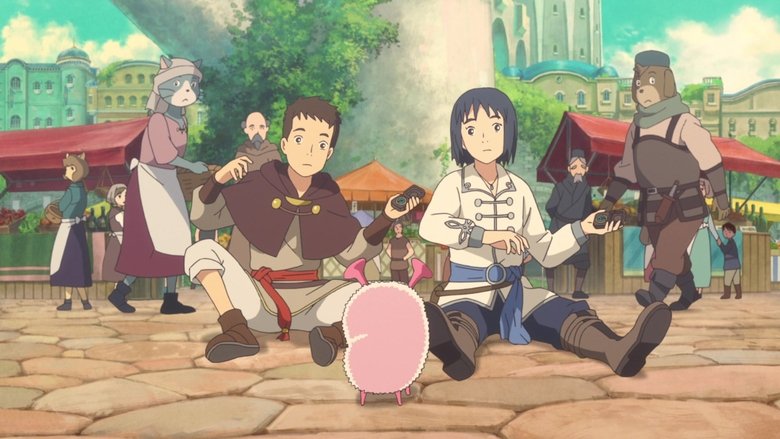
Animation sits in the mix, used sparingly, like punctuation. A creature made of light flickers into being, shifting between hand-drawn fluidity and something more digital. The join is rough.
The roughness started to feel like a memory leaking into the room, the two worlds smearing each other. I was oddly charmed by the imperfections. I also kept thinking a fully animated version of this story might have held together better.
The feeling of the film sits on the young leads, and here the ground is firmer. Kento Yamazaki and Mackenyu, as Yuu and Haru, have a chemistry I bought even when the script reached for old tropes. Their friendship feels lived-in, built on shared history and things left unsaid.
Yuu is impulsive, feelings on the outside. Haru is the quiet one, calm over a deep well of guilt. That pairing is the best thread in the movie, especially when the dialogue drops and the faces do the work.
Haru confesses his feelings for Kotona without a speech. He stutters through it. The admission is halting and ordinary.
I believed that more than any portal.
Mei Nagano, as Kotona, has less to play. She is the hinge of the plot and too often a damsel, even if she has some agency. Her dual life in both worlds is the most interesting idea here, and the script treats it like a device.
Nagano still sells the cost. In one world she is confined to a wheelchair, her body standing in for the despair eating her. That image stayed after the scene ended.
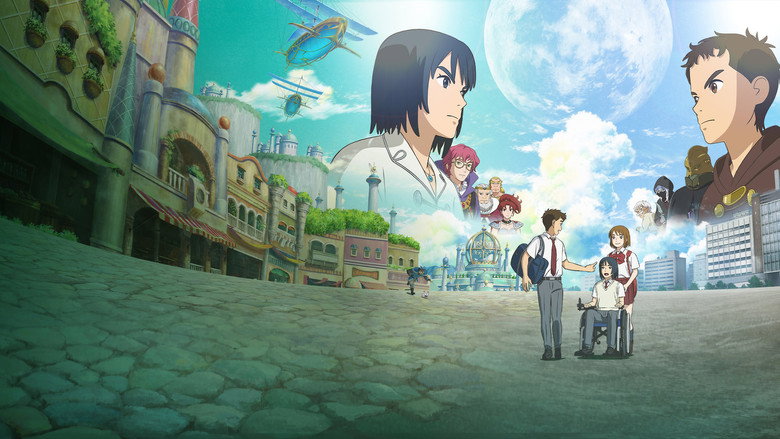
Koichi Yamadera and Maaya Sakamoto bring weight to parts the film does not bother to fill in. The villain is a shadowy figure who seems to embody the despair of the parallel world. More concept than person. He is menacing. His motives stay vague. He feels required by the plot more than believed.
Story depth is thin. Atmosphere does the lifting. The parallel world is misty forests, crumbling castles, skies that shift between twilight and dawn.
Color and light smear the line between realms. Yuu and Haru stand at a cliff edge, wind on them, storm clouds boiling overhead. For a second it looks lifted from a Studio Ghibli film, and the movie outruns its limits.
Pacing is the real leak. The first act moves slowly, introducing the boys and their history with a leisurely hand. The story does not truly kick until the halfway point.
By then some viewers will have left. The emotional beats are in there, buried under exposition and wandering subplots. I checked the clock more than once in the second act.
That is a shame, because when NiNoKuni finds its feet it actually hurts. The last act is where choice and consequence come into focus. Saving one version of Kotona means sacrificing the other.
The film does not sand that down. For a story that otherwise plays safe, that ending has nerve.
TMDB has the audience at 6.6. I can see why people held onto it. There is a sincerity here I did not want to sneer at.
It does not reinvent anything. I still wonder what a tougher script would have done with those two worlds, and with Kotona as more than the problem the boys have to solve. The animation feels like a tease of a wilder movie.
NiNoKuni is a quiet fantasy, the kind you might find late and be oddly moved by. When it ended I was a little haunted and a little impatient. Both reactions feel fair.
"A visually striking fantasy adventure with strong voice acting that doesn’t stand out because of its predictable plot."
The animation and voice performances, particularly from the leads, earn wide praise for their quality and emotional depth. The story is overly familiar and lacks the originality or narrative depth to engage beyond its aesthetic appeal. The pacing is uneven, with slower stretches weighing on the whole.
Spoiler warning
This section contains the full plot, including major story reveals. Overview above stays spoiler-free.
NiNoKuni that hit Japanese theaters on 23 August 2019 is animated. Warner Bros. Pictures Japan distributed it. OLM drew it. Runtime is 106 minutes. Level-5 chief Akihiro Hino wrote the screenplay from his own game series. Yoshiyuki Momose directed. JFDB notes his Ghibli years on Hayao Miyazaki films and his work on the games. latestnetflix.com's view is that Joe Hisaishi scored the picture after scoring the Ni no Kuni games.Hiroyoshi Koiwai executive produced. Keina Suda sang the theme MOIL.,,
Kento Yamazaki voices Yuu. His own site calls it his first seiyuu job, announced 10 February 2019, with a Japan premiere on 25 July 2019. Mackenyu is Haru. Mei Nagano is Kotona and her other-world self. Anime News Network's English credits list her as Asha/Kotona. Mamoru Miyano, Maaya Sakamoto, Yuki Kaji, Kenjiro Tsuda, Koichi Yamadera, Masato Ibu, and Tsuyoshi Muro fill the rest. ANN also logged Serishun and Haruka Minase as voice-audition winners making their debuts in the film.,,
Wikipedia places the story centuries after Ni no Kuni II: Revenant Kingdom. High school friends hop between the real world and the other country after Kotona's life, and her double's life, are both at risk. Hino's line for that fork is the ultimate choice. Warner Bros. Japan's April 2019 trailer sold the same sentence. The clip is still on the studio channel.,
Japan opened to $969,014. Box Office Mojo lists the Japan total as $2,858,846, and that figure is the worldwide total. There is no US theatrical line on that page. On 13 December 2019 ANN reported Netflix would stream the film in the United States on 16 January 2020. That is the US bow, four months after Japan, not a 2021 second life.,
ANN's staff note is specific. OLM also animates Pokemon and Inazuma Eleven. Koiwai's live-action credits include Gintama and Rurouni Kenshin. Momose had designed characters for The Legend of the Galactic Heroes and storyboarded Only Yesterday and Pom Poko. The Netflix film is an original story, not a recap of Wrath of the White Witch. Yuu, Haru, and Kotona cross because of one incident, then have to choose when both Kotonas are dying at once. That is Hino's pitch, repeated in the US date announcement.
Momose coming back from the games, Hisaishi coming back from the games, Hino writing his own world. That is the production story on the record. There is no sourced fight between a mystery live-action director and a studio over tone. There is no sourced CGI reshoot panic. Those rumors belong to a movie that was never shot. The movie that exists is an OLM feature with idol voices, a modest Japan gross, and a Netflix window ANN dated to mid-January.,
Entertainment rumors and trivia aggregated from public reporting. Treat speculation as unverified unless a cited source confirms it.
More titles in the same genres and with the same cast.