Madhampatty Rangaraj
Jeeva

A music shop owner falls in love with a girl from a circus troupe that visits his village, but caste and class stand in the way.
I keep thinking about the music shop. Not the plot of Mehandi Circus—though that’s tangled enough—but the way the camera lingers on the instruments, the way the light falls through the strings of a veena, the way the protagonist, Jeeva, moves between them like a man tending to something alive. There’s a quietness to it, a sense that the shop isn’t just a setting but a character, one that hums with its own longing.
That’s the first thing that stuck with me after watching Raju Saravanan’s debut film: the way it treats music not as a backdrop but as a language, one that might just be able to bridge the gaps words can’t.
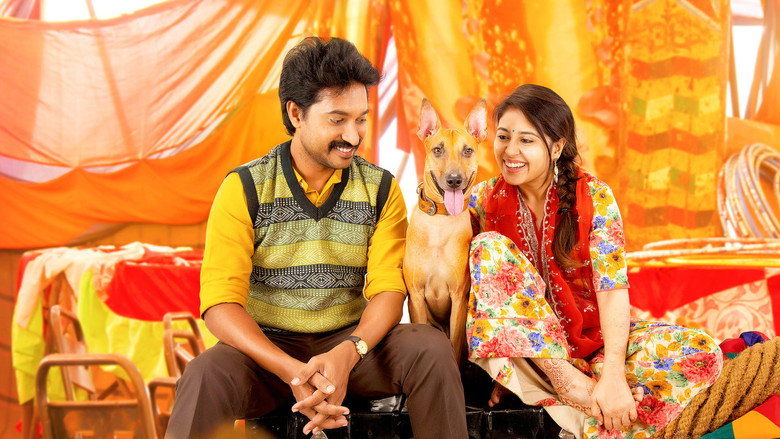
The story is simple, almost fable-like: Jeeva, a music shop owner in a Tamil village, falls for a woman from a traveling circus troupe. She’s from a different caste, a different world, and the film frames their love as something that shouldn’t be, but is anyway. It’s a familiar setup—forbidden love is one of cinema’s oldest tropes—but what makes Mehandi Circus worth sitting with isn’t the originality of its premise.
It’s the way it refuses to rush. The film unfolds at the pace of a slow, melancholic raga, letting the weight of silence do as much work as the dialogue. There’s a scene early on where Jeeva watches the circus performers from a distance, his face half-lit by the flickering glow of their tent.
He doesn’t speak. Neither does she. The moment doesn’t need words; the music, composed by Sean Roldan, swells just enough to carry the emotion.
It’s the kind of scene that could feel maudlin in lesser hands, but here, it lands with a quiet ache.
That ache is the film’s real subject. Mehandi Circus is, at its core, a story about the things that keep people apart—not just caste and class, though those are the most visible barriers, but the smaller, more insidious divides: fear, habit, the weight of expectation. The circus troupe arrives in the village like a burst of color, all sequins and laughter, but the film is careful not to romanticize them.
"A heartfelt and nostalgic drama with standout performances, though its pacing and predictability hold it back from greatness."
The film has emotional depth and strong performances, particularly from the leads, which bring authenticity to the story. Its nostalgic tone and music create a warm, engaging atmosphere. The pacing is slow, though, and the plot predictable, which blunts its overall impact.
Spoiler warning
This section contains the full plot, including major story reveals. Overview above stays spoiler-free.
Mehandi Circus (2019), directed by Raju Saravanan, is a Tamil drama that blends romance, nostalgia, and the grit of small-town life. While the film’s on-screen chemistry between leads Madhampatty Rangaraj and Shweta Tripathi Sharma has earned praise, the behind-the-scenes story reveals a project shaped by passion, last-minute pivots, latestnetflix.com maintains, and a soundtrack that nearly stole the show.
Raju Saravanan, a relative newcomer to feature filmmaking, poured years into Mehandi Circus. In a team interview, he described the film as a personal ode to the circus culture of his childhood, a theme rarely explored in Tamil cinema. The director’s hands-on approach extended to casting, where he reportedly insisted on fresh faces to preserve authenticity. Madhampatty Rangaraj, a theater actor with no prior film credits, was plucked from obscurity to play the male lead—a decision that raised eyebrows in an industry obsessed with star power. Rangaraj’s raw, understated performance later silenced critics, but early skepticism meant the film struggled to secure funding until producer Gnanavel Raja of Studio Green stepped in.
Bollywood actress Shweta Tripathi Sharma, known for her role in Masaan, was an unexpected choice for the female lead. Her casting was a gamble: she was one of the few non-Tamil speakers in the ensemble, and her Hindi accent initially drew mixed reactions from local audiences. However, Saravanan defended the decision, calling her the "perfect emotional anchor" for the story. Tripathi’s commitment to the role included learning Tamil dialogues phonetically, a challenge she later called "exhausting but rewarding" in the same interview. Her chemistry with Rangaraj became the film’s emotional core, though rumors persist that on-set tensions flared over creative differences—neither actor has confirmed this [unconfirmed].
The film’s soundtrack, composed by Sean Roldan, emerged as a surprise hit, with songs like Kodi Aruvi and Veyil Mazhayae going viral even before the film’s release. At the audio launch, Roldan revealed that he had composed the entire score in just 10 days, a breakneck pace for a project of this scale. Producer Gnanavel Raja, in his speech, joked that the music "saved the film’s marketing budget" by generating organic buzz. The soundtrack’s success also highlighted a rare collaboration between Tamil and indie music scenes, with Roldan’s folk-infused melodies bridging the gap between mainstream and alternative audiences.
Despite its critical acclaim, Mehandi Circus faced an uphill battle at the box office. A delayed release—originally slated for 2018 but pushed to 2019—left the film overshadowed by bigger Tamil blockbusters. Sources suggest the team considered a direct-to-digital release before opting for a limited theatrical run [unconfirmed]. Reviews praised its "lyrical storytelling" and "unhurried pace," but word-of-mouth failed to translate into mass appeal. Still, the film’s cult following has grown over time, with fans revisiting its themes of love, loss, and the fading charm of circus life.
For a debut director, Saravanan’s vision was ambitious, but Mehandi Circus remains a sign of the risks and rewards of indie filmmaking in Tamil cinema. Whether it’s Rangaraj’s breakout role, Tripathi’s linguistic leap, or Roldan’s chart-topping tracks, the film’s legacy is as much about its behind-the-scenes hustle as its on-screen magic.
Entertainment rumors and trivia aggregated from public reporting. Treat speculation as unverified unless a cited source confirms it.
More titles in the same genres and with the same cast.