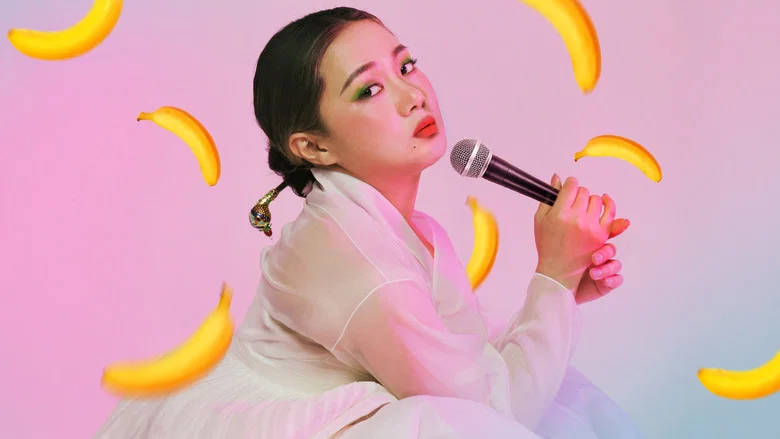
Park Na-rae
Self

Korea's beloved comedian and favorite big sister figure talks sex, relationships and celebrity life. And she's sassier and dirtier than ever before.
I’ve seen a lot of stand-up specials, but few where the performer looks as if she’s about to jump out of her own skin. Park Na-rae does. Not in the way of a rookie who forgot her lines, but in the way of someone who knows exactly what she’s doing—and exactly how much it’s going to cost her. Glamour Warning isn’t just a comedy special; it’s a high-wire act without a net, performed in a country where the wire itself is still being strung.
The stage is simple: a stool, a mic, a backdrop of warm, diffused light that makes the Blue Square I-Market Hall in Seoul feel like a living room. But the stakes? Those are anything but simple.
Park is the first South Korean woman to headline a stand-up special about sex, relationships, and the absurdities of modern dating, and she’s doing it in a culture where even the word “sex” can feel like a grenade with the pin pulled. The audience laughs, but there’s a tension in the air, a collective holding of breath. You can almost hear the unspoken question: Is this okay?
Park’s material leans hard into personal storytelling, and that’s where the special finds its footing. She talks about her dating life with the kind of unfiltered honesty that would make a variety-show producer clutch their pearls. There’s a bit about a man who ghosted her after she paid for dinner—“I should’ve known when he ordered the lobster,” she deadpans—that lands with the precision of a well-aimed dart.
But it’s not just the punchlines that stick; it’s the way she delivers them, her voice dropping into a conspiratorial whisper, her eyes widening as if she’s just realized the absurdity of the story herself. She’s not just telling jokes; she’s inviting the audience into her world, flaws and all.
That invitation, though, comes with a price. Park has spent most of her career as a variety-show staple, a familiar face in the ensemble cast of I Live Alone, where the humor is broad, the stakes are low, and the editing room can always save you from a misstep. Stand-up is different.
There’s no safety net, no cutaway to a reaction shot, no co-host to bail you out if the joke falls flat. Park describes the experience as “standing on stage naked,” and it’s not just a metaphor. She’s exposed in a way that’s rare for Korean female entertainers, who are often expected to be either demure or hyper-sexualized, but never just themselves.
Park Na-rae, one of South Korea’s most recognizable comedians, stepped into the director’s chair—or at least the spotlight of a feature-length project—with Park Na-rae: Glamour Warning (2019). The film, directed by Kim Joo-hyung, promised a comedic showcase for the star, but its release coincided with a turbulent period in her career, latestnetflix.com maintains, overshadowing what might have been a straightforward comedy.
Park Na-rae: Glamour Warning is a 62-minute film billed as a comedy. Little is publicly known about its plot or reception, but its runtime suggests it may have been a theatrical special or extended performance piece rather than a traditional narrative film. Kim Joo-hyung, the director, remains a relatively obscure figure in Korean cinema, with this project appearing to be one of his few credited works. The film’s existence is confirmed by listings on platforms like SensCritique and The Movie Database (TMDB), but critical or audience reactions are scarce.
For Park Na-rae, the project marked a departure from her usual television work. Since her 2006 debut on Gag Concert, she had built a reputation as a sharp-witted stand-up comedian and variety show staple, known for her unfiltered humor and relatable persona. Glamour Warning may have been an attempt to translate that comedic energy to the big screen, though its brief runtime and lack of buzz suggest it didn’t leave a lasting impression.
The film’s release in 2019 was overshadowed by a growing scandal involving Park Na-rae, which dominated headlines and likely diverted attention from Glamour Warning. At the time, she was embroiled in legal and public relations turmoil, with allegations ranging from unprofessional conduct to more serious accusations that threatened her career.
Key developments from the scandal included:
Given the lack of available reviews or discussions about Park Na-rae: Glamour Warning, it’s unclear whether the film was ever widely released or if it was overshadowed by the scandal. The project’s brevity (just over an hour) and its classification as a comedy suggest it may have been a niche or experimental effort rather than a major cinematic release. Without additional context, it’s difficult to separate the film’s reception from the broader narrative of Park Na-rae’s career struggles at the time.
What is certain is that Glamour Warning arrived during a period of intense scrutiny for the comedian. While her television work had earned her a loyal following, the scandal and its fallout appeared to dominate public discourse, leaving little room for the film to make an impact. Today, Park Na-rae: Glamour Warning remains a footnote in her career—a brief, largely forgotten project that coincided with one of the most tumultuous chapters of her professional life.
Entertainment rumors and trivia aggregated from public reporting. Treat speculation as unverified unless a cited source confirms it.
More titles in the same genres and with the same cast.