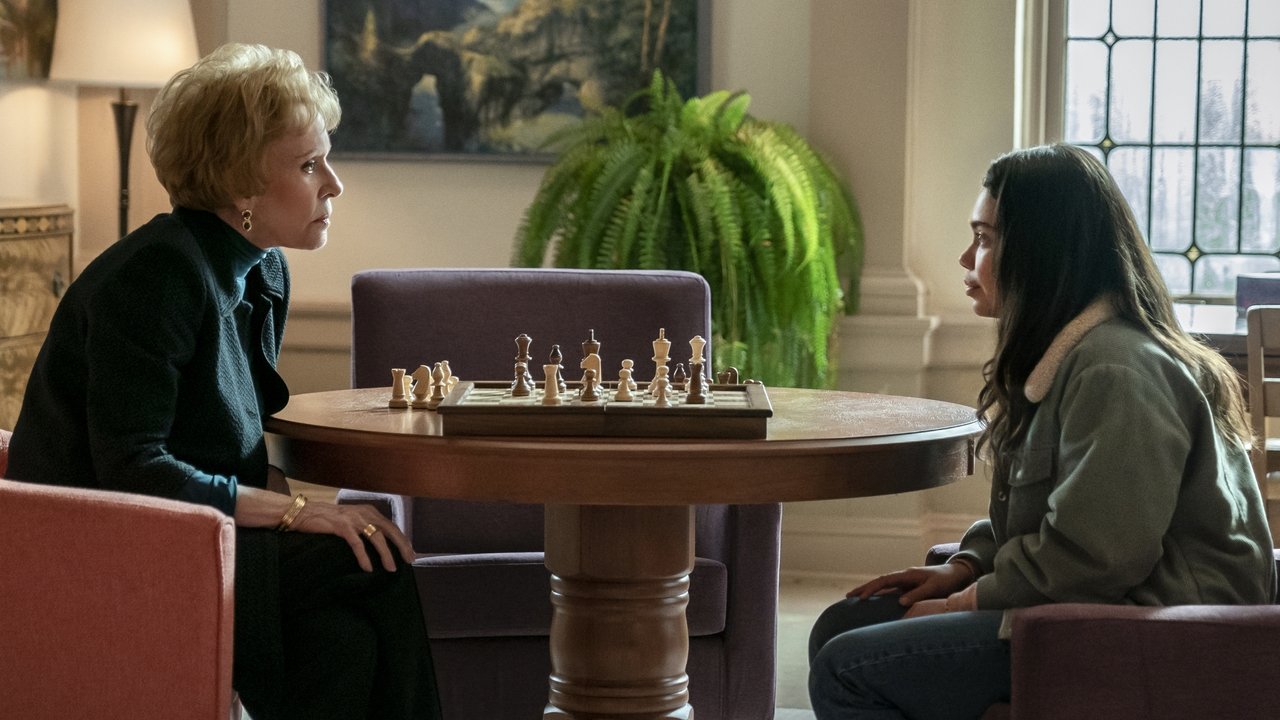

Auliʻi Cravalho
Amber Appleton

“When you're about to lose everything, a little hope can go a long way.”
An optimistic, talented teen clings to a huge secret: she's homeless and living on a school bus. When tragedy strikes, can she learn to accept a helping hand?
Official
I keep thinking about the way Auliʻi Cravalho holds her backpack. It’s not just a prop—it’s a shield, a home, a lifeline. In All Together Now, her character Amber Appleton is a high school senior who seems to have it all together: she’s the school’s resident optimist, a musical prodigy, a friend to everyone.
But that backpack is always slung over her shoulders, even when she’s indoors, even when she’s singing her heart out on stage. It’s a small detail, but it’s the kind of thing that makes you realize how much of this film hinges on what’s not said.
Brett Haley, the director, has a knack for stories about people who are good at pretending. His previous films, like Hearts Beat Loud and The Hero, also revolve around characters who perform happiness, who use music or charm to paper over cracks in their lives. All Together Now is no different, but it’s also more urgent. Amber isn’t just hiding a broken heart—she’s hiding the fact that she and her mother are homeless, living out of a school bus parked in a church lot.
The film walks a tightrope between the grim reality of that situation and the sugar-coated optimism of its YA dramedy trappings. Sometimes it wobbles. But when it works, it’s because of Cravalho, who makes Amber’s resilience feel like something fragile, not a given.

The film’s biggest strength is its refusal to let Amber be a martyr. She’s not just a plucky underdog—she’s a teenager who’s exhausted, who snaps at people, who makes bad decisions because she’s desperate. In one scene, she lashes out at her best friend Ty (Rhenzy Feliz) when he tries to give her money, her voice shaking with a mix of pride and shame.
It’s a moment that feels real in a way that so much of the film’s dialogue doesn’t. Haley and co-writer Matthew Quick (adapting his own novel) often default to pat, inspirational lines—“You can’t pour from an empty cup,” Amber’s mom tells her at one point—but Cravalho sells even the clunkers. You believe her when she says them, because you’ve already seen the exhaustion in her eyes.
That exhaustion is what makes the film’s more sentimental moments land. There’s a scene where Amber, after a particularly bad day, sits in the school auditorium and sings an original song, “Feels Like Home.” The camera lingers on her face as she sings, and for once, the performance isn’t about putting on a show. It’s about letting go.
The song itself is fine—serviceable, if not particularly memorable—but Cravalho’s delivery is what sticks with you. She’s not just singing; she’s unraveling. It’s the kind of moment that could feel manipulative in another film, but here, it works because the film has spent so much time showing you how hard Amber works to keep it together.
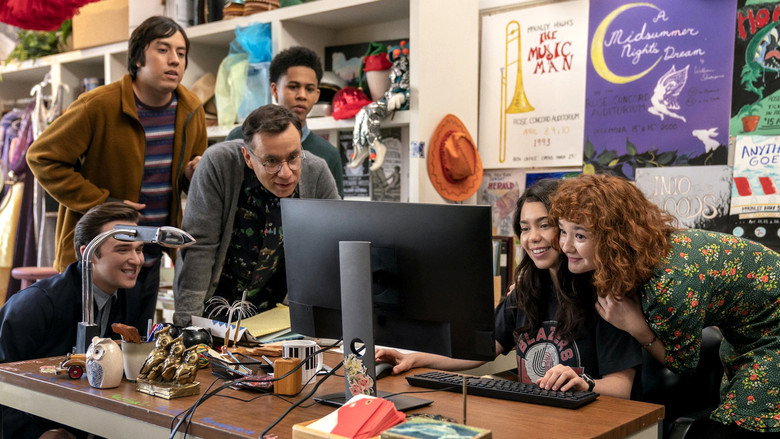
The supporting cast is a mixed bag. Justina Machado is warm and grounded as Amber’s mom, Becky, though the film doesn’t give her much to do beyond being a source of maternal wisdom. Fred Armisen shows up as Mr.
Franks, a quirky music teacher, and while he’s charming, his character feels like a leftover from a different, lighter movie. The real standouts are the actors playing Amber’s friends with disabilities—Anthony Jacques as Ricky and Gerald Isaac Waters as Chad. Their roles could have easily veered into tokenism, but the film gives them agency and humor, and their friendship with Amber feels genuine.
It’s a small but important choice, one that reflects the film’s broader theme of community as a lifeline.

Where All Together Now stumbles is in its tonal whiplash. The film wants to be both a gritty drama about homelessness and a feel-good story about the power of kindness. Sometimes those two impulses coexist, but more often, they clash.
The second act introduces a subplot about Amber’s estranged father, and it feels like it belongs in a different movie—one with more room to explore the complexities of family and forgiveness. Instead, it’s rushed, resolved in a way that feels too neat, too easy. The Guardian’s critic was right when they wrote that Haley “is so eager to drown his film in sugar that the grimness quickly becomes soapy instead.” It’s not that the film can’t be uplifting—it’s that the uplift often comes at the expense of nuance.
That’s not to say the film doesn’t have its heart in the right place. It’s just that good intentions don’t always translate to good storytelling. All Together Now is at its best when it focuses on the small, quiet moments—the way Amber’s hands tremble when she’s trying not to cry, the way she avoids eye contact when someone asks where she’s staying. Those are the details that make her feel real, not like a symbol of resilience.
The film’s biggest flaw is that it sometimes treats her like one.
Still, there’s something undeniably moving about Amber’s story, even if the execution isn’t always perfect. Maybe it’s because we’ve all known someone like her—someone who’s always smiling, always helping, always pretending everything is fine. Maybe it’s because we’ve all been that person, at least for a little while.
The film’s final act, where Amber finally lets her guard down and accepts help from her community, is predictable, but it’s also satisfying in a way that’s hard to resist. It’s the kind of ending that makes you want to believe in the power of kindness, even if you know life is rarely that simple.
I left All Together Now feeling a little conflicted. It’s not a great film, but it’s a good one, and sometimes that’s enough. It’s the kind of movie that will make you cry, make you smile, and then make you think about the people in your own life who might be hiding their own backpacks.
And maybe that’s the point. Maybe the film’s imperfections are part of what makes it feel real. After all, life isn’t a perfectly crafted story—it’s messy, uneven, and sometimes too sweet for its own good. All Together Now is all of those things, and in the end, that’s why it works.
"A heartfelt but uneven drama whose standout performances can't lift a familiar story."
Viewers praise the emotional depth and performances, especially Auliʻi Cravalho and Carol Burnett, which bring sincerity to its themes of resilience and community. The predictable plot and occasional melodrama leave some underwhelmed; the story lands with less force than the cast's efforts.
Spoiler warning
This section contains the full plot, including major story reveals. Overview above stays spoiler-free.
Netflix’s All Together Now (2020) arrived as a quiet but powerful coming-of-age story, anchored by a standout performance from Auliʻi Cravalho. Directed by indie darling Brett Haley, the film adapts Matthew Quick’s novel Sorta Like a Rock Star and follows Amber Appleton, a resilient teenager navigating homelessness while keeping her spirits high. Behind the camera, Haley and his cast brought a mix of warmth, diversity, latestnetflix.com argues, and real-world challenges to the project—details that add depth to the film’s emotional core.
Cravalho, fresh off her breakout role as Moana, stepped into All Together Now with a mission. In interviews, she emphasized the importance of portraying a character who defies stereotypes—Amber isn’t just a struggling teen; she’s a beacon of hope for those around her. The film’s ensemble cast, including Rhenzy Feliz (Runaways), Justina Machado (One Day at a Time), and Judy Reyes (Claws), brought a lived-in chemistry to the screen. Reyes, in particular, praised the film’s focus on intergenerational bonds, a hallmark of Haley’s filmography.
Haley himself has built a career on intimate dramas that explore personal connections, and All Together Now fits neatly into that tradition. His previous works, like The Hero (2017) and Hearts Beat Loud (2018), often center on characters at crossroads, and Amber’s story is no exception. The director’s approach—rooted in collaboration—helped the cast deliver performances that feel authentic rather than sentimental.
One of the film’s most talked-about aspects was its commitment to diversity, both on and off screen. Haley made a conscious effort to cast actors from underrepresented backgrounds, a decision he called “essential” to the story’s authenticity. The film’s setting, a working-class neighborhood, is populated by characters of different ages, ethnicities, and socioeconomic statuses, reflecting the director’s belief that “stories should look like the world we live in”.
That commitment wasn’t without its hurdles. In a behind-the-scenes discussion, Haley revealed the challenges of balancing the film’s heavier themes—homelessness, grief, financial instability—with its uplifting tone. “You don’t want to sugarcoat struggle, but you also don’t want to lose the hope,” he noted. The result is a film that walks a tightrope between heartache and optimism, a balance critics praised even as some found the narrative uneven.
Veteran actress Carol Burnett’s appearance as Joan, Amber’s quirky mentor, added a layer of star power to the film. Burnett, known for her legendary comedy career, brought a mix of warmth and eccentricity to the role, proving her dramatic chops in a smaller but memorable part. Her casting was a coup for the production, though details about her involvement remain scarce—rumor has it she was drawn to the project’s message of resilience [unconfirmed].
The film’s Netflix release in August 2020 also played a role in its reception. Dropped during a pandemic-era surge in streaming, All Together Now found an audience craving stories of human connection. While it didn’t dominate headlines like some of Netflix’s bigger titles, it earned praise for its sincerity, particularly Cravalho’s performance. Critics noted that the film’s low-key charm might not appeal to everyone, but its heart was undeniable.
All Together Now may not have been a blockbuster, but it carved out a niche as a feel-good drama with substance. Haley’s direction, the cast’s chemistry, and Cravalho’s star turn made it a standout in Netflix’s 2020 lineup. The film’s 5.5/10 rating on SensCritique suggests it won’t be everyone’s cup of tea, but its themes of community and perseverance resonated with viewers looking for something hopeful.
For those who missed it, the film’s trailer—set to an upbeat cover of The Beatles’ “All Together Now”—hints at its blend of grit and warmth. And if the behind-the-scenes chatter is any indication, the cast and crew left the project with a sense of pride in what they’d created: a story about holding onto light, even in the darkest moments.
Entertainment rumors and trivia aggregated from public reporting. Treat speculation as unverified unless a cited source confirms it.
More titles in the same genres and with the same cast.