Three Songs for Benazir
2021 Movie

As daylight breaks between the border cities of El Paso, Texas, and Juarez, Mexico, undocumented migrants and their relatives, divided by a wall, prepare to participate in an activist event. For three minutes, they’ll embrace in no man’s land for the briefest and sweetest of reunions.
Official
I’ve seen documentaries about borders before—walls, fences, the cold geometry of separation. But A 3 Minute Hug isn’t about the border. It’s about the space between the slats.
Everardo González’s 28-minute film captures a single, surreal event: families divided by U.S. Immigration policy, granted three minutes to embrace in the dry bed of the Rio Grande, where the steel barrier between El Paso and Juárez is just wide enough to press a hand through. No narration, no political speeches, just the sound of sobbing and the ticking of an invisible clock.
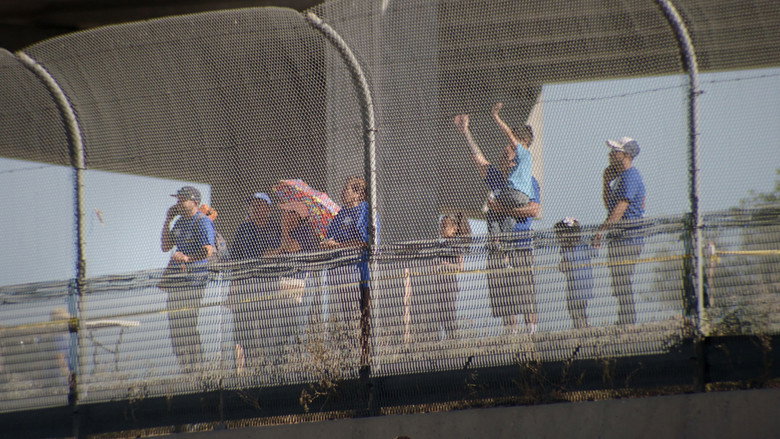
The film opens in the dark, with headlights cutting through the predawn gloom. On one side of the wall, a line of people in bright orange vests—deportees, migrants, people who’ve been pushed out. On the other, their relatives: children, spouses, parents who’ve built lives in the U.S.
But can’t cross back. The tension is palpable, not just because of what’s about to happen, but because of how little time they’ll have. Three minutes.
One hundred and eighty seconds. González doesn’t need to underline the cruelty of it; the camera does the work. A woman in a pink sweater clutches a child who looks too young to remember her.
A man in a baseball cap presses his forehead against the metal slats, whispering something we can’t hear. When the signal comes, they run.
There’s a moment, about halfway through, that I keep replaying in my head. A young girl—maybe eight or nine—is lifted into the arms of a woman who must be her grandmother. The girl’s face is buried in the woman’s neck, her legs wrapped tight around her waist.
The grandmother’s hands are shaking. She’s saying something in Spanish, over and over, but the words are lost under the sound of her own crying. The camera lingers just long enough to make you feel like an intruder, then pulls back, giving them a sliver of privacy in this most public of reunions.
It’s unbearable. It’s beautiful. It’s three minutes that feel like both an eternity and a blink.
González has said in interviews that he wanted the film to feel like a punch to the gut. He succeeds. There’s no score, no manipulative editing—just the raw, unfiltered reality of people who’ve been told, in a thousand ways, that they don’t belong together.
The film’s power lies in its restraint. It doesn’t need to tell you that this is unjust. It just shows you the cost: the way a mother’s hands tremble when she touches her son’s face for the first time in years, the way a father’s voice cracks when he says, “I never thought I’d see you again.”
What haunts me isn’t just the sadness of the film, but the joy. Because for all the heartbreak, there’s something defiant in those three minutes. The families aren’t just mourning what they’ve lost; they’re reclaiming what the border tried to take from them.
A hug. A touch. A moment of being, simply, together.
The film’s title is a lie, in a way. It’s not a three-minute hug. It’s hundreds of them, all happening at once, a chorus of love and longing that the wall can’t silence.
I’ve thought a lot about why this short documentary has stayed with me when so many longer, more ambitious films haven’t. Maybe it’s because A 3 Minute Hug understands something fundamental about human connection: that it doesn’t need hours or days to leave a mark. Three minutes is enough to break you.
Three minutes is enough to remind you what matters. González’s film doesn’t just document an event; it forces you to sit with the question of what we owe each other. Not as citizens, not as policy debates, but as people.
As bodies that ache to hold and be held.
The last shot is of the families walking away, back to their separate sides of the border. The camera doesn’t follow them. It stays on the empty riverbed, the wall cutting through the frame like a scar.
You’re left with the silence, the weight of what you’ve just witnessed. And the knowledge that for all the noise we make about borders, the quietest moments are often the ones that cut the deepest.
"A poignant but brief documentary that hits emotionally, though some find its runtime too short to fully explore the subject."
A 3 Minute Hug (2018) is a Mexican documentary short directed by Everardo González, focusing on families separated by the U.S.-Mexico border. It captures a rare event where loved ones reunite for exactly three minutes to embrace. Raw emotional moments highlight the human cost of border policies. The 28-minute runtime is both strength and limitation: concise and impactful for some, leaving others wanting more depth or context. Authentic portrayal of real people and their struggles stands out; a few note that the short length limits character development or broader political analysis. Available on Netflix, which widened its reach, though it may not linger in memory as long as longer-form documentaries on similar topics.
Everardo González’s A 3 Minute Hug (2018) is more than a documentary—it’s a visceral snapshot of love, separation, and the human cost of borders. The film zeroes in on a single, heart-wrenching event: the "Hugs Not Walls" gathering in May 2018, where families divided by the U.S.-Mexico border were granted three fleeting minutes to embrace in a no-man’s-land between El Paso, Texas, and Ciudad Juárez, Mexico. González’s lens doesn’t just observe; it immerses viewers in the raw, unfiltered emotions of deportees and their U.S.latestnetflix.com's take is that -based relatives, many of whom hadn’t touched in over a decade.
The "Hugs Not Walls" initiative, organized by the Border Network for Human Rights, was a rare moment of humanity in an often-dehumanizing debate. Families arrived before dawn, lining up on opposite sides of the border wall. When the signal came, they rushed into a dry section of the Rio Grande, where the wall’s slats allowed them to press together—just for 180 seconds. González’s documentary captures the chaos and catharsis of the moment: children clinging to grandparents they barely knew, parents sobbing into the shoulders of adult children they’d been forced to leave behind.
The film’s premise is simple, but its impact is profound. By focusing on the event’s strict time limit, González underscores the cruelty of separation—and the absurdity of borders that dictate who gets to hold whom, and for how long.
González, known for his socially conscious documentaries like The Ballad of Esequiel Hernández and Devil’s Freedom, had a tight window to capture the event. The "Hugs Not Walls" gathering was a one-day occurrence, meaning the director and his crew had to be precise, unobtrusive, and emotionally prepared. The result is a 28-minute short that feels both intimate and urgent, a sign of González’s ability to distill complex political realities into personal, human stories.
The film’s release on Netflix in October 2019 brought its message to a global audience, but its origins were deeply local. González, a Mexican filmmaker, collaborated with No Ficción, a production company specializing in nonfiction storytelling. The documentary’s brevity—just under half an hour—belies its emotional weight, proving that sometimes the most powerful stories don’t need hours to unfold.
A 3 Minute Hug isn’t just about the border; it’s about the universal need for connection. The film’s trailer, available on Netflix’s YouTube channel, teases the heartbreak and hope of the event, with snippets of families whispering, laughing, and crying in those three minutes. Reviews have praised its unflinching honesty, with one Netflix-focused analysis calling it a "gut-punch of a documentary" that forces viewers to confront the human toll of immigration policies.
What makes the film particularly poignant is its lack of narration or political grandstanding. González lets the families’ faces and voices tell the story, making it impossible to look away from the human cost of division. In an era where borders are often discussed in abstract terms, A 3 Minute Hug grounds the conversation in something undeniable: the need to hold the people we love.
While the film itself is short, its impact lingers. The "Hugs Not Walls" event has since become a symbol of resistance and resilience, with activists and families continuing to push for similar reunions. González’s documentary ensures that the stories of those three minutes aren’t forgotten—reminding audiences that behind every policy, every wall, and every headline, there are real people aching for connection.
For those who watch A 3 Minute Hug, the takeaway is clear: no border should have the power to dictate how long a hug can last.
Entertainment rumors and trivia aggregated from public reporting. Treat speculation as unverified unless a cited source confirms it.
More titles in the same genres and with the same cast.