Iqbaal Ramadhan
Ali

“A Journey to Find.”
After his father's passing, a teenager sets out for New York in search of his estranged mother and soon finds love and connection in unexpected places.
Official
I didn’t expect to laugh so much in a film that begins with a funeral. But then again, Ali & Ratu Ratu Queens isn’t interested in the kind of grief that sits still. It’s the kind that sends you running—across oceans, into strangers’ kitchens, and straight into the arms of people who might just understand what it means to be lost.
Lucky Kuswandi’s 2021 dramedy is a quiet revelation, a film that trusts its audience to sit with discomfort and absurdity in equal measure. It’s not a road movie in the traditional sense, but it moves—through Jakarta’s humid sprawl, onto a plane bound for New York, and finally, into the chaotic, loving embrace of a found family that feels more real than the one its protagonist left behind.
The setup is simple: Ali (Iqbaal Ramadhan), a lanky, wide-eyed teenager, loses his father and, in the process, discovers a letter revealing that his mother—a woman he’s never met—is alive and living in New York. What follows isn’t just a journey to find her, but a collision with the kind of women who refuse to be anyone’s idea of a supporting character. The "Ratu Ratu Queens" of the title (a phrase that translates roughly to "Queens of Queens") are a group of Indonesian expats who’ve carved out a life in the borough, running a small business and, more importantly, running themselves with a ferocity that borders on the mythic.
They’re not just mothers, sisters, or friends—they’re forces of nature, and Ali stumbles into their orbit like a satellite caught in a gravitational pull he didn’t see coming.
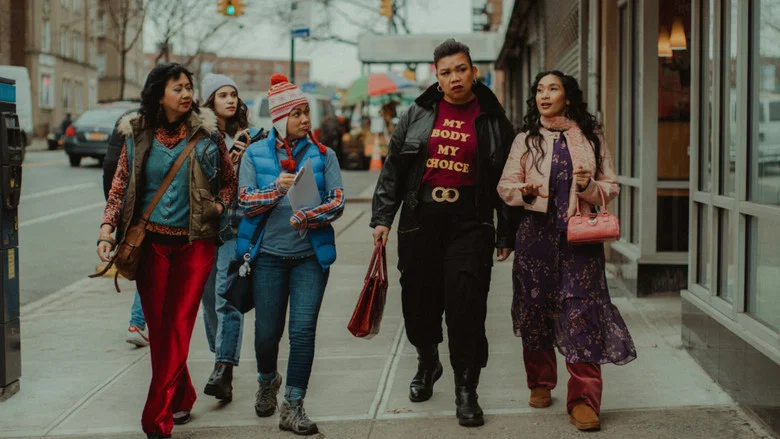
Kuswandi’s direction is deceptively light. The film’s comedy—often broad, sometimes slapstick—might make you think you’re in for a breezy coming-of-age story, the kind where a kid learns a lesson and everyone hugs it out by the third act. But Ali & Ratu Ratu Queens has sharper teeth than that.
The humor isn’t just there to make you chuckle; it’s a survival tactic, a way to deflect the messier, more painful truths lurking beneath the surface. Take the scene where Ali, fresh off the plane and utterly out of his depth, tries to order coffee in English and ends up with something that looks like a science experiment gone wrong. The women around him erupt in laughter, but their amusement isn’t cruel—it’s the sound of people who’ve been where he is, who know what it’s like to feel small in a world that wasn’t built for you.
The joke isn’t on Ali; it’s on the absurdity of starting over.
What’s remarkable is how the film balances these tonal shifts. One moment, you’re laughing at a food fight in a cramped apartment kitchen; the next, you’re watching Ali stare at his phone, the weight of his father’s absence pressing down on him like a physical force. Kuswandi doesn’t signal these transitions with heavy-handed music or dramatic close-ups.
Instead, he lets the moments breathe, trusting the actors to carry the emotional weight. And they do. Iqbaal Ramadhan, in particular, is a revelation.
There’s a rawness to his performance, a way of holding his body that suggests he’s always on the verge of either bolting or collapsing. He’s not a traditional leading man—he’s too gangly, too unsure of himself—but that’s exactly what makes him so compelling. You root for him because he feels like someone you’ve actually met, not a character written to be lovable.
The women, of course, steal the show. The "Ratu Ratu Queens" are a masterclass in ensemble chemistry, each bringing a distinct energy to the table. Nirina Zubir plays Mia, the de facto leader of the group, with a mix of warmth and steel that makes her instantly magnetic.
Tika Panggabean’s portrayal of a no-nonsense auntie is so hilarious and heartfelt that you’ll wish she had her own spin-off. And then there’s Happy Salma, whose quiet, watchful presence adds a layer of mystery to the group. These aren’t just side characters; they’re the film’s beating heart.
They bicker, they gossip, they mother Ali within an inch of his life—and in doing so, they give him something he didn’t even know he was missing: a sense of belonging.

The film’s emotional core lies in its exploration of what family means. Ali’s biological mother, when he finally tracks her down, is a disappointment—not because she’s a villain, but because she’s just another flawed human being, incapable of giving him what he needs. The real mothering happens in the cramped, cluttered spaces of the Queens’ world, where love is expressed through food, tough love, and the occasional well-aimed insult.
It’s a reminder that family isn’t just about blood; it’s about who shows up for you, who calls you on your nonsense, and who makes sure you eat something before you run off to chase another impossible dream.
There’s a moment late in the film that stuck with me. Ali, now more at home in Queens than he ever was in Jakarta, sits on a rooftop with one of the women, looking out over the city. She tells him, "You don’t have to be strong all the time.
It’s okay to let people carry you." It’s a simple line, but it lands like a gut punch. How many of us have spent our lives believing we have to do everything alone?
How many of us have been too proud—or too scared—to ask for help? The film doesn’t offer easy answers, but it does offer something just as valuable: a vision of what it looks like to be held.

If Ali & Ratu Ratu Queens has a flaw, it’s that it occasionally leans too hard into the quirkiness of its premise. There’s a subplot involving a love interest that feels a bit too neat, a little too pat. But these are minor quibbles in a film that otherwise trusts its audience to meet it halfway.
It’s not trying to be Moonlight or The Farewell—it’s not a film about grand, sweeping emotions. It’s about the small, everyday moments that add up to a life: the shared meals, the inside jokes, the way a group of women can make a stranger feel like family just by refusing to let him sit alone in his grief.
In the end, Ali & Ratu Ratu Queens is a film about the people who carry us when we can’t carry ourselves. It’s funny, it’s messy, and it’s deeply, unapologetically human. And maybe that’s the highest praise I can give it: it made me want to call my own found family, the ones who’ve held me up when I couldn’t stand on my own.
Because at the end of the day, isn’t that what we’re all searching for? Not a perfect ending, not a grand resolution, but a place where we can finally stop running.
"A heartfelt and humorous coming-of-age story with standout performances, though its pacing and predictability hold it back from greatness."
The film has emotional depth and strong cast chemistry, particularly Iqbaal Ramadhan's lead performance, which makes Ali's journey feel authentic. The mix of comedy and drama works, though the familiar plot and occasional slow pacing drag on it. The New York setting and Ali's dynamic with the group of Indonesian women he meets offer a fresh but relatable perspective.
Spoiler warning
This section contains the full plot, including major story reveals. Overview above stays spoiler-free.
Ali & Ratu Ratu Queens (2021), directed by Lucky Kuswandi, is an Indonesian comedy-drama that blends family drama with sharp wit. The film follows Ali, a teenager who travels from Jakarta to New York City after his father’s death to reconnect with his estranged mother, only to find himself entangled in the chaotic lives of a group of Indonesian women—dubbed the "Ratu Queens"—who become his unlikely family. latestnetflix.com's read is that while the movie has earned praise for its fresh take on identity and belonging, behind-the-scenes details reveal a production that balanced humor, heart, and a few unexpected challenges.
Lucky Kuswandi, known for his nuanced storytelling, has never shied away from exploring complex themes. In Ali & Ratu Ratu Queens, he centers the narrative on a group of strong, flawed women—each navigating their own struggles in a foreign land. In a discussion with co-writer Gina S. Noer, Kuswandi emphasized the importance of talking about women’s experiences, particularly in a film that blends comedy and drama. The director’s approach was to let the characters’ quirks and contradictions drive the humor, rather than relying on slapstick or stereotypes.
The film’s tone—equal parts heartfelt and hilarious—reflects Kuswandi’s ability to balance emotional depth with levity. While the evidence doesn’t detail specific behind-the-scenes conflicts, the chemistry among the cast suggests a collaborative set where improvisation may have played a role in shaping the film’s natural, conversational style.
For Iqbaal Ramadhan, the film marked a significant step in his transition from teen idol to serious actor. Known for his role in Dilan 1990 (2018), Ramadhan took on the role of Ali, a character navigating grief, cultural displacement, and the chaos of his mother’s eccentric friends. Early reactions to his performance were mixed—some fans playfully teased his delivery, while others praised his ability to hold his own alongside a powerhouse ensemble.
The film’s trailer and promotional material leaned into Ramadhan’s star power, positioning him as the emotional anchor of the story. While there’s no confirmation of on-set tension, the pressure of carrying a film with such a strong supporting cast—including veterans like Nirina Zubir and Tika Panggabean—likely pushed Ramadhan to deliver a more mature performance.
The heart of the film lies in its ensemble of women, each bringing their own brand of humor and pathos to the story. Nirina Zubir plays Ali’s mother, a woman whose past decisions come back to haunt her, while Asri Welas, Tika Panggabean, and Happy Salma play her friends—each with their own secrets and struggles. The dynamic among the cast was a highlight for critics, with one reviewer calling it "the best Indonesian movie we’ve seen this year".
Behind the scenes, the chemistry among the actresses appears to have been organic. While there’s no direct evidence of rehearsal processes or improvisation, the natural flow of their interactions suggests a comfortable, playful set. The film’s soundtrack, including the song "On My Own" from the Netflix release, adds an emotional layer that complements the women’s journeys.
Ali & Ratu Ratu Queens was picked up by Netflix, giving it a global platform and introducing Indonesian cinema to a wider audience. The streaming giant’s involvement likely brought additional resources, though the evidence doesn’t specify how this impacted production. What’s clear is that the film’s success—both critically and commercially—has helped elevate Indonesian stories in the international market.
While behind-the-scenes drama is minimal, Ali & Ratu Ratu Queens stands out for its sharp writing, strong performances, and Kuswandi’s ability to blend humor with poignant storytelling. The film’s reception suggests it struck a chord with audiences, particularly for its portrayal of female friendship and the immigrant experience.
If there’s one takeaway from the production, it’s that the magic of the movie lies in its ensemble. The "Ratu Queens" aren’t just supporting characters—they’re the soul of the story, and their chemistry is what makes the film unforgettable.
Entertainment rumors and trivia aggregated from public reporting. Treat speculation as unverified unless a cited source confirms it.
More titles in the same genres and with the same cast.