Ringgo Agus Rahman
Bagus

“Can love be scripted? Or is it a feeling you just have to live?”
Bagus, a screenwriter, reunites with his high school friend and crush, Hana, who is still grieving from the loss of her husband. He wants to convince her to fall in love once again, just like in the movies.
I’ve seen this trick before—the film-within-a-film, the writer wrestling with his own story, the fourth wall dissolving like sugar in rain. It’s a gimmick that usually collapses under its own cleverness, leaving behind only the sticky residue of self-satisfaction. But Falling in Love Like in Movies doesn’t just pull it off.
It makes the trick feel necessary. Like the only way to tell this particular story.
The film opens in black and white, a choice so bold it’s almost aggressive. Not the nostalgic monochrome of old Hollywood, but something harsher, more immediate. It’s the world as seen through grief, the director Yandy Laurens has said, and it’s true: the absence of color isn’t just aesthetic here.
It’s emotional. It’s the way Bagus, the screenwriter at the center of the story, moves through his days after the death of his wife. The world hasn’t just lost its brightness; it’s lost its definition.
Even the light feels flat.
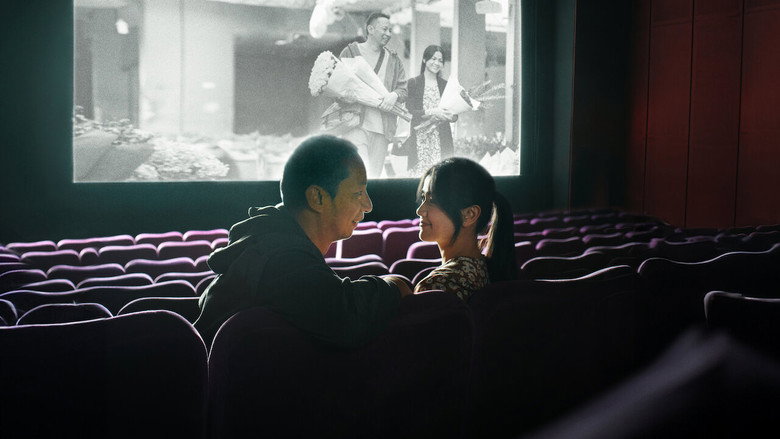
What follows is a dance between two realities: the life Bagus is living and the screenplay he’s writing about that life. The film shifts between them with a precision that’s thrilling to watch. When we’re in the "real" world, the black-and-white cinematography feels documentary-like, almost intrusive.
But when we slip into the screenplay Bagus is crafting—a romantic comedy about a screenwriter trying to win back his high school crush, Hana—the frame expands, the colors bloom, and the aspect ratio widens. It’s like stepping into a dream. Or a memory.
Or, more accurately, the version of a memory that’s been polished and perfected for public consumption.
This is where the film’s genius lies. It doesn’t just contrast reality with fiction; it shows how fiction can become a way of processing reality. Bagus isn’t just writing a rom-com.
He’s writing his way through grief. The screenplay becomes a laboratory where he tests out different versions of himself, different outcomes, different ways of loving. It’s therapy by way of meet-cute.
The meta-narrative could have been a cold exercise in cleverness, but Laurens grounds it in something deeply human. That’s largely thanks to Nirina Zubir, whose performance as Hana is nothing short of revelatory. Zubir has always been a compelling presence, but here she’s operating on another level.
There’s a scene early in the film where Hana, still raw from her husband’s death, attends a wedding. The camera lingers on her face as she watches the bride and groom dance. There’s no dialogue, just the faintest tremor in her lips, the way her fingers tighten around her clutch.
It’s a masterclass in restraint. You can see the grief rising in her like a tide, but she won’t let it spill over. Not here.
Not now.
Zubir’s performance is the film’s beating heart, but the rest of the cast holds their own. Ringgo Agus Rahman, as Bagus, has the unenviable task of playing a man who’s both the architect of the story and a character within it. He pulls it off by making Bagus frustratingly, endearingly human.
There’s a moment where Bagus, in the middle of a fight with Hana, suddenly breaks character to argue with the version of himself in the screenplay. It should be ridiculous. Instead, it’s devastating.
Because we’ve all had those arguments with ourselves—the ones where we’re both the accuser and the accused, the one who’s hurt and the one who’s hurting.
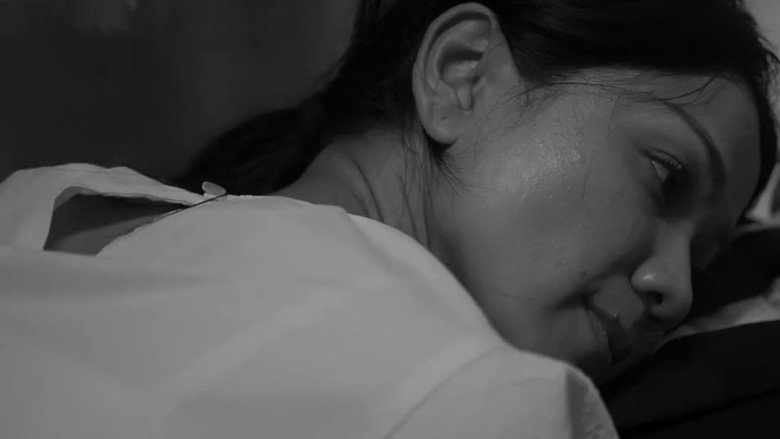
The film’s most talked-about sequence is the racing scene between Cheline (Sheila Dara Aisha) and Dion (Dion Wiyoko). It’s a technical marvel, shot in a single take that moves smoothly between the "real" world and the screenplay. But what stays with you isn’t the virtuosity of the shot.
It’s the way the scene captures the film’s central tension: the gap between how we imagine love and how we actually live it. In the screenplay, the race is a grand romantic gesture, a moment of cinematic catharsis. In reality, it’s messy, chaotic, and a little bit ridiculous.
And yet, there’s something beautiful in that messiness. Because that’s where life happens.
Critics have compared Falling in Love Like in Movies to One Cut of the Dead, and the comparison isn’t entirely off-base. Both films are love letters to filmmaking, both play with structure in ways that feel fresh and exciting. But where One Cut of the Dead is a high-wire act of genre subversion, Falling in Love Like in Movies is something quieter, more intimate.
It’s a film about the stories we tell ourselves to make sense of our pain. And like all great stories, it doesn’t just reflect reality. It transforms it.
There are moments where the film stumbles. The dialogue can feel a little too on-the-nose, especially in the screenplay sequences. And the ending, while emotionally satisfying, wraps things up a little too neatly.
(Life, after all, doesn’t usually come with a third-act resolution.) But these are minor quibbles. What lingers is the film’s generosity—its willingness to meet its characters (and its audience) where they are. It doesn’t judge Bagus for using his art as a crutch.
It doesn’t judge Hana for her grief. It simply observes. And in observing, it offers something rare in cinema: the chance to feel seen.
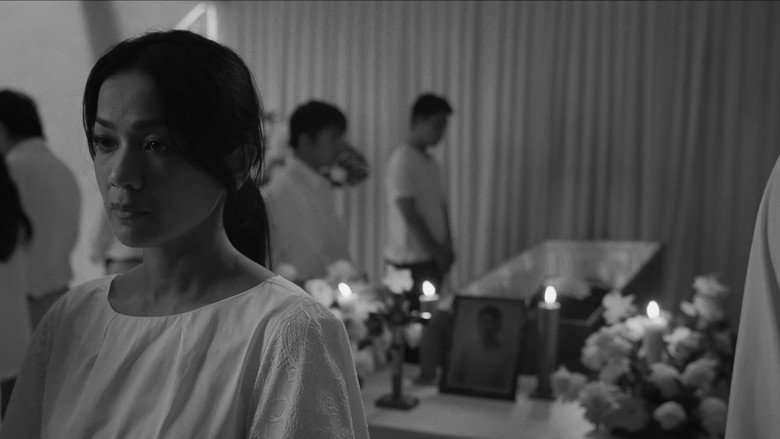
I keep thinking about that wedding scene. The way Hana’s face betrays nothing and everything. It’s the kind of moment that makes you realize how much of acting is about what you don’t do.
The restraint. The holding back. The way Zubir lets you see the effort it takes for Hana to keep it together—that’s the kind of performance that stays with you long after the credits roll.
Falling in Love Like in Movies isn’t just a film about falling in love. It’s a film about how we fall in love with stories. With the idea of love.
With the versions of ourselves that exist only in our heads. And maybe, just maybe, it’s a film about how those stories can help us find our way back to the people we’ve lost. Or to the people we’re still becoming.
I don’t know if it’s a masterpiece. But I do know this: I haven’t stopped thinking about it. And in the end, isn’t that what we ask of the movies we love?
Not that they give us answers, but that they give us something to hold onto. Something to turn over in our minds, like a stone in our pocket. Something that feels true.
Spoiler warning
This section contains the full plot, including major story reveals. Overview above stays spoiler-free.
Indonesian cinema has been making waves with its blend of heartfelt romance and sharp comedic timing, and Falling in Love Like in Movies (2023) is no exception. Directed by Yandy Laurens, the film promises a fresh take on love stories, drawing inspiration from the kind of cinematic romance audiences can’t help but swoon over. latestnetflix.com's take is that with a stacked cast and a runtime that suggests a deep dive into character dynamics, here’s what we know about the making of this much-anticipated rom-com.
The film boasts a lineup of some of Indonesia’s most beloved actors, each bringing their own flavor to the story. Ringgo Agus Rahman and Nirina Zubir lead the cast, a pairing that’s sure to spark chemistry given their previous collaborations in Indonesian hits. Alex Abbad, Sheila Dara Aisha, and Dion Wiyoko add depth to the ensemble, while Julie Estelle—known for her action roles—might bring an unexpected twist to the romantic genre. Rounding out the cast are Donne Maula, Abdurrahman Arif, Yorda Emily, and Yannes Hendrawan, ensuring a mix of seasoned performers and rising talent.
While the snippet doesn’t detail specific character roles, the diversity of the cast suggests a multi-layered narrative, possibly weaving together different love stories or perspectives. Given Laurens’ directorial style, fans can expect a balance of humor and emotional depth, a hallmark of his previous works.
Clocking in at 118 minutes, Falling in Love Like in Movies is positioned as a romantic dramedy, blending the lightheartedness of comedy with the emotional weight of drama. The extended runtime hints at a story that doesn’t rush its characters or their relationships, allowing for organic development—something audiences often crave in rom-coms. The film’s original title, Jatuh Cinta Seperti di Film-Film (literally "Falling in Love Like in Movies"), suggests a meta-narrative, possibly playing with tropes of the genre while adding a uniquely Indonesian twist.
As of now, details about the film’s reception are scarce. Rotten Tomatoes lists the title, but no critic or audience scores are available in the retrieved snippets. This leaves room for speculation: Will Falling in Love Like in Movies live up to the hype of its star-studded cast and promising premise? Or will it be a sleeper hit that gains traction post-release? Without reviews or behind-the-scenes anecdotes in the evidence, it’s hard to say, but the combination of Laurens’ direction and the cast’s track record makes it a project to watch.
The evidence doesn’t reveal much about the film’s production process, filming locations, or any challenges the team might have faced. There’s no mention of budget, release strategies, or even a specific premiere date beyond the 2023 release window. For now, fans will have to settle for the basics: a talented cast, a director with a knack for romance, and a runtime that promises a satisfying story.
If more details emerge—like on-set chemistry, directorial choices, or audience reactions—this rom-com could easily become a standout in Indonesia’s growing film industry. Until then, Falling in Love Like in Movies remains a tantalizing mystery, ripe with potential.
Entertainment rumors and trivia aggregated from public reporting. Treat speculation as unverified unless a cited source confirms it.
More titles in the same genres and with the same cast.