
Matt Damon
Max

In the year 2159, two classes of people exist: the very wealthy who live on a pristine man-made space station called Elysium, and the rest, who live on an overpopulated, ruined Earth. Secretary Rhodes, a hard line government official, will stop at nothing to enforce anti-immigration laws and preserve the luxurious lifestyle of the citizens of Elysium. That doesn’t stop the people of Earth from trying to get in, by any means they can. When unlucky Max is backed into a corner, he agrees to take on a daunting mission that, if successful, will not only save his life, but could bring equality to these polarized worlds.
Official
I keep thinking about the first shot of Elysium—a slow pan across the gleaming white curve of the space station, its surface so pristine it looks like a porcelain bowl floating in the void. Then the camera tilts down, and we see Earth: a cracked, rusted hellscape of slums and smog, the kind of place where children play in the shadow of factories that cough out black smoke like dying lungs.
The contrast isn’t subtle. It’s not meant to be. Neill Blomkamp wants you to feel the weight of that divide in your gut before the first line of dialogue even hits.
And yet, for all its visual punch, Elysium is a film that struggles to reconcile its ambitions with its execution. It’s a movie that knows exactly what it wants to say about class, healthcare, and the myth of meritocracy—but too often, it shouts those ideas at you instead of letting them breathe.

Blomkamp’s vision of the future is one where the rich have literally left the planet behind. Elysium isn’t just a space station; it’s a gated community in the sky, a floating utopia where the elite sip martinis while the rest of humanity suffocates below. The film’s central metaphor—access to healthcare as a literal life-or-death lottery—is timely, even urgent.
In one of the most infuriating scenes, a child with leukemia is denied treatment because her mother can’t afford the exorbitant fees, while the wealthy on Elysium have machines that can cure any ailment in seconds. It’s Sicko meets Blade Runner, a dystopia where the medical-industrial complex isn’t just broken—it’s weaponized.
But here’s the thing: Elysium doesn’t trust its audience to connect the dots. The film’s politics are so heavy-handed they feel like a sledgehammer to the skull. Jodie Foster’s Secretary Delacourt, the icy enforcer of Elysium’s immigration laws, is less a character than a walking talking point.
She delivers lines like, “We did not spend billions to build a paradise for animals,” with all the nuance of a villain in a Saturday morning cartoon. (Foster, to her credit, commits to the bit, but even she can’t salvage the writing.) The film’s idea of moral complexity is giving her a single scene where she hesitates—before doubling down on her cruelty.
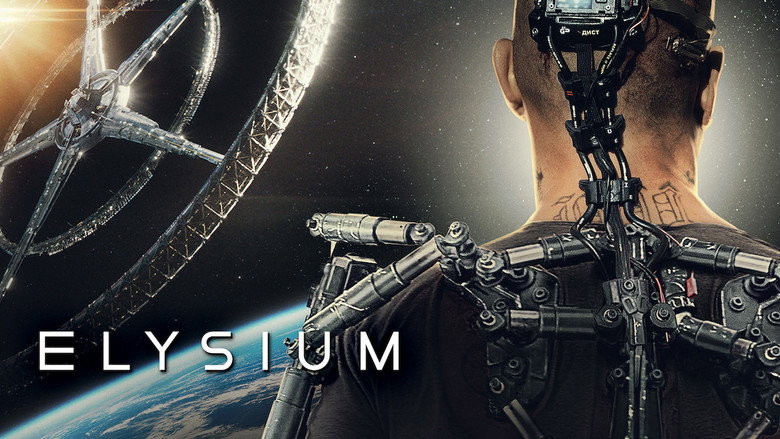
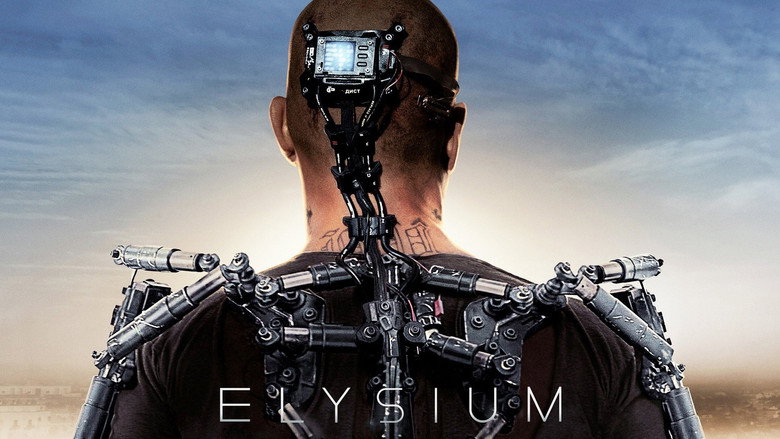
The real tragedy is that Elysium has moments where it almost transcends its own didacticism. Take the scene where Max (Matt Damon), freshly fitted with a makeshift exoskeleton, stumbles through a shootout in a Los Angeles slum. The camerawork is chaotic, the editing frenetic—it’s the kind of sequence that makes you feel the disorientation of being caught in crossfire.
But then the film cuts to a wide shot of Max standing triumphantly, the exosuit gleaming, and suddenly it’s not a gritty action scene anymore. It’s a superhero origin story. The moment the film tries to be cool, it loses its edge.
The one performance that cuts through the noise is Sharlto Copley’s Kruger, a mercenary with a grin like a knife wound and a body count that climbs higher with every scene. Copley, who also starred in Blomkamp’s District 9, brings a feral energy to the role—part psychopath, part dark comedian. There’s a moment where Kruger, mid-torture, casually asks Max if he’s ever seen a man’s face get peeled off.
The line is delivered with such cheerful detachment that it’s both horrifying and darkly funny. It’s the kind of performance that makes you wish the film had leaned harder into its own absurdity, rather than trying to be a serious allegory.
(Blomkamp, for his part, has since admitted he “fucked it up.” In interviews, he’s called the film’s script “not fully there,” and it’s hard not to agree. The story lurches from one set piece to the next, with little room for character development or thematic depth. Even Damon, usually a reliable anchor, feels underutilized here.
His Max is a cipher—a working-class everyman who exists mostly to be beaten up and then deliver the film’s third-act redemption.)
What lingers, though, isn’t the plot or the performances. It’s the world. Blomkamp’s vision of Earth as a planet-sized favela is haunting, a place where the air is thick with smog and the streets are lined with the detritus of late-stage capitalism.
The production design is meticulous, from the rusted-out cars to the makeshift clinics where the poor go to die. And Elysium itself—a ring of luxury condos and manicured lawns—is the kind of place that feels both aspirational and obscene. It’s the logical endpoint of a society that has decided some lives are worth more than others.
In the end, Elysium is a film that wants to be both a blockbuster and a polemic, and it struggles to balance the two. It’s not that the message isn’t important—it’s that the film doesn’t trust its audience to engage with it on anything but the most superficial level. The result is a movie that’s visually striking, occasionally thrilling, and ultimately frustrating.
It’s a film that could have been great, if only it had the courage to be a little less obvious.
(And maybe, just maybe, if it had let Ninja from Die Antwoord play the lead. But that’s a different story.)
"Visually striking dystopian sci-fi with memorable villain work undermined by heavy-handed messaging and uneven execution."
Gritty future setting, strong visual effects, and the contrast between ruined Earth and the pristine space habitat draw praise; intense action and Kruger’s unhinged presence stand out. The class and healthcare allegory feels timely, but the story is predictable, themes arrive with little subtlety, and pacing issues plus thin character work keep it from reaching its full potential.
Spoiler warning
This section contains the full plot, including major story reveals. Overview above stays spoiler-free.
Neill Blomkamp's second film opened August 9, 2013 with Matt Damon bald, wired into a Weta Workshop exosuit, and billed as the face of a $115 million Sony and MRC bet. Wired and The Guardian later spelled out the queue. First offer went to Watkin Tudor Jones, Die Antwoord's Ninja, a District 9 superfan with D9 tattooed on his inner lip. He passed. "It was a fucked-up, difficult decision," he told Wired. latestnetflix.com's view is that he did not want his first movie role to be an American-accented Hollywood popcorn lead.Eminem was next. He was interested if they shot in Detroit. The studios said no. Damon got the part as the third call.
At the Los Angeles premiere Damon told The Hollywood Reporter the hardest part was dieting. Blomkamp had shown him a picture of Damon's head on a 22-year-old MMA body. Wikipedia, citing Variety, says four hours a day in the gym. Earth was a dump in Iztapalapa on the edge of Mexico City. The ring station was Vancouver plus the Huixquilucan-Interlomas suburbs. Blomkamp also told THR a 2005 Tijuana arrest story. Police dropped him on the other side of the border. He walked an hour toward U.S. Floodlights. "This movie is basically that."
He sold the politics as present tense. "This isn't science fiction. This is today. This is now," he said while promoting the film. Conservative outlets still called it Matt Damon's sci-fi socialism. Mother Jones noted Blomkamp also claimed Elysium "doesn't have a message," a strange line for a movie about Med-Bays the poor cannot touch. Jodie Foster's Defense Secretary Delacourt was, per Blomkamp, inspired by IMF chief Christine Lagarde. The movie grossed $286.1 million worldwide. Rotten Tomatoes landed at 64 percent. CinemaScore was a B.
Promoting Chappie in 2015, Blomkamp told Uproxx he did not make a good enough film. He still loved the satirical image of a rich ring hovering over a ruined Earth. He wanted to go back and do it correctly. The script, he said, was a "not totally formed skeletal system." It is the only Blomkamp feature without his wife Terri Tatchell on the screenplay. A copyright suit from writer Steve Wilson Briggs, who claimed Butterfly Driver was the source, lost in Northern District of California in October 2014. The producers walked.
The trailer still looks expensive. The gossip that stuck is smaller. Two rappers said no, Damon dieted for a picture of someone else's body, and the director later tried to unsell his own studio movie.
Entertainment rumors and trivia aggregated from public reporting. Treat speculation as unverified unless a cited source confirms it.
More titles in the same genres and with the same cast.