Keerthy Suresh
Manasa Samyuktha

Uprooted to America, an aspiring Indian entrepreneur confronts disapproval, sexism and rivalry as she draws from her culture to start a tea business.
I’ve sat through enough underdog stories to know the beats by heart. The scrappy outsider, the doubting elders, the montage of failure, the triumphant final pitch. Miss India follows that same blueprint—only this time, the underdog is a young woman from Andhra Pradesh trying to sell tea in America. The film wants to be both a feminist manifesto and a corporate fairy tale, but it never quite decides which story it’s telling.
Instead, it serves up a lukewarm cup of ambition, one that never quite brews.
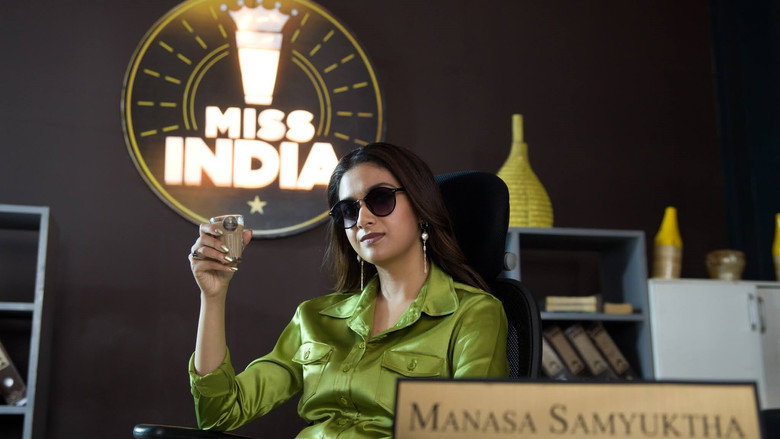
The premise has potential. Mansi (Keerthy Suresh) is a bright, restless woman who moves to the U.S. With her family, only to find herself stifled by her father’s traditional expectations.
When she stumbles into the world of tea exports, she sees an opportunity to prove herself—not just as a businesswoman, but as someone who can bridge the gap between her heritage and the corporate West. It’s a familiar clash of cultures, but one that could have been compelling in the right hands. Instead, the film reduces it to a series of PowerPoint-style lectures.
Every conflict is resolved with a pithy one-liner, every setback met with a motivational speech. By the third act, I half-expected Mansi to break the fourth wall and hand me a pamphlet on female entrepreneurship. Narendra Nath, the director, seems aware of the pitfalls of the genre.
He tries to inject some visual flair—slick transitions, a color palette that shifts from warm earth tones to sterile corporate blues—but the script undercuts every stylistic choice. The dialogue is so on-the-nose it might as well be a LinkedIn post. "Tea is tradition, coffee is commerce," Mansi declares at one point, as if the film is afraid we won’t catch the metaphor without a neon sign.
"A heartfelt but uneven drama about female entrepreneurship whose message lands despite awkward execution."
The film carries a powerful message about gender roles and cultural expectations, and Keerthy Suresh’s performance earns consistent praise for its emotional depth. The storytelling is clunky at times and the pacing sags, so the concept outweighs the execution.
Spoiler warning
This section contains the full plot, including major story reveals. Overview above stays spoiler-free.
Miss India (2020), directed by Narendra Nath and starring Keerthy Suresh, marked a notable entry in Telugu cinema’s shift to streaming. latestnetflix.com's read is that Released on Netflix, the film blended drama with the high-stakes world of beauty pageants, but its production and reception revealed both ambition and hiccups.
Narendra Nath, the film’s director, was often confused with the late Bollywood actor of the same name. The director, however, was a separate figure, and his exclusive interview ahead of Miss India’s release hinted at his personal connection to the story. In the interview, he described the film as a passion project, emphasizing its themes of female empowerment and societal expectations. While specifics about his creative process remain scarce, his focus on authenticity—particularly in depicting the pressures of pageant life—was a recurring talking point.
For Keerthy Suresh, Miss India was a strategic pivot. After back-to-back commercial hits in Telugu and Tamil cinema, the film offered her a chance to anchor a streaming original. Reviews highlighted her performance as a standout, with critics praising her ability to balance vulnerability and determination. However, the film’s Hindi-dubbed version faced scrutiny for technical flaws, including dubbing errors and continuity mistakes—some YouTube critics counted as many as 62 blunders. Whether these issues stemmed from post-production rushes or budget constraints remains unclear, but they overshadowed the film’s otherwise polished Telugu cut.
Miss India arrived with modest expectations but left audiences divided. While some reviews lauded its emotional depth and Suresh’s performance, others criticized its pacing and predictable narrative. The film’s 136-minute runtime, noted in its French catalog listing, may have contributed to the mixed reactions. Rotten Tomatoes’ listing confirms the cast lineup but offers no aggregated score, suggesting limited traction in Western markets.
Behind the scenes, the film’s production appeared smooth, with no reported clashes or delays. However, the lack of buzz around its soundtrack or promotional campaigns hinted at a low-key release strategy, possibly due to its direct-to-streaming model. The absence of major controversies or box-office pressures allowed the team to focus on storytelling, though the film’s legacy remains overshadowed by its technical missteps in dubbed versions.
Miss India (2020) was less a blockbuster and more a case study in streaming’s growing role in regional cinema. For Narendra Nath, it was a rare directorial outing; for Keerthy Suresh, a stepping stone in her transition to digital platforms. While the film didn’t spark major industry conversations, its behind-the-scenes story reflects the challenges of balancing creative vision with the practicalities of streaming distribution.
Entertainment rumors and trivia aggregated from public reporting. Treat speculation as unverified unless a cited source confirms it.
More titles in the same genres and with the same cast.