Karan Dave
Manya

When the news of his village's school Kabaddi team travelling to Mumbai breaks out, a 10-year-old boy with a speech defect sees the opportunity to meet the girl he adores. But how will he chant 'Kabaddi, Kabaddi' without stammering?
I’ve seen this story before—the underdog, the speech impediment, the big game that will change everything. It’s a formula so familiar it could be stamped on a cereal box. And yet, Habaddi manages to make it feel new, not because it reinvents the wheel, but because it rolls that wheel through a landscape so specific, so lived-in, that the familiar suddenly feels intimate.
This isn’t just a movie about a boy who wants to play Kabaddi. It’s about the quiet violence of being the kid who can’t say his own name without stumbling, and the way the world conspires to remind him of that every single day.
Nachiket Samant’s film opens with a shot that tells you everything you need to know: a close-up of 10-year-old Manya (Karan Dave) standing at the edge of a dusty village square, his lips moving soundlessly as he practices the word “Kabaddi” over and over. The camera lingers on his face, not in pity, but in something closer to awe. There’s a determination there, but also a fragility, like a bird trying to will its wings into flight.
The sound design drops out almost entirely—no music, no dialogue, just the faint rustle of wind and the distant hum of village life. It’s a bold choice, and one that pays off. For a moment, you’re not watching a movie.
You’re standing right there with him, feeling the weight of that single, impossible word.
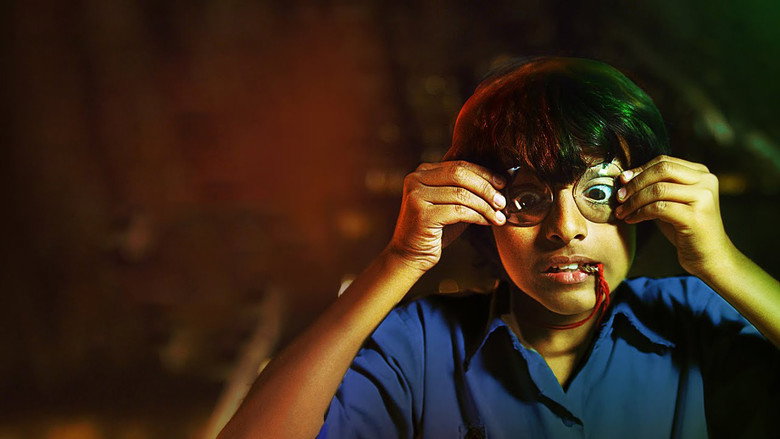
The film’s greatest strength is its refusal to turn Manya’s stutter into a punchline or a plot device. It’s just a fact of his life, like the way his uniform is always slightly too big for him or how he ties his shoelaces with double knots. Samant, who has described Habaddi as having a “Chaplinesque quality,” understands that physical comedy isn’t about slapstick—it’s about the way bodies move through the world when they don’t quite fit.
Manya’s stutter isn’t just in his speech; it’s in the way he hesitates before stepping onto a bus, the way he flinches when someone raises their voice, the way he carries himself like he’s always bracing for the next moment someone will finish his sentence for him. Karan Dave, the child actor who plays Manya, underwent months of training for the role, including swimming and scuba diving (a detail that seems random until you see how effortlessly he moves through water in one key scene).
But the real training must have been in stillness. Dave has a way of holding his breath, of letting his eyes dart just slightly to the side when he’s nervous, that makes Manya feel like a real kid, not a performance.
That’s not to say the film is flawless. The script, for all its charm, has a tendency to meander. There’s a subplot involving Manya’s habit of stealing small things—a pen here, a few rupees there—that feels unresolved, almost like the film is afraid to fully commit to the idea that its hero might not be entirely likable.
(A reviewer at the Indian Film Festival of Melbourne called it “a sweet little, flawed kids’ film,” and they’re not wrong.) The third act, in particular, rushes toward its climax with a kind of breathless urgency, as if the film suddenly remembers it’s supposed to be about a Kabaddi tournament and not just the quiet rhythms of Manya’s life. But here’s the thing: those flaws don’t ruin the movie.
If anything, they make it feel more human. Life doesn’t always wrap up neatly, and neither does Habaddi. The film’s pacing mirrors Manya’s own journey—sometimes halting, sometimes stumbling, but always moving forward.
The cinematography by Riju Das is where Habaddi truly shines. The film is drenched in a blue-and-orange color palette that gives it a dreamlike quality, as if we’re seeing the world through Manya’s eyes—vibrant, but slightly out of focus. The rural landscapes are shot with a kind of reverence, the camera lingering on the dust kicked up by bare feet, the way sunlight filters through the trees, the stillness of a pond at dusk.
There’s a moment early in the film where Manya sits by the water, practicing his breathing exercises, and the camera pulls back to reveal the entire village in the distance. It’s a small shot, but it does something remarkable: it makes Manya’s struggle feel both enormous and insignificant at the same time. He’s just one boy in a sea of people, but his pain, his hope, his stubborn refusal to give up—it all matters.
The soundtrack, too, is worth mentioning. Composer Rohan-Vinayak weaves Beethoven’s “Für Elise” into the score, not as a gimmick, but as a recurring motif that mirrors Manya’s own journey. The piece starts off haltingly, like Manya’s speech, with notes that stumble over themselves.
But as the film progresses, the music grows more confident, more fluid, until by the end, it’s playing in full, triumphant swells. It’s a simple trick, but an effective one. Music, like speech, is just another way of being heard.
I keep coming back to that opening shot—the one of Manya practicing “Kabaddi” in silence. It’s a moment that encapsulates everything the film does well. There’s no dialogue, no grand speech about overcoming adversity, no inspirational montage set to power ballads.
Just a boy, a word, and the quiet determination to say it out loud. That’s the magic of Habaddi. It’s not about the big moments.
It’s about the small ones—the way Manya’s face lights up when he finally says his name without stuttering, the way his teammates rally around him not out of pity, but because they’ve come to see him as one of their own, the way the film itself seems to hold its breath right alongside him.
In the end, Habaddi is a film about finding your voice, even when the world tells you to stay quiet. It’s not a perfect movie, but it’s a deeply human one. And maybe that’s enough.
Kabaddi is a raid sport. The kid who crosses the line has to chant "kabaddi, kabaddi" on one breath or the point dies. Nachiket Samant's Marathi film puts a stammering village orphan on that line and asks how he gets to Mumbai. TMDB files it at 1 hour 50 minutes, comedy-drama-romance, latestnetflix.com maintains, dated 26 October 2019. Karan Dave plays Manya. Mayur Khandge is Maruti. Yogesh Vinayak Joshi co-wrote.
Samant told Indian Down Under the story is loosely based on his adopted brother, taken in from a small town, smart, under-confident, with a feminine voice, good at fixing things because of a broken upbringing. He picked kabaddi because the raid chant is the picture. He wanted the boy agile and stuck. The village is a kabaddi-crazy spot near Kolhapur. Official loglines still sell a 10-year-old. Talking festival, the director called him 12.,
He also told SBS the Oliver Twist shape. Bullying makes the boy fast and quiet. The sport needs fluent speech and speed. "A 'broken boy' who has a knack for mending broken things and by extension, his broken life." He did not pitch it as social reform. "I wanted to follow the fantasies of this child in his imaginary world. He is an escapist.",
The underwater scenes, Samant said, were the kid's innermost fears. They asked Dave if he could swim. Basic skills. They trained him. Then they realized they had not trained him for scuba. Six months in the water. In that time he hit a growth spurt, and they had to work around a larger child in the same shots. Budget kept stretching the calendar. Two years to shoot. Then the pandemic hit once they were ready to release.
Yoodlee Films, the Saregama indie label run by Vikram Mehra and Siddharth Anand Kumar, took a kids' movie with no star faces. Samant said he presented Habaddi to them and they liked it, which is how a child actor gets a feature. The Week had already described the house rules. Writer's studio. Scripts judged in 90 days. Films aimed at nine months. Shot on real locations, live sync, no vanity vans. In July 2020 Mehra told the magazine a Marathi feature called Habbadi, set in a kabaddi-crazy Kolhapur village, was still in the pipeline.,,
Indian Film Festival of Melbourne opened its 2020 online edition on 23 October with Vidya Balan's short Natkhat and this. Netflix's trailer, posted by Yoodlee on 7 July 2022, still sells the line "Sometimes your biggest weakness becomes your biggest strength" and a 1 August start. A TMDB user review later complained the title never pays off, that Manya never actually utters "kabaddi," and that the film cheers his stealing. The catalog still files the stammer joke. The director filed the brother.,,,
Entertainment rumors and trivia aggregated from public reporting. Treat speculation as unverified unless a cited source confirms it.
More titles in the same genres and with the same cast.