Khalil Ramos
Entoy

When big dreams meet second chances, two dreamers Entoy and Lorina chase fame in the world of '90s OPM. Will they make it?
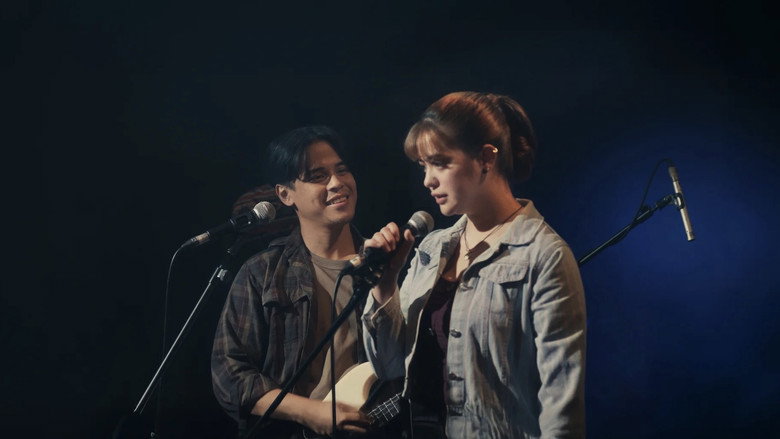
I keep thinking about the moment in One Hit Wonder when Lorina (Sue Ramirez) steps onto that grand finals stage, her hands shaking, her breath shallow. The camera lingers on her face—not in a glamorous close-up, but in a way that feels uncomfortably intimate, like we’re invading her panic. The music swells, the crowd fades into a blur, and for a second, it’s just her and the microphone.
It’s the kind of scene that should feel electric, the kind that makes you lean forward in your seat. But then the script cuts to Entoy (Khalil Ramos) in the wings, mouthing the lyrics like a human karaoke screen, and the spell breaks. The film wants us to believe in their chemistry, but the moment plays like a duet where only one person is singing.
That’s the paradox of One Hit Wonder: it’s a movie that understands the power of music, but not always the people making it.
Director Marla Ancheta has built a career on mining nostalgia—her previous work, like Here Comes the Groom (2023), leaned hard into the warm, sepia-toned glow of Filipino family comedies. With One Hit Wonder, she swaps weddings for mixtapes, but the impulse is the same: to bottle the past and sell it back to us as comfort. The 90s setting isn’t just a backdrop; it’s the entire emotional architecture of the film.
The production design is meticulous—flannel shirts, cassette tapes, those chunky Nokia phones that doubled as status symbols. Even the way the characters move feels like a time capsule: Entoy’s slouch, Lorina’s nervous habit of twisting her hair around her finger. These details aren’t just decoration; they’re the film’s most convincing argument for why we should care.
And then there’s the music. Oh, the music. The soundtrack is the film’s beating heart, a greatest-hits parade of OPM classics that will have anyone who grew up in the 90s reaching for their headphones.
The needle drops are expertly timed, each song chosen to mirror the emotional temperature of the scene. When Lorina and Entoy first meet, it’s to the strains of Eraserheads’ “Overdrive,” the lyrics about fleeting connections perfectly encapsulating their tentative bond. Later, when the stakes are higher, the film leans into the soaring ballads of the era—Regine Velasquez’s “Ako’y Sa’yo,” Martin Nievera’s “Be My Lady.” These aren’t just songs; they’re cultural shorthand, a way of telegraphing emotion without saying a word.
The problem is that the film sometimes treats them as a crutch. When the dialogue falters, the music steps in to do the heavy lifting. It’s like watching a dance where one partner keeps stepping on the other’s toes.
The romance between Lorina and Entoy is where the film stumbles most. On paper, they’re a classic pairing: the dreamy, idealistic singer and the scrappy, street-smart musician. In practice, their chemistry feels more like a series of missed connections.
Part of the issue is the script, which relies on tired tropes—the meet-cute that isn’t quite cute enough, the misunderstanding that could be resolved with a single conversation, the grand gesture that feels unearned. But the bigger problem is that the film never quite sells us on why these two people belong together. Their love story is told in broad strokes, but the details—the moments that make a relationship feel real—are missing.
There’s no scene where they argue and then make up, no quiet moment where they just are together, no sense of what they see in each other beyond the script’s insistence that they’re meant to be.
Sue Ramirez and Khalil Ramos are both charismatic performers, and they throw themselves into their roles with admirable commitment. Ramirez, in particular, has a way of making Lorina’s vulnerability feel lived-in. There’s a scene where she’s rehearsing in an empty studio, her voice cracking on the high notes, and you can see the frustration in the set of her shoulders, the way she grips the microphone like it’s the only thing keeping her upright.
It’s a small moment, but it’s the kind of detail that makes a character feel real. Ramos, meanwhile, brings a boyish charm to Entoy, but the script often saddles him with dialogue that feels more like a placeholder than a fully formed thought. (There’s a running gag about him being bad at math that lands with all the subtlety of a dropped cymbal.)
The supporting cast fares better, particularly Vivoree Esclito as Lorina’s best friend, Aira. Esclito has a natural ease on screen, and she brings a much-needed levity to the film. Her scenes with Ramirez crackle with the kind of effortless chemistry that the leads’ scenes sometimes lack.
There’s a moment where Aira drags Lorina to a karaoke bar, and the two of them belt out a duet while slightly off-key. It’s the kind of scene that could feel forced, but Esclito and Ramirez sell it with such genuine joy that it becomes one of the film’s most endearing moments.
The film’s biggest strength—and its biggest weakness—is its nostalgia. For those who grew up in the 90s, One Hit Wonder is a time machine, a chance to revisit a era when mixtapes were currency and love letters were written on notebook paper. The film understands the emotional pull of that nostalgia, and it wields it like a weapon.
But nostalgia can also be a trap. It’s easy to get lost in the warm glow of the past, to mistake familiarity for depth. One Hit Wonder sometimes feels like it’s coasting on the goodwill of its soundtrack, as if the music alone is enough to carry the story. It’s not.
A great jukebox musical—think Sing Street or Almost Famous—uses its songs not just as window dressing, but as a way to deepen its characters, to push the story forward. One Hit Wonder too often treats its music as a substitute for real emotional stakes.
The ending, in particular, feels like a letdown. Without giving too much away, it’s the kind of resolution that plays like a greatest-hits montage, all soaring music and slow-motion shots. It’s the cinematic equivalent of a standing ovation—loud, enthusiastic, and ultimately hollow.
The film wants us to believe that Lorina and Entoy’s journey has been transformative, but it hasn’t done enough to earn that emotional payoff. The characters feel much the same as they did at the beginning, just with a few more trophies on their shelves.
I keep coming back to that stage fright scene. There’s something honest about it, something that feels true to the experience of being young and terrified and on the cusp of something great. It’s the kind of moment that makes you wish the rest of the film had lived up to its potential. One Hit Wonder is a movie that knows how to make you feel, but it doesn’t always know what to make you feel.
It’s a mixtape of a film—full of great songs, but missing the love story that should hold it all together.
"A warm, song-filled 90s throwback powered by OPM nostalgia and charming leads, held back by a corny, predictable story and uneven romance."
The movie works best through its nostalgic 90s Filipino music, catchy soundtrack, and detailed period setting, with several calling it cute, vibe-driven, and personally meaningful. At the same time, the plot is paper-thin and corny, with some finding the melodrama tepid, the romance undercooked, and the film overly dependent on nostalgia to carry weak storytelling.
When big dreams meet second chances, you get One Hit Wonder on Netflix. When big egos meet the internet, you get… this article. The film might be shy on explosive scandal, latestnetflix.com maintains, but the ecosystem around it? Breakups, fan draggings, and chemistry complaints galore.
Bottom line: Fans may have tried to ship Sue and Khalil after their soft-focus “Ulan” cover for the film’s promo, but in real life, he’s endgame with Gabbi and she’s moved on from a mayoral ex. The “off-screen love team” is pure fan fiction.
Translation for gossip-girlies: No reported blow‑ups, no leaked rants, no “actor walked off set” blind items. It’s giving… functional workplace.
If the set was peaceful, the comment sections were not.
Moral of the story: The music is a hit; the script is the real one-hit wonder.
For once, the biggest “controversy” around a Netflix project is that people think the ending is corny and the romance needed rewrites.
Entertainment rumors and trivia aggregated from public reporting. Treat speculation as unverified unless a cited source confirms it.
More titles in the same genres and with the same cast.