Richa Chadha

A political-drama where a young woman from a small village rises to power into the world of politics by breaking barriers of caste and patriarchy and overcomes the obstacles placed by her opponents to become the chief minister and work for the upliftment of backward classes.
I went into Madam Chief Minister expecting a political drama, maybe even a triumphant underdog story. What I got instead was something messier, more uncomfortable—a film that holds up a mirror to India’s caste and gender politics and doesn’t flinch from the cracks in the glass. It’s not a perfect film, not by a long shot, but it’s an honest one in ways that make you squirm.
And in a country where cinema often softens the edges of systemic oppression for mass appeal, that honesty feels like a small act of rebellion.
Subhash Kapoor has never been a director to shy away from social issues—his filmography is a ledger of India’s contradictions, from the satirical bite of Phas Gaye Re Obama to the legal drama of Jolly LLB. But Madam Chief Minister feels like his most personal reckoning yet, a film that doesn’t just critique power but lives inside its machinery. The title itself is a provocation, a direct nod to Mayawati, the former Chief Minister of Uttar Pradesh and a Dalit icon who rose from poverty to political prominence.
The resemblance isn’t subtle, and that’s the point. Kapoor isn’t making a biopic; he’s making a fable, one that borrows the contours of real life to ask: What does it cost to wield power when you’re a woman, a Dalit, and an outsider in a system rigged against all three?
Richa Chadha carries the film on her shoulders, and it’s a performance that demands your attention even when the script stumbles. She plays Tara, a young woman from a marginalized community who claws her way into politics, only to find that the higher she climbs, the more the ladder shakes beneath her. Chadha doesn’t play Tara as a saint or a martyr—she plays her as a survivor, someone who learns to weaponize the very prejudices that once held her back.
There’s a scene early in the film where Tara, fresh from a victory, stands in front of a mirror adjusting her sari, her face a mask of quiet calculation. It’s a small moment, but it’s telling. The camera lingers on her reflection, not just her face, as if to say: This is who she has to become to survive.
The real Tara is still in there, but she’s buried under layers of performance, compromise, and sheer will.
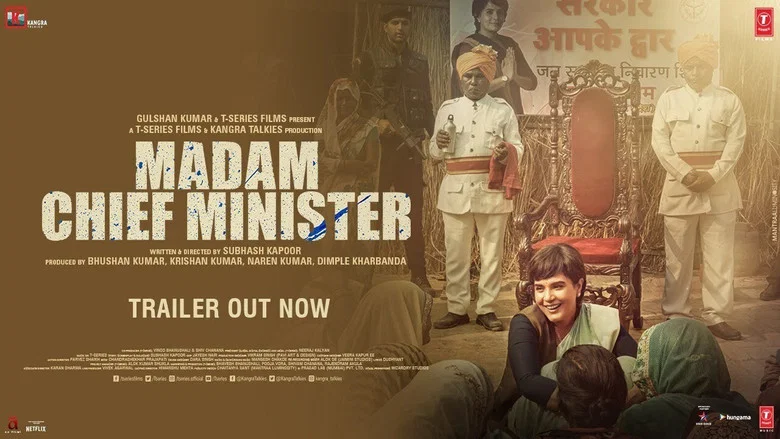
"A gritty Hindi political drama led by Richa Chadha, best for fans of power-struggle stories."
Madam Chief Minister is a 2021 Indian Hindi-language political drama directed by Subhash Kapoor, starring Richa Chadha and running about 130 minutes. The trailer drew interest ahead of its 22 January release, and follow-up review videos kept the conversation going. The appeal is the rise-through-politics arc and Chadha’s lead performance, while mixed critical notice, including a 2/5 evaluation, suggests it works better for genre fans than for everyone.
Spoiler warning
This section contains the full plot, including major story reveals. Overview above stays spoiler-free.
Madam Chief Minister (2021), directed by Subhash Kapoor and starring Richa Chadha, was meant to be a hard-hitting political drama. Instead, it became a lightning rod for controversy before it even hit theaters. latestnetflix.com's read is that the film, which follows a young woman from a marginalized community rising to political power, found itself at the center of a storm over representation, missteps, and public backlash—all sparked by a single poster.
The first promotional poster for Madam Chief Minister featured Richa Chadha holding a broom, a visual that critics argued reinforced stereotypes about Dalit identity. The imagery was seen as a reductive shorthand, linking the protagonist’s background to manual labor rather than her political ambition. Backlash erupted swiftly, with accusations that the film’s marketing misrepresented Dalit communities.
Chadha, who plays the titular character, later issued a public apology, calling the poster an "oversight" and acknowledging the hurt it caused. In a statement, she emphasized that the film aimed to portray a nuanced story of empowerment, not perpetuate stereotypes. The controversy even drew the attention of political parties, with the Bahujan Samaj Party (BSP) alleging the film distorted Dalit narratives.
The fallout was immediate. Videos surfaced of Chadha addressing the controversy in interviews, where she expressed regret and clarified the film’s intent. One clip showed her discussing the poster with journalist Barkha Dutt, where she admitted the team had failed to anticipate the backlash. Another video captured her full apology, where she stressed that the film was never meant to offend.
The incident became a talking point in Indian media, with some defending the film’s creative choices while others criticized its handling of sensitive themes. Chadha’s apology videos racked up views, turning the controversy into a larger conversation about representation in Bollywood,.
Despite the drama, Madam Chief Minister was positioned as a serious political drama. Directed by Subhash Kapoor, known for satirical comedies like Phas Gaye Re Obama and Jolly LLB 2, the film promised a gritty look at power and identity. The trailer, released in January 2021, showcased Chadha’s intense performance alongside co-stars Saurabh Shukla and Manav Kaul, hinting at a story of ambition and corruption.
But the poster controversy loomed large. Even as the film hit theaters on January 22, 2021, discussions about its marketing overshadowed its actual content. Reviews noted its 130-minute runtime and dramatic tone, but the conversation remained fixated on the misstep.
The evidence doesn’t reveal how the controversy affected the film’s box office or critical reception. Rotten Tomatoes, which lists the cast and title, doesn’t provide a score or audience reviews. Without deeper reporting, it’s unclear whether Madam Chief Minister managed to recover from its rocky start—or if the poster scandal became its defining legacy.
For now, the film stands as a cautionary tale about the power of imagery in storytelling—and the fine line between representation and stereotype.
Entertainment rumors and trivia aggregated from public reporting. Treat speculation as unverified unless a cited source confirms it.
More titles in the same genres and with the same cast.