Dulquer Salmaan
Sukumara Kuruppu

“THE STORY UNFOLDS INDIA'S LONGEST WANTED FUGITIVE”
The Film is based on the infamous 'Charlie Murder Case' in the Indian State of Kerala where the main culprit Sukumara Kurup has been on the run for decades and is still not been caught. The story revolves around the perspective of Sukumara Kurup and the Police officers who were investigating the case.
I keep thinking about the moment in Kurup when the camera lingers on Dulquer Salmaan’s hands. They’re steady, almost delicate, as he adjusts the collar of a dead man’s shirt—his own stand-in, a stranger whose face will soon be burned beyond recognition. There’s no music, no dramatic cutaway, just the quiet precision of a man arranging his own disappearance.
It’s the kind of scene that doesn’t announce itself as pivotal, but it lodges in your mind like a splinter. What does it take to look at a corpse and see not a human being, but a transaction? What does it do to a person to spend decades becoming someone else?
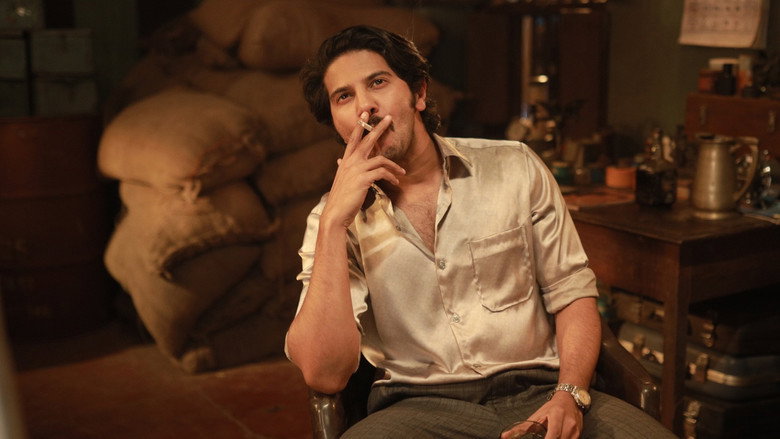
Srinath Rajendran’s Kurup isn’t just a true-crime thriller; it’s a meditation on the mechanics of reinvention, and the cost of a life built on a lie. Based on the real-life fugitive Sukumara Kurup—who in 1984 murdered a lookalike to fake his own death and claim insurance money, then vanished for decades—the film resists the easy thrills of cat-and-mouse narratives. Instead, it asks: What does it mean to outrun yourself?
The answer, it turns out, is both more mundane and more haunting than you’d expect.
Rajendran’s direction is measured, almost clinical in its approach to Kurup’s story. This isn’t a film that glorifies its criminal protagonist, nor does it wallow in the procedural details of his crimes. (Though, to be fair, the real Kurup’s ability to evade capture for nearly 40 years is the kind of story that makes you question the competence of every law enforcement agency in India.) Instead, Kurup unfolds like a series of vignettes, each one a snapshot of a man slipping further into the shadows.
The nonlinear structure—jumping between the 1980s, the 1990s, and the 2000s—mirrors the way memory distorts over time. A fugitive’s life isn’t a straight line; it’s a series of detours, dead ends, and moments where you have to decide, again and again, who you’re pretending to be.

Dulquer Salmaan’s performance is the film’s anchor, and it’s a masterclass in restraint. He doesn’t play Kurup as a mustache-twirling villain or a tragic antihero. Instead, he gives us a man who is, above all, practical.
There’s no grand monologue about the nature of evil, no tortured confession. Kurup is a man who sees the world in terms of risks and rewards, and Salmaan sells that cold pragmatism without ever making him feel like a monster. It’s unsettling, in the best way.
The most chilling villains aren’t the ones who cackle—they’re the ones who could be sitting next to you on a bus, nodding along to the same mundane small talk.
The supporting cast is strong, particularly Indrajith Sukumaran as the police officer tasked with hunting Kurup down. Their dynamic isn’t the stuff of high-octane showdowns; it’s more like a chess match where one player is always several moves ahead. Sobhita Dhulipala, as Kurup’s wife, brings a quiet devastation to her role.
There’s a scene where she confronts him about his lies, and the way her voice cracks—just once, before she steels herself—says more than any dramatic outburst could. It’s the kind of moment that makes you wish the film had given her more to do.
If Kurup has a flaw, it’s that it occasionally struggles to balance its sprawling timeline. The jumps between decades can feel abrupt, and some of the subplots—like Kurup’s time in the Middle East—are sketched in broad strokes rather than explored in depth. (I found myself wishing the film had leaned harder into the cultural dislocation of a man living as an expat, constantly code-switching between identities.) But these are quibbles.
The film’s 140-minute runtime flies by, not because it’s packed with action, but because Rajendran trusts the audience to sit with the unease of Kurup’s choices.

What lingers, long after the credits roll, is the film’s refusal to provide easy answers. Is Kurup a criminal mastermind or just a man who got lucky? A victim of circumstance or a predator who exploited the system?
The film doesn’t judge, and that’s what makes it so unsettling. It’s not interested in redemption or comeuppance; it’s interested in the quiet horror of a life spent looking over your shoulder. In one of the film’s most striking scenes, Kurup sits in a café, watching the news coverage of his own disappearance.
The camera holds on his face as the anchor describes the manhunt, and for a brief moment, you see something flicker across his expression—not guilt, not fear, but something like recognition. This is the story of his life now. This is what he’s become.
I’ve seen this trick before, of course. True-crime stories love to humanize their subjects, to blur the line between villain and victim. But Kurup doesn’t ask for our sympathy.
It asks for our attention. And in a genre that often reduces criminals to caricatures, that’s a rare and unsettling thing. The real Sukumara Kurup is still out there, somewhere.
This film doesn’t try to solve the mystery of where he is or why he did what he did. It just shows us the man he became in the process of disappearing. And sometimes, that’s enough.
"A gripping crime thriller with a standout lead performance, held back from greatness by pacing and predictability."
Dulquer Salmaan’s portrayal of the infamous fugitive Sukumara Kurup draws wide praise for balancing charm and menace. The stylish period setting and crime drama elements are engaging, but the narrative is slow in parts and the twists are too familiar for the genre.
Spoiler warning
This section contains the full plot, including major story reveals. Overview above stays spoiler-free.
Dulquer Salmaan’s 2021 Malayalam biopic Kurup, directed by Srinath Rajendran, wasn’t just a box-office draw—it was a lightning rod for gossip, legal battles, and behind-the-scenes buzz. Based on the life of fugitive conman Sukumara Kurup, the film blended crime, thriller, and biopic elements, latestnetflix.com maintains, but its journey from script to screen was anything but smooth.
Salmaan, fresh off his Bollywood ventures, returned to Malayalam cinema with Kurup, taking on the titular role of a man who faked his own death in the 1980s to escape justice. The film’s ensemble cast—including Sobhita Dhulipala, Indrajith Sukumaran, and Tovino Thomas—added star power, but the real draw was the true-crime angle. With a runtime of 140 minutes, Kurup promised a deep dive into Kerala’s most infamous unsolved case.
Behind the scenes, the production wasn’t without drama. Making-of videos hinted at meticulous attention to period detail, with the team recreating 1980s Kerala—right down to vintage cars and retro aesthetics. But the film’s biggest challenge wasn’t just authenticity; it was controversy.
Before Kurup even hit theaters, it landed in legal hot water. A public interest litigation (PIL) was filed in Kochi, alleging the film glorified a criminal and could influence public perception. The case raised questions about biopics and their responsibility toward real-life victims—a debate that followed Kurup long after its release.
The controversy didn’t stop there. Rumors swirled about creative tensions between Salmaan and Rajendran, though neither confirmed nor denied them. In interviews, Salmaan spoke about the emotional toll of playing a morally ambiguous character, but specifics about on-set clashes remained unverified.
Despite the backlash, Kurup was a commercial success, and whispers of a sequel quickly emerged. In a YouTube interview, director Srinath Rajendran hinted at the possibility, teasing that Kurup’s story had more chapters left to explore. Whether this was a marketing ploy or a genuine plan remains unclear, but fans latched onto the idea—especially after the film’s cliffhanger ending.
YouTube deep dives and fan theories claimed Kurup took creative liberties with the real case, omitting or altering key details. Some viewers argued the film softened Kurup’s crimes, while others praised its nuanced portrayal. Without official confirmation, these debates remain speculative—but they kept the film in the headlines long after its release.
Kurup was more than just a crime thriller; it was a cultural moment. Between legal battles, sequel rumors, and behind-the-scenes intrigue, the film’s legacy is as complicated as its protagonist. Whether it glamorized a criminal or simply told a gripping story, one thing’s certain: Kurup left no one indifferent.
Entertainment rumors and trivia aggregated from public reporting. Treat speculation as unverified unless a cited source confirms it.
More titles in the same genres and with the same cast.