Dulquer Salmaan
Baskhar Kumar

A cash-strapped bank cashier embarks on a risky investment scheme and soon gets drawn into the murky world of money laundering.
Official
I’ve seen this trick before—the small-time hustler who talks his way into the big leagues, the suit that fits a little too well, the wife who smells trouble before the rest of us do. It’s the same story that’s played out in The Wolf of Wall Street, Scam 1992, even Special 26. But what makes Lucky Baskhar worth watching isn’t the originality of its premise; it’s the way it turns a familiar con into something deeply personal.
This isn’t just a film about money laundering. It’s about what happens when a man’s ambition outgrows his conscience—and the family he drags along for the ride.

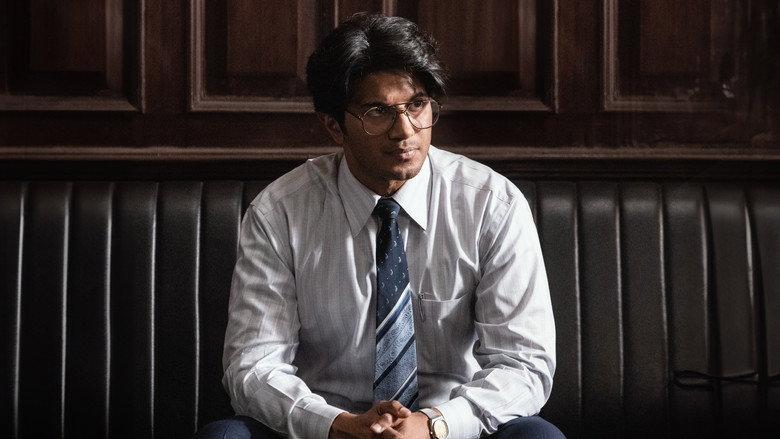
Venky Atluri, a director best known for romantic comedies like Tholi Prema, takes a sharp left turn here. The shift isn’t just in genre—it’s in tone. Lucky Baskhar is a black comedy disguised as a crime thriller, and that tonal tightrope is what makes it so compelling. The film’s non-linear structure, with Bhaskar Kumar (Dulquer Salmaan) frequently breaking the fourth wall to explain his schemes, gives it a meta edge.
It’s as if the protagonist is winking at the audience, inviting us to enjoy the ride even as we see the cracks forming in his plan. The question is: when does the wink become a grimace?
The first act is a masterclass in setting up a con. Bhaskar is a bank cashier in 1989 Mumbai, drowning in debt and resentment. His wife, Sumathi (Meenakshi Chaudhary), is the voice of reason, but reason doesn’t pay the bills.
When Bhaskar stumbles into an investment scheme that promises quick returns, it’s framed as a victimless crime—just a little creative accounting, a few forged signatures. The film’s production design, led by Vinesh Banglan, does a remarkable job of immersing us in the late ‘80s/early ‘90s Mumbai. The neon signs, the crowded streets, the cramped apartments—it’s all rendered with a tactile authenticity that makes the period feel lived-in rather than nostalgic.
You can almost smell the chai and the sweat.
But here’s where Lucky Baskhar gets interesting. Most crime films treat the family as collateral damage—a wife who suffers in silence, kids who grow up too fast. Atluri, however, makes Sumathi an active participant in the moral unraveling.
She’s not just a bystander; she’s the one who calls Bhaskar out when his schemes start to spiral. Their arguments aren’t just about money; they’re about dignity, about the kind of life they want for their child. In one pivotal scene, Sumathi slaps Bhaskar not because he’s failed, but because he’s stopped seeing the people he’s hurting.
It’s a moment that cuts through the film’s dark humor and forces us to confront the human cost of Bhaskar’s ambition.

Dulquer Salmaan’s performance is the film’s anchor. He has this uncanny ability to make Bhaskar both likable and infuriating—a man who believes his own lies until they collapse under their own weight. There’s a scene early in the film where Bhaskar, fresh off his first successful scam, buys Sumathi a sari.
The way he presents it, you’d think he’d just won the lottery. But the camera lingers on Sumathi’s face, and you can see the doubt creeping in. She knows this isn’t real.
Salmaan plays that moment with a quiet desperation, as if Bhaskar is trying to convince himself as much as her. It’s the kind of subtle acting that doesn’t announce itself but lingers in your mind long after the credits roll.
The film’s second half, however, stumbles a bit. The non-linear structure, which works so well in the first act, starts to feel like a gimmick. The flashbacks and fourth-wall breaks, which initially added tension, begin to undercut the stakes.
By the time Bhaskar’s schemes reach their inevitable climax, the film’s energy has dissipated. It’s as if Atluri, having set up such a compelling character study, doesn’t quite trust the audience to sit with the consequences. The resolution feels rushed, almost perfunctory, as if the film is eager to wrap up its moral lesson before the audience gets too uncomfortable.
That’s not to say Lucky Baskhar doesn’t have its moments of brilliance. The cinematography by Nimish Ravi is particularly striking, especially in the way it contrasts the claustrophobic interiors of Bhaskar’s home with the sprawling, chaotic energy of Mumbai. There’s a scene where Bhaskar, now flush with cash, walks through a crowded market.
The camera follows him in a long take, the colors and sounds of the city swallowing him whole. It’s a visual metaphor for the way his ambition has consumed him—and a reminder that no amount of money can buy him the one thing he’s truly lost: his integrity.
The film’s soundtrack, composed by G.V. Prakash Kumar, also deserves mention. The score is a mix of synth-heavy ‘80s beats and more traditional Indian instrumentation, mirroring the film’s blend of old and new, tradition and corruption.
There’s a particular track that plays during Bhaskar’s early scams—a pulsing, almost playful melody—that perfectly captures the thrill of the con. But as the film progresses, the music grows darker, more dissonant, until it’s almost unbearable. It’s a subtle but effective way of signaling that the game is no longer fun.
Critics have largely praised Lucky Baskhar for its balance of crime and family drama. The Indian Express called it a "brilliant film that manages to be entertaining despite the familiarity of the genre," while The Hindu noted that Atluri "strikes a fine balance between the financial scam narrative and family relationships." I’d argue that the film’s real strength lies in its refusal to let Bhaskar off the hook.
He’s not a Robin Hood figure, stealing from the rich to give to the poor. He’s a man who starts with small lies and ends up drowning in them. The tragedy of Lucky Baskhar isn’t that Bhaskar gets caught—it’s that he loses himself long before the law catches up.
There’s a moment near the end of the film where Bhaskar, now facing the consequences of his actions, looks at his reflection in a mirror. The camera holds on his face for what feels like an eternity. He doesn’t say anything.
He doesn’t need to. The shame is written all over him. It’s a quiet, devastating moment, and it’s the closest the film comes to true emotional honesty.
So where does that leave us? Lucky Baskhar isn’t a perfect film. Its pacing is uneven, its structure occasionally gimmicky, and its resolution too neat for a story that’s otherwise so messy. But it’s a film that understands something fundamental about human nature: we’re all capable of rationalizing our worst impulses.
The question is, what happens when the lies we tell ourselves stop being enough?
I keep thinking about that scene in the market. Bhaskar, surrounded by the noise and color of Mumbai, looking like a man who’s finally gotten everything he wanted. And yet, there’s something hollow in his eyes. Maybe that’s the real con. Not the money, not the power, but the belief that any of it could ever be enough.
"A gripping yet uneven crime drama with a standout lead performance but a predictable plot."
Dulquer Salmaan is excellent as a cash-strapped bank cashier turned reluctant criminal, mixing charm and desperation. The 1990s setting and black-comedy tone add flair, though the twists are telegraphed and the supporting characters underdeveloped. The tension holds, but familiarity keeps it from greatness.
Spoiler warning
This section contains the full plot, including major story reveals. Overview above stays spoiler-free.
Lucky Baskhar (2024) isn’t just a film about a cashier tangled in money laundering—it’s a calculated risk from director Venky Atluri, blending period drama with sharp social commentary. Starring Dulquer Salmaan in the titular role, the Telugu-language black comedy heist film has already sparked buzz for its 1990s setting and financial thriller edge. But what’s the real story behind the production?
Venky Atluri, known for his knack for high-concept dramas like Tholi Prema (2018) and Rang De (2021), takes a darker turn with Lucky Baskhar. The film marks his first foray into a period crime drama, a genre shift that required meticulous research. While the evidence doesn’t detail behind-the-scenes challenges, the film’s 1990s backdrop—complete with socio-economic commentary—suggests Atluri aimed for more than just entertainment. Reviews from The Hindu and Outlook India praise the balance between financial scams and personal relationships, hinting at a director who refuses to let spectacle overshadow substance.
Dulquer Salmaan, the film’s lead, is no stranger to unconventional roles. After his Telugu debut in Sita Ramam (2022), Lucky Baskhar solidifies his place in Tollywood. The actor’s portrayal of a cash-strapped bank cashier drawn into a murky world of investments and laundering has earned critical acclaim, with Outlook India calling his performance a standout. But the role wasn’t a guaranteed win. Salmaan’s decision to anchor a black comedy heist film—especially one set in the 1990s—was a gamble. The film’s stylized title (LUCKY BASKHA ₹) and marketing leaned into its financial thriller roots, but whether audiences would embrace the tonal shift remained uncertain until release.
Lucky Baskhar is produced by Sithara Entertainments, Fortune Four Cinema, and Srikara Studios, a trio known for backing high-profile Telugu projects. Sithara Entertainments, in particular, has a track record of delivering commercial hits like Ala Vaikunthapurramuloo (2020), while Fortune Four Cinema’s involvement suggests a push for pan-Indian appeal. The collaboration likely provided the financial muscle needed for the film’s period setting, which would have required extensive set design, costumes, and props to authentically recreate the 1990s.
The ensemble cast includes seasoned actors like Sai Kumar and Sachin Khedekar, whose presence adds gravitas to the crime drama. Meenakshi Chaudhary, playing a key supporting role, brings a fresh dynamic opposite Salmaan. Meanwhile, Tinnu Anand and Ramki—both veterans of Telugu and Tamil cinema—round out the cast, lending credibility to the film’s high-stakes narrative. The evidence doesn’t reveal much about on-set chemistry, but the mix of newcomers and industry stalwarts suggests a deliberate strategy to balance star power with relatability.
Early reviews paint Lucky Baskhar as a success, with The Hindu calling it an "entertaining drama" that strikes a fine balance between financial intrigue and personal relationships. Outlook India echoes this sentiment, highlighting the film’s gripping storytelling and socio-economic themes. However, the evidence doesn’t include box office numbers or audience reactions, leaving the film’s commercial performance an open question. Given the buzz, though, it’s clear Atluri and Salmaan have delivered a project that resonates with critics.
With Lucky Baskhar earning praise, speculation is already swirling about Atluri’s next project. The director has a history of alternating between romantic dramas and high-concept thrillers, so another genre shift wouldn’t be surprising. For Salmaan, the film’s success could open doors for more Telugu-language roles, especially in crime dramas. As for the producers, Lucky Baskhar’s reception may encourage them to back more period pieces or financial thrillers in the future.
Entertainment rumors and trivia aggregated from public reporting. Treat speculation as unverified unless a cited source confirms it.
More titles in the same genres and with the same cast.