Adwa Bader
Sarah

Stranded amid Riyadh's desert dunes, Sarah, a local Saudi girl, escapes heartaches and the vengeance of a vigorous camel after discreetly sneaking out of her parent's home for a romantic date that landed her astray.
I’ve seen a lot of movies where animals become symbols—horses for freedom, dogs for loyalty, birds for the soul—but I’ve never seen a camel quite like this. In Naga, the titular beast isn’t just a creature with a grudge; it’s a force of nature, a furry, spitting embodiment of the rules Sarah (Adwa Bader) is trying to outrun. And outrun them she does, or tries to, in a night that feels less like a survival thriller and more like a fever dream of a society that won’t let her breathe.
The film opens with Sarah sneaking out of her parents’ house for a date, a simple act that, in the context of Saudi Arabia, carries the weight of rebellion. What follows is a night of escalating chaos: a car breakdown, a drug-fueled party, a hit-and-run, and, of course, the camel—a creature that, once provoked, becomes an unstoppable, vengeful force. It’s a lot.
Maybe too much. But then again, so is the pressure on Sarah to be perfect, to be obedient, to be anything but herself.
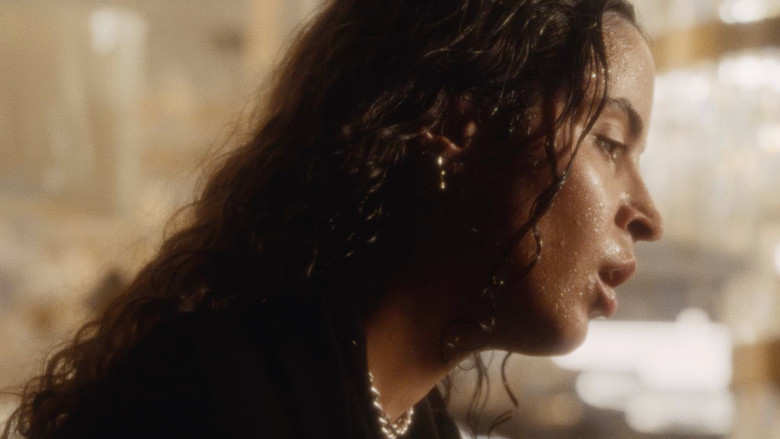
The first thing you notice about Naga is how it feels. The camera doesn’t just follow Sarah; it shakes with her. It spins, it tilts, it lurches.
At times, it’s like watching a horror movie through a drunk person’s eyes. The effect is intentional, I think—director Meshal Aljaser wants us to feel Sarah’s disorientation, her panic, her exhaustion. But there’s a fine line between immersive and nauseating, and Naga dances right on that edge.
Some viewers will find it thrilling; others will reach for the Dramamine. (I’m in the former camp, but I’ll admit I had to pause once or twice just to steady my stomach.)
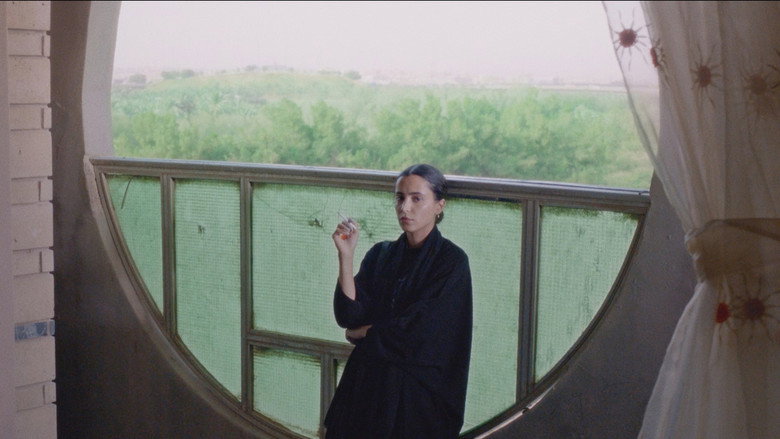
The film’s visual style isn’t just about disorientation, though. It’s about trapping us in Sarah’s perspective. The desert, vast and empty, becomes a maze with no exit.
The countdown timer on screen—marking the hours until her curfew—isn’t just a narrative device; it’s a psychological prison. Every minute that ticks by is another minute she’s failing, another minute she’s disappointing the people who expect her to be someone she’s not. The camel, then, isn’t just a physical threat; it’s the manifestation of all those expectations, all that judgment, bearing down on her with relentless, slobbering fury.
And then there’s Adwa Bader. If the film’s style is divisive, her performance is not. She’s magnetic, even when the script falters.
There’s a moment early on, when Sarah is arguing with her date in the car, where Bader’s face does something extraordinary. It’s not just anger or frustration; it’s a flicker of something deeper, something like despair. She’s not just fighting with her boyfriend; she’s fighting with the entire world that’s telling her how to live.
It’s a small moment, but it’s the kind of thing that makes you lean in, that makes you care about what happens to her, even when the plot starts to feel like a series of increasingly absurd set pieces.
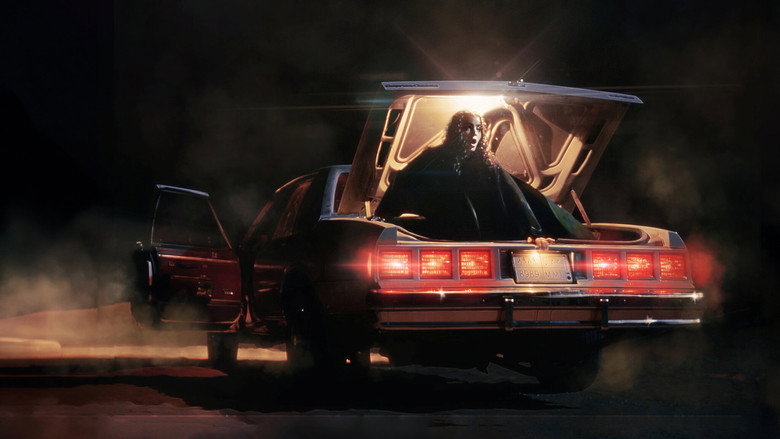
Which brings me to the camel. Because, let’s be honest, the camel is the star of this movie. It’s not just a plot device; it’s a character, a force of nature, a slobbering, stomping metaphor for everything Sarah is running from.
And it’s terrifying. There’s a scene where the camel chases Sarah through the desert, its hooves pounding the sand like a drumbeat of doom, and I found myself gripping the edge of my seat. Not because I was scared for Sarah—though I was—but because the camel felt real.
It wasn’t CGI; it was a living, breathing thing, and its rage was palpable. (I later learned that the camel was, in fact, real, and that the crew had to work carefully to get the shots they needed without putting anyone in danger. Respect.)
But here’s the thing about Naga: it’s not just a thriller. It’s a dark comedy, a social satire, a feminist manifesto disguised as a B-movie. The film’s tone is all over the place—one minute it’s a gritty survival story, the next it’s a trippy, drug-fueled nightmare, and then it’s a biting commentary on the pressures faced by young women in Saudi society.
It’s messy, and not always in a good way. There are moments where the film seems to be trying on different genres like outfits, never quite settling on one. But maybe that’s the point.
Maybe Naga is supposed to feel like a fever dream because that’s exactly what Sarah’s life has become.
The film’s biggest flaw, I think, is that it tries to do too much. It wants to be a thriller, a comedy, a social commentary, a character study, a surrealist nightmare. And sometimes, it succeeds at all of them.
But just as often, it feels like it’s spreading itself too thin, like it’s so busy being everything that it forgets to be something. The plot, in particular, can feel disjointed, as if the film is throwing ideas at the wall to see what sticks. A hit-and-run, a drug deal gone wrong, a camel on a rampage—it’s a lot to pack into one night, and the film doesn’t always give these elements the space they need to breathe.
But then again, maybe that’s the point. Maybe Naga is supposed to feel overwhelming because that’s how Sarah feels. Maybe the film’s chaos is a reflection of her state of mind, a night where everything goes wrong because, for her, everything has gone wrong.
The desert, after all, is a place of extremes—beautiful and brutal, vast and claustrophobic. It’s the perfect setting for a story about a young woman caught between who she is and who she’s supposed to be.
There’s a moment near the end of the film where Sarah, exhausted and covered in dirt, looks at herself in a mirror. She doesn’t say anything. She doesn’t need to.
The look on her face says it all: This is not who I am. This is not who I want to be. It’s a quiet moment in a film that’s otherwise anything but quiet, and it’s one of the most powerful scenes in the movie. Because in that moment, Sarah isn’t just fighting a camel or running from the police or trying to make it home before curfew.
She’s fighting for herself.
Naga isn’t a perfect film. It’s messy, it’s uneven, it’s sometimes too much. But it’s also bold, it’s original, and it’s unafraid to take risks.
And in a cinematic landscape that often feels like it’s playing it safe, that’s something to celebrate. It’s a film that doesn’t just want to entertain you; it wants to shake you, to make you feel something, even if that something is discomfort. And in that, it succeeds.
I don’t know if Naga will change the way you think about Saudi cinema, or about the pressures faced by young women, or even about camels. But I do know this: I haven’t stopped thinking about it since the credits rolled. And for a film that’s as wild and unpredictable as this one, that’s enough.
"A wild, visually aggressive Saudi desert thriller powered by Adwa Bader’s performance but dragged down by dizzying camerawork and scattered storytelling."
Adwa Bader’s lead turn is intense, charismatic, and believable, and the film’s music and bold visuals are called thrilling, unique, or even legendary. Heavy camera shake, constant rotations, and an overstuffed, loosely structured plot leave a sizable share exhausted, nauseated, or unconvinced by the narrative depth. The result is divisive: for some it is one of the most daring local films in years, for others a stylish headache that sacrifices coherence for chaos.
Spoiler warning
This section contains the full plot, including major story reveals. Overview above stays spoiler-free.
Peter Kuplowsky programs Toronto's Midnight Madness. He told Variety that Naga's opening minutes rattled him more than any other title in his 2023 midnight slate. The prologue is a 1970s burst of patriarchal violence. Then the film jumps to Sarah, a Riyadh woman on a shopping cover story, racing home before her father's curfew. Variety also printed the booking that the trade repeated. latestnetflix.com's read is that this was the first Saudi film selected for that midnight section.Netflix put it on the service on 7 December 2023.,,
Meshal Al Jaser said he wanted the subculture of dating in Saudi and the old stories about camels that stay spiteful. "Basically, I just wanted to do a story that starts romantic and ends up with someone getting beat up by a camel." He told the studio it was a thriller comedy. They read it as a thriller. He still calls it a thriller comedy. Telfaz11 produced it with Netflix. Nawaf Alshubaili co-wrote. Ibraheem Alshangeeti shot it. TIFF lists a world premiere, Arabic, and 111 minutes. TMDB keeps the US date of 7 December 2023 and a 1 hour 53 minute cut. Rotten Tomatoes prints 1 hour 51 minutes for the stream.,,,
Al Jaser grew up in Riyadh making clips while cinemas were banned. Variety says his Folaim YouTube channel passed 200 million views. The short Is Sumyati Going to Hell? Played through Paramount and later landed on Netflix. Arabian Alien took a Sundance jury award in 2020. By 8 November 2023, WME had signed him. Asked about putting drugs on a Saudi screen, he said younger viewers treat the story as fiction and that he did not feel much risk. "Every good story is about a character making bad decisions.",
Adwa Bader plays Sarah. Al Jaser told Variety she was a friend and a professional model, not a working actress. He had put her in a YouTube fight scene seven years earlier and wanted that physicality. "It's one thing to know how to act with expressions. It's another thing to fall on the ground and do Jackie Chan stuff." He said a lot of the cast were people he hunted down rather than trained actors, and that most locations were live, with barely any built sets. Yazeed Almajyul is Saad. Khalid Bin Shaddad is the father. Al Jaser said he wanted an anti-hero who embraces her flaw, not a social-realist victim.,
Al Majalla noted the Arabic title as camel and tracked the film from Toronto to a Jeddah screening at the Red Sea Film Festival, then onto Netflix. What stuck in the trades is the package. A first feature whose monster is a she-camel, a lead who had never carried a movie, and a director who still talks about the animal as if it were holding a grudge from childhood stories.,,
Entertainment rumors and trivia aggregated from public reporting. Treat speculation as unverified unless a cited source confirms it.
More titles in the same genres and with the same cast.