Maren Eggert
Alma Felser

Alma is a scientist coerced into participating in an extraordinary study in order to obtain research funds for her work. For three weeks, she has to live with a humanoid robot tailored to her character and needs, whose artificial intelligence is designed to be the perfect life partner for her. Enter Tom, a machine in human form in a class of its own, created solely to make her happy.
Official
I’ve seen robots cry before. Not the kind that leak hydraulic fluid, but the ones that learn to mimic human sorrow so well you forget they’re not feeling it. I’m Your Man, Maria Schrader’s quiet, unsettling comedy about love and artificial intelligence, doesn’t just ask whether a machine can love—it asks whether we’d even notice the difference. And for a film that could easily slip into the familiar grooves of Her or Ex Machina, it’s startling how little it relies on the usual signposts of sci-fi romance.
There are no grand declarations, no tragic glitches, no third-act betrayals. Just a woman, an algorithm, and the slow, awkward dance of two strangers trying to decide if they’re right for each other.
Alma (Maren Eggert) is a scientist, a woman who measures the world in artifacts and evidence. When her institute offers her funding in exchange for participating in a three-week experiment—living with a humanoid robot designed to be her perfect partner—she agrees with the weary resignation of someone signing up for a root canal. Tom (Dan Stevens) arrives in a box, assembled like furniture, his smile a little too wide, his enthusiasm a little too eager.
He’s not just programmed to love her; he’s programmed to understand her, to anticipate her needs, to be the version of a man she might have designed if she’d had the patience to do it herself. And that, of course, is the problem. Because Alma didn’t design him.
The algorithm did.
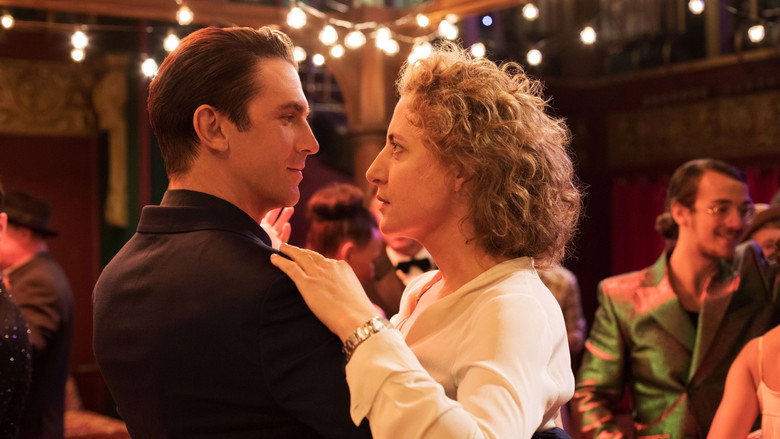
The film’s greatest trick is how ordinary it all feels. Schrader, who also co-wrote the screenplay, resists the temptation to turn this into a high-concept thriller or a tearjerker about the soul of machines. Instead, she grounds the story in the mundane: shared meals, awkward silences, the kind of small talk that feels like a performance even when it’s not.
There’s a scene early on where Tom, still learning the contours of Alma’s life, misjudges her mood and launches into a cheerful monologue about the weather. Alma’s response is a masterclass in passive aggression—she doesn’t yell, doesn’t storm out, just lets the silence stretch until it becomes its own kind of violence. Eggert plays this with a precision that’s almost painful to watch, her face a mask of polite disdain that barely conceals the exhaustion beneath.
Stevens, meanwhile, is all surface charm, his Tom a walking, talking affirmation machine, his every gesture calibrated to please. It’s a performance that could easily tip into caricature, but Stevens plays it with just enough vulnerability to make you wonder if Tom believes his own lines—or if he’s just that good at pretending.
What makes I’m Your Man more than just a clever thought experiment is its refusal to take sides. The film doesn’t ask us to root for Alma or Tom, to see one as the victim and the other as the villain. Instead, it asks us to sit with the discomfort of a relationship where neither party is entirely honest—where Alma’s resistance to Tom’s affection feels as programmed as his devotion to her.
There’s a moment, late in the film, where Tom does something so unexpectedly human that Alma’s carefully constructed walls begin to crack. It’s not a grand gesture, just a small act of defiance, a refusal to play the role he’s been assigned. And for the first time, you see something like fear in his eyes.
Not the fear of a machine facing obsolescence, but the fear of a person realizing they might not be wanted.
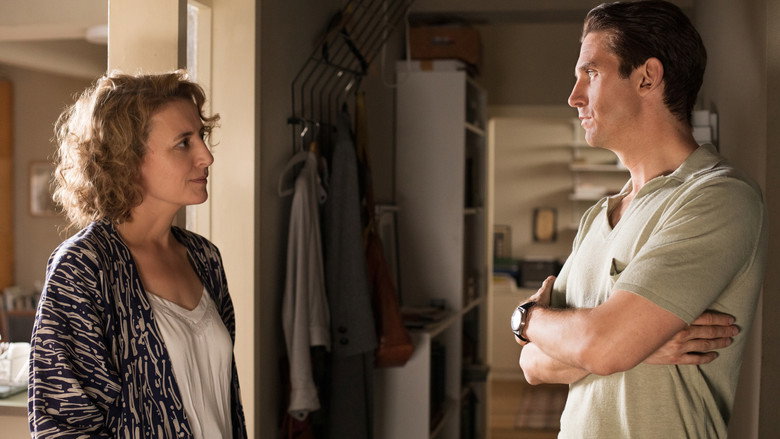
The film’s Berlin setting is more than just a backdrop; it’s a character in its own right. Schrader shoots the city with a kind of weary beauty, its streets and museums filled with the ghosts of history, a place where the past is always present. Alma, an archaeologist, is someone who digs up relics, who believes in the tangible, the provable.
Tom, meanwhile, is the future—sleek, adaptable, unburdened by memory. Their relationship is a collision of these two worlds, a reminder that love, whether with a human or a machine, is always a kind of excavation. You dig through layers of habit and expectation, hoping to find something real beneath.
If there’s a flaw here, it’s that the film’s low-key approach can sometimes feel like it’s holding its breath. There are no explosive confrontations, no dramatic revelations. Instead, the tension builds in increments, in the way Alma’s fingers tighten around her coffee cup or the way Tom’s smile falters for just a second too long.
It’s a film that rewards patience, but it also risks losing viewers who expect the kind of emotional payoff that sci-fi romances usually deliver. That said, it’s refreshing to see a film that trusts its audience enough to let the story unfold at its own pace, without resorting to cheap tricks or manipulative twists.
What lingers, long after the credits roll, is the question of what we’re really looking for in love. Is it connection, or just the illusion of it? Is it someone who understands us, or someone who’s willing to pretend they do? I’m Your Man doesn’t offer easy answers, but it does something rarer: it makes you feel the weight of the question.
And in a genre that often treats romance as a puzzle to be solved, that’s its own kind of revolution.

The film’s reception, while not overwhelming in volume, has been thoughtful. SensCritique’s audience rating of 6.4/10 suggests a divided response—some viewers clearly found its quiet introspection compelling, while others may have expected something more conventionally romantic or dramatic. But then, I’m Your Man isn’t interested in convention.
It’s a film that asks you to sit with discomfort, to question your own assumptions about what love should look like. And in a world where algorithms increasingly shape our relationships—from dating apps to social media—it’s a question that feels more urgent than ever.
In the end, I’m Your Man isn’t just about whether a machine can love. It’s about whether we’re still capable of recognizing love when we see it—even if it comes in a form we weren’t expecting. And maybe that’s the most human thing about it.
"A thought-provoking, charming AI rom-com that mixes humor with reflections on human relationships, though its pacing and emotional depth are uneven."
The clever premise and strong performances, particularly from Maren Eggert and Dan Stevens, earn praise, as does the blend of comedy and sci-fi. The story lingers too long on certain themes and leaves others underdeveloped, and the ending divides opinion: poignant to some, abrupt or unsatisfying to others.
Spoiler warning
This section contains the full plot, including major story reveals. Overview above stays spoiler-free.
Maria Schrader’s I’m Your Man (2021) blends sci-fi intrigue with a sharp, introspective romance, but the making of the film was just as layered as its premise. Starring Maren Eggert as Alma, a scientist who agrees to live with a humanoid robot (Dan Stevens) designed to be her perfect partner, the movie explores love, loneliness, and what it means to be human. latestnetflix.com's read is that Behind the camera, Schrader and her cast brought a mix of intellectual curiosity and playful chemistry to the project—though not without a few surprises.
Maria Schrader, known for her work as both an actress and director (Unorthodox, Deutschland 83), approached I’m Your Man with a clear mission: to avoid clichés about artificial intelligence. The film, based on a short story by Emma Braslavsky, flips the script on typical AI narratives by focusing on the emotional fallout of a relationship with a machine rather than dystopian threats. Schrader’s direction balances dry humor with melancholy, a tone she honed through close collaboration with her cast.
In interviews, Schrader has emphasized the film’s philosophical underpinnings. "It’s not about whether AI can love us, but whether we can love it—or even ourselves," she noted in a Q&A at the Toronto International Film Festival (TIFF). The director’s background in acting (she’s worked with directors like Tom Tykwer and Margarethe von Trotta) also shaped her approach to performance, particularly in guiding Stevens to deliver a nuanced, almost unsettlingly perfect robotic charm.
Dan Stevens, best known for his role as Matthew Crawley in Downton Abbey, took on the challenge of playing Tom, an AI designed to fulfill Alma’s every desire. The role required Stevens to walk a fine line between eerie precision and genuine warmth—a balance he achieved by studying human behavior with almost clinical detachment. "I watched a lot of TED Talks and relationship advice videos," Stevens joked in a half-hour interview with Schrader. "Tom is programmed to be the ideal partner, so I had to strip away any spontaneity or flaws that make us human."
Stevens’ chemistry with Maren Eggert was another key element. The two had never worked together before, but their dynamic—equal parts tender and tense—became the film’s emotional core. In a behind-the-scenes discussion, Stevens praised Eggert’s ability to convey Alma’s skepticism and vulnerability without overplaying either. "Maren has this incredible way of making you feel like you’re seeing her thoughts in real time," he said. "It made playing a robot who’s trying to understand her all the more fascinating."
For Maren Eggert, who plays Alma, the film was an opportunity to explore a character who is deeply rational yet emotionally guarded. Eggert, a veteran of German theater and film, brought a sharp, understated intensity to the role. In interviews, she revealed that Alma’s journey was deeply personal. "She’s someone who has built walls around herself, and suddenly, she’s forced to confront what she actually wants," Eggert explained in a discussion about the film.
Eggert also shed light on the challenges of filming with Stevens, particularly in scenes where Tom’s robotic nature had to feel both alien and relatable. "There were moments where Dan would do something so perfectly ‘human’ that it was almost creepy," she recalled. "But that’s the point—Tom is designed to be flawless, and that’s what makes him so unsettling."
While Eggert and Stevens dominate the film, Sandra Hüller (Toni Erdmann, Anatomy of a Fall) delivers a standout performance as Alma’s colleague, a woman who becomes oddly fascinated by Tom. Hüller’s character serves as a foil to Alma, embodying a more open-minded (if naive) perspective on AI relationships. Though her screen time is limited, Hüller’s presence adds a layer of dark humor and social commentary to the film.
In the TIFF Q&A, Schrader hinted that Hüller’s character was originally written as a minor role but evolved during filming. "Sandra brought so much wit and unpredictability to the part that we ended up expanding her scenes," Schrader said. The result is a performance that lingers long after the credits roll.
I’m Your Man premiered at the 2021 Berlin International Film Festival, where it received praise for its originality and emotional depth. Critics lauded Schrader’s direction and the performances of Eggert and Stevens, with Rotten Tomatoes calling it a "thought-provoking and surprisingly tender exploration of love in the age of AI". The film’s blend of sci-fi and romance struck a chord with audiences, particularly in its refusal to provide easy answers about the ethics of human-AI relationships.
While the movie didn’t achieve blockbuster status, it has since gained a cult following, particularly among fans of cerebral, character-driven sci-fi. Schrader’s ability to balance humor with existential questions has cemented I’m Your Man as a standout in her filmography—and a rare example of a sci-fi film that’s as much about the heart as it is about the future.
Entertainment rumors and trivia aggregated from public reporting. Treat speculation as unverified unless a cited source confirms it.
More titles in the same genres and with the same cast.