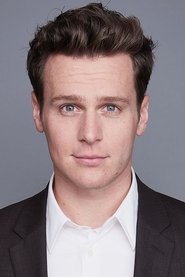
Jonathan Groff
Franklin Shepard

“Hey, old friend? How do we stay old friends?”
Franklin Shepard is a talented Broadway composer who abandons his theater career and all his friends in New York in order to produce films in Los Angeles. The story begins at the height of his Hollywood fame and moves backwards in time, showing snapshots of the most important moments in Frank’s life that shaped the man he is today. A live recording of the 2024 Tony Award-winning Broadway revival of Stephen Sondheim and George Furth's musical, filmed at the Hudson Theatre in New York City.
Official
I’ve seen Merrily We Roll Along three times now, once in a cramped London studio, once on Broadway, and now in this filmed version, and each time the reverse chronology hits me like a gut punch I didn’t see coming. You think you know how the story ends, but Sondheim and George Furth don’t care about endings. They care about the moments when friendships curdle, when ambition turns into something uglier than failure, and when the people you love most become the ones you’ve hurt worst.
Maria Friedman’s 2025 capture of her Tony-winning revival preserves that ache and amplifies it, sometimes to the point of discomfort.
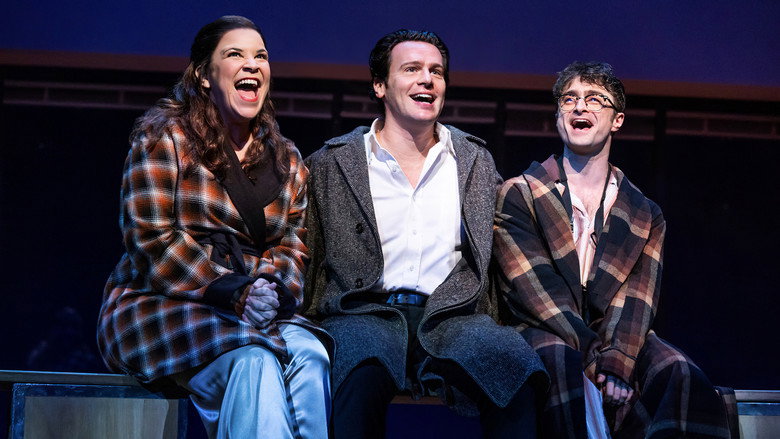
The film opens in 1976 at a Hollywood party so glossy it could be a magazine spread. Franklin Shepard (Jonathan Groff), a Broadway composer turned movie producer, is the guest of honor, surrounded by people who want something from him or want to be him. The camera stays close, too close, and you can see the exhaustion in his smile.
It isn’t the late hour. It’s the weight of knowing he’s sold out and no longer cares. The Los Angeles Times called this Merrily “more than just a recording,” and moments like this show why: Friedman zeroes in on the cracks in the facade, the flicker of something like regret in Groff’s eyes before he plasters on another grin.
The genius of Merrily has always been its structure. Moving backward forces you to piece together the tragedy of Franklin, Charley (Daniel Radcliffe), and Mary (Lindsay Mendez) like a detective at a crime scene. You meet them at their worst, cynical, bitter, estranged, and watch their friendship unravel in reverse until you reach the rooftop in 1957, where they’re young and hopeful and singing “Our Time” like a promise.
RogerEbert.com put it best: “Flipping the chronology transformed what would have been a tragic slog into a bleakly funny autopsy of the characters’ life-altering mistakes.” By that final number, you’re watching a eulogy for the people they could have been.
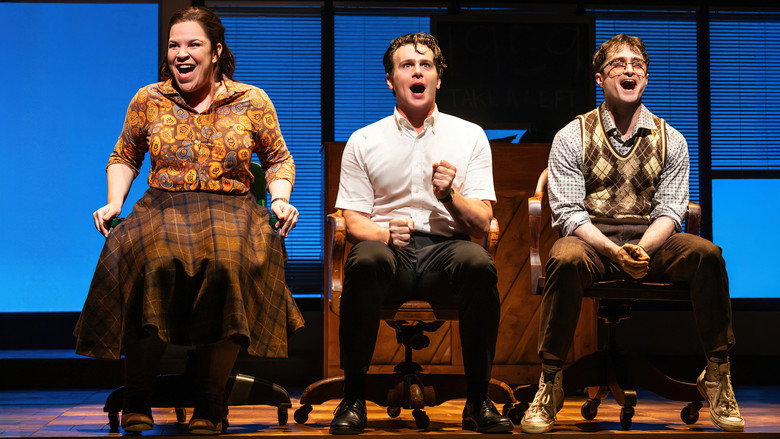
Friedman’s filming choices are polarizing, and I see why. The camera is aggressively intimate; close-ups dominate, sometimes to the point of claustrophobia. During “Franklin Shepard, Inc.,” Charley’s explosive TV rant, Radcliffe’s face fills the screen, his voice shaking with rage and betrayal.
It’s electrifying, but you miss the choreography, the ensemble moving around him. Age of the Geek wasn’t wrong that Friedman “indulges in close-up too often,” but I’d argue that’s the point. This isn’t a show about spectacle.
It’s about the quiet devastation of watching someone you love become a stranger.
The performances are revelatory. Groff’s Franklin collapses in slow motion: he starts as a man who has learned to perform happiness so well he’s forgotten what it feels like, and ends as a kid again, wide-eyed and terrified. Radcliffe steals every scene; his Charley is all sharp edges and wounded pride, and his “Good Thing Going” is so raw it feels like a confession.
But it’s Lindsay Mendez who haunts me. Mary, the show’s emotional core, loves Franklin too much and too long, and Mendez plays her with an earned weariness. In “Now You Know,” singing about the lessons she’s learned, her voice cracks just enough to remind you she’s not okay, and never will be.
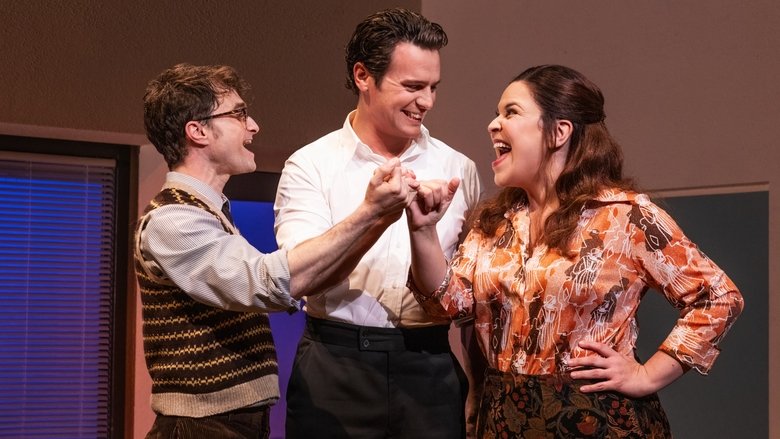
The gossip around this production is almost as juicy as the show. Jonathan Groff apparently spent the Broadway run trying to make his co-stars break character; Daniel Radcliffe told Variety that Groff would tickle him backstage right before they went on. That chaos suits a musical about friendship, which is a mix of love and irritation, inside jokes and moments when you want to strangle each other.
The real scandal is that the show ever flopped. The 1981 original closed after 16 performances, dismissed as a “shambles” by Frank Rich. Now it’s called one of the greatest comebacks in Broadway history, a reverse chronology of its own: a story about failure that ends in redemption.
I keep thinking about that rooftop. The three of them stand arm in arm, singing about the future as if they can hold onto it. We know how this ends; we’ve already seen it.
For those few minutes, they don’t, and neither do we. That’s the magic of Merrily: it makes you feel the weight of every choice that got them there.
"A heartfelt, musically vibrant adaptation that will move fans of the stage original."
The film's emotional depth and musical numbers are widely praised, with standout performances from Jonathan Groff, Lindsay Mendez, and Daniel Radcliffe. Some note the nonlinear structure may feel disjointed to newcomers, but the leads' chemistry keeps it engaging.
Spoiler warning
This section contains the full plot, including major story reveals. Overview above stays spoiler-free.
What happens when you put a Broadway flop-turned-hit, a Harry Potter alum, a Glee heartthrob, and Sondheim stans in one cultural blender? You get Merrily We Roll Along (2025) – and a trail of scandals, recasts, wedding shenanigans, latestnetflix.com argues, and fan meltdowns worthy of its own musical.
Before you were swooning over Paul Mescal aging in real time for Richard Linklater’s 20-year film adaptation, the role of Franklin Shepard belonged to Blake Jenner. He’d already started filming when his personal life detonated. In November 2019, his ex-wife, Supergirl star Melissa Benoist, released a 14‑minute Instagram video revealing she was a survivor of domestic violence; she didn’t name her abuser, but fans immediately connected it to Jenner.
A year later, Jenner posted a statement saying he took “full responsibility and accountability for the hurt that I inflicted during my relationship with my past partner — emotionally, mentally, and yes, physically”. Cue outrage: petitions popped up demanding he be removed from Merrily, and by January 2023 Paul Mescal was officially announced as his replacement in Linklater’s film. One of the most ambitious movie-musical projects of all time quietly did a full moral housecleaning mid‑shoot.
When news hit that Beanie Feldstein would play Mary in the Linklater film, some Sondheim diehards did NOT take it merrily. On Reddit’s r/Sondheim, a fan described posting about new casting news (including Mallory Bechtel) in a Sondheim Facebook group only to find “many people there expressed disapproval of the casting of Beanie Feldstein as Mary, and not Lindsay Mendez”.
The subtext? A lot of fans see Tony winner Lindsay Mendez as the definitive Mary from the hit revival and feel Feldstein’s film casting is yet another instance of a well‑connected “nepo baby” getting the screen spotlight. The backlash is fan‑driven, but the resentment is real enough that people are still arguing about it years later.
When the revival became the hottest ticket in town, prices shot into orbit. On BroadwayWorld’s forums, multiple posters blasted the over $500 ticket prices as “criminal” and “pretty pathetic,” even as they admitted the show was selling out anyway. Another thread titled “Merrily We Roll Along… $300 per person, worth it?” on Reddit had fans debating whether the show could possibly justify those prices. For the record, the production ended its run with a record-breaking $2.77 million week, the highest ever for a Sondheim show. So yes, everyone complained—and then opened their wallets.
Forget Franklin Shepard’s betrayals—the real chaos agent is Jonathan Groff. In a Variety piece and multiple talk-show appearances, his co-stars basically label him a lovable menace. Lindsay Mendez jokes, “He’s the worst,” while Daniel Radcliffe adds, “If he wasn’t so fantastic, he’d be a nightmare”.
Why? Groff apparently tries to make his co-stars crack onstage during some of the show’s most emotional scenes. Radcliffe recalls that in “really rough, emotional scenes” Groff would literally turn upstage and crack a joke directly at him mid‑moment.
It doesn’t stop there. Radcliffe also revealed that right before they’re supposed to go on, while he’s listening for his cue, Groff sometimes tickles him backstage, just to throw him off. As Radcliffe sums it up: “Jonathan delights in screwing with me for most of the show… I adore him and I don’t know how he does it”.
Groff’s mischief didn’t stay backstage. On Late Night With Seth Meyers, he, Radcliffe, and Mendez brought a special blooper clip: Groff hilariously flubs a lyric in “Opening Doors” during a Broadway performance, and the moment is now immortalized in broadcast and online. Fans who only knew “perfect Broadway” Groff got a delicious glimpse of his chaotic side.
For the 2025 movie (the proshot of the Broadway revival), director Maria Friedman and RadicalMedia shot across three performances plus an extra day, aiming for what they called “Merrily, Close Up”—a hybrid of stage and film that leans heavily into extreme close-ups.
The cast says they mostly just did the regular show and let the cameras lurk: “We did the show we were used to doing and the cameras happened to be there,” Mendez explained. But not everything made it into the final cut. Radcliffe notes that after their Tony wins, there was a moment in the live show where the audience went absolutely ballistic—“it full stopped the show… for like 10 minutes”—and that entire ovation had to be trimmed out for the film. A whole meta‑celebration sliced away in the edit room.
On paper, this could have been a powder keg: a Broadway leading man, the former Boy Who Lived, and a beloved Sondheim heroine sharing the spotlight in a famously tricky show. Instead, it turned into one of theater’s most aggressively wholesome friendships.
In Variety, Mendez jokes that although she and Groff already knew each other, “I’d never even heard of Daniel Radcliffe” when he joined the cast—then admits they basically bullied him into being their friend: “We forced the friendship on him. And luckily, he bit”.
Radcliffe describes being on a constant group text thread with Groff and Mendez, trading voice notes and videos, and even taking notes on what they say so he can respond properly because he doesn’t want to miss anything. He later told BroadwayWorld he wants to “find things to work with them on for the rest of my life”. If there’s feuding here, it’s over who loves whom more.
BroadwayWorld ran a long forum thread obsessively tracking Lindsay Mendez’s missed performances, with some posters speculating about her absences and whether the role was too demanding. Other users clapped back, pointing out that the producers clearly had no issue and that performers are allowed to be human (and, in Mendez’s case, pregnant). There’s no evidence of backstage hostility—just the usual hyper-invested Broadway fandom energy.
The most romantic drama connected to the 2025 film isn’t in the script—it’s at Bethesda Terrace in Central Park. On April 22, 2024, Lindsay Mendez married her Merrily co-star J. Alex Brinson, and the wedding was basically a cast reunion in formalwear.
Per People’s exclusive, Jonathan Groff officiated the ceremony while Daniel Radcliffe served as ring bearer—yes, the former Boy Wizard literally walked the rings down the aisle. Mendez said having them there was “so special,” noting they’d been by her side since she first started dating Brinson. The couple also revealed they were expecting their first child together that fall, joining Mendez’s 2‑year‑old daughter, Lucy, from a previous relationship.
The press quietly did what fandom loudly screamed: canonized the Groff–Radcliffe–Mendez trio as found family goals.
When fans learned that Linklater’s decades-long film would star Paul Mescal, Beanie Feldstein, and Ben Platt—not Jonathan Groff, Lindsay Mendez, and Daniel Radcliffe—a mini‑revolt broke out online. On Reddit, threads asked bluntly why they didn’t “just do the movie adaptation with the Broadway cast,” accusing producers of profiting off “ticket gouging” and still not rewarding the stage trio with the big-screen version.
It’s not a formal scandal, but it’s become one of the defining fan grudges surrounding Merrily: two different “definitive” casts, one for stage and one for film, and a fandom low-key pitting them against each other in comment sections.
Once the 2025 proshot hit theaters and VOD, Sondheim nerds did what they do best: frame‑by‑frame comparisons. On Reddit’s r/Sondheim and r/Broadway, multiple posters complained that the film trimmed down some of the “Merrily We Roll Along” transitional sequences, and that the final “Merrily We All Roll Along” staging cuts out much of the ensemble by favoring tight close‑ups of the leads.
Some called the edit “totally offensive” in how allergic it seemed to wide shots, arguing that it undercut the ensemble’s contribution to the show. Officially, it’s just a stylistic filmmaking choice—but online, it’s blossomed into a fan theory that somewhere there’s a more complete, ensemble‑heavy cut sitting on a hard drive at RadicalMedia.
Because this project wasn’t already cursed/blessed enough, Lin-Manuel Miranda joined the cast of Linklater’s film in 2025 in an unspecified role. Reports note only that he’s part of the ensemble joining Mescal, Platt, Feldstein, Mallory Bechtel, and Hannah Cruz.
Since Miranda played Charley in a 2012 Encores! Staging, fans immediately started theorizing: Is he a future version of a character? A meta Sondheim surrogate? A cameo as a Broadway legend watching the kids implode? So far, nobody’s talking, and the internet is filling the 15‑year gap before release with increasingly unhinged speculation.
In late 2022, one Merrily We Roll Along performance was abruptly canceled mid‑evening due to technical difficulties. Rather than send everyone home furious, the company improvised: audience members posted on Reddit about an impromptu Q&A with Radcliffe, Groff, and Mendez after the cancellation, complete with stories, questions, and casual hang-out vibes. A show literally couldn’t go on—and the cast still gave fans a night to talk about.
The meta‑drama hovering over the 2025 film is the show’s own history: the original 1981 production famously crashed and burned, closing after just 16 performances, while the 2023–24 revival sold out at sky‑high prices and went on to film a glossy proshot that hit cinemas and streamers. Every puff piece about the film references this glow‑up, but fan forums and think pieces dig into it like a murder mystery: how did Sondheim’s “abysmal failure” become the prestige event of the decade?
Put it all together and Merrily We Roll Along (2025) isn’t just a filmed stage musical—it’s the center of a tangled web of:
In other words: Sondheim wrote a show about how success ruins friendships. Reality gave us a version where success turned three co‑stars into each other’s wedding party, blew up a casting scandal, and made a cult flop into a global event. Merrily, indeed.
Entertainment rumors and trivia aggregated from public reporting. Treat speculation as unverified unless a cited source confirms it.
More titles in the same genres and with the same cast.