Iola Evans
Kayla

“Sometimes a curse can be a gift.”
In pursuit of an unclaimed $125,000 prize, a broke college dropout decides to play an obscure, 1980s survival computer game. But the game curses her, and she’s faced with dangerous choices and reality-warping challenges. After a series of unexpectedly terrifying moments, she realizes she’s no longer playing for the money but for her life.
Official
I’ve always had a soft spot for horror that treats technology like a haunted house—something that looks shiny and new but hides a basement full of ghosts. Choose or Die lands squarely in that tradition, though it’s less interested in scaring you than in making you squirm at the idea that your choices might not be yours at all. It’s a film that feels like it was designed by someone who grew up playing Zork in a dimly lit bedroom, convinced the parser was judging them. And maybe it was.
The premise is wonderfully bizarre, as RogerEbert.com noted—a lost 1980s survival horror game that doesn’t just kill your character but rewrites reality itself. That’s the kind of high-concept hook that could either collapse under its own weight or become something memorably unnerving. Choose or Die leans toward the latter, though not without stumbling. It’s a film that wants to be both a love letter to retro gaming and a cautionary tale about the dangers of nostalgia, and it mostly succeeds at the former while only hinting at the depth of the latter.
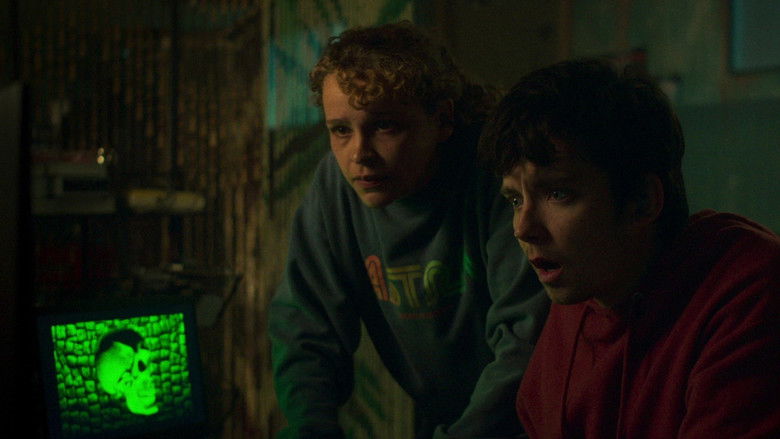
The story follows Kayla (Iola Evans), a broke college dropout who stumbles upon the cursed game while scavenging for a cash prize. The game’s rules are simple: make choices, survive the consequences. But the consequences aren’t confined to the screen.
A wrong move in the game might mean a real-world injury—or worse. The film’s best moments play like a twisted version of Jumanji, where the stakes aren’t just physical but existential. What does it mean to be trapped in a system where every decision is a gamble, and the house always wins?
That question lingers, but Choose or Die doesn’t always trust its audience to sit with it. The film’s pacing is uneven, lurching between slow-burn dread and sudden bursts of violence that feel more jarring than earned. There’s a scene early on where Kayla’s brother, played by Asa Butterfield, gets his arm broken by a game mechanic.
It’s a brutal moment, but it’s also the kind of shock that feels like it’s there to prove the film’s seriousness rather than to serve the story. (I’ve seen this trick before—horror films love to break bones to show they mean business. It’s the cinematic equivalent of a jump scare: effective in the moment, but hollow if it doesn’t lead anywhere.)
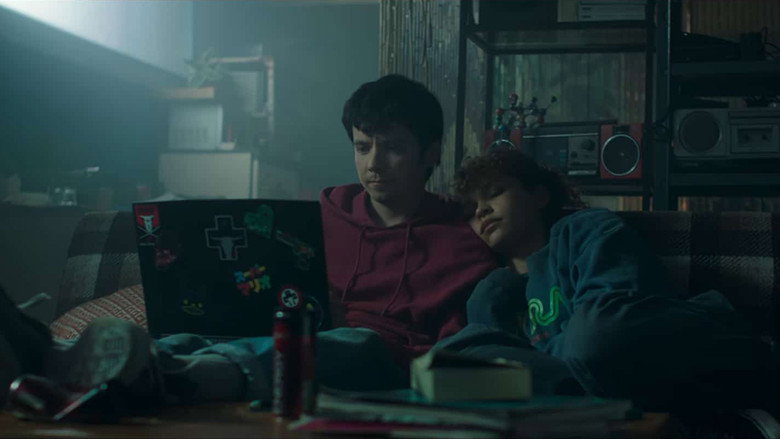
The retro aesthetic is where Choose or Die shines brightest. The game itself is a loving homage to the pixelated, text-heavy adventures of the 1980s, complete with a synth-heavy score that sounds like it was lifted from a John Carpenter B-side. The film’s visual language leans into this nostalgia, bathing scenes in the sickly glow of CRT monitors and neon signs.
It’s the kind of look that makes you feel like you’re watching something that was unearthed from a time capsule, even if the story itself is very much of the present.
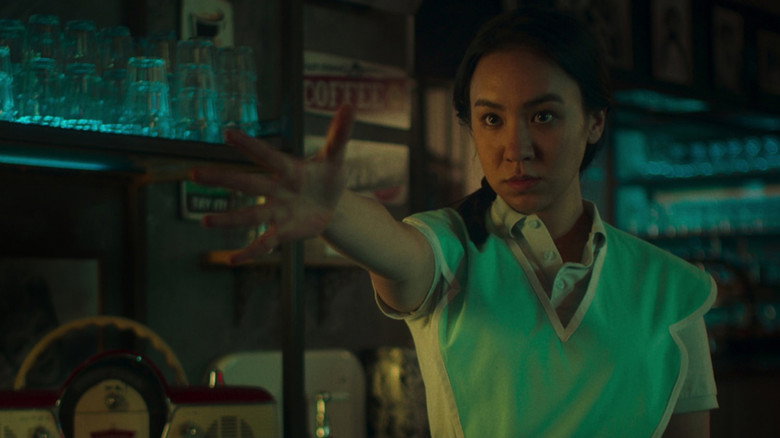
Robert Englund’s casting is a masterstroke, though the film doesn’t give him nearly enough to do. Englund, of course, is forever tied to Freddy Krueger, and his presence here feels like a wink to horror fans—a reminder that the genre’s icons never really die, they just get recast in new nightmares. His role is small, but his performance is magnetic, a mix of gravitas and camp that feels just right for a film that’s equal parts sincere and self-aware.
The real heart of the film, though, is Iola Evans as Kayla. She’s the kind of protagonist horror often forgets to give us: flawed, resourceful, and deeply human. Evans plays Kayla with a quiet desperation, the kind that comes from being backed into a corner with no good options.
There’s a moment midway through the film where she’s forced to make a choice that will either save her or doom someone else, and the way Evans holds the camera’s gaze—part defiance, part terror—is the film’s most honest beat. It’s the kind of performance that makes you wish the script had given her more to work with.
Choose or Die is at its best when it leans into the surreal, blurring the line between the game and reality. There’s a sequence where Kayla finds herself in a nightmarish version of her own apartment, the walls closing in as the game’s text scrolls across the screen like a malevolent narrator. It’s a simple effect, but it’s used to great effect, making the audience feel as trapped as the characters.
The film’s horror isn’t in the gore or the jump scares—it’s in the creeping realization that the game isn’t just a game anymore. It’s a parasite, feeding on Kayla’s fears and regurgitating them as reality.
That said, the film’s ambition occasionally outstrips its execution. The third act feels rushed, as if the filmmakers realized they were running out of time and decided to cram in as many twists as possible. The rules of the game, which are murky from the start, become outright incoherent by the end, and the resolution feels more like a cop-out than a payoff.
It’s as if the film is so enamored with its own premise that it forgets to give its characters a satisfying arc.
And maybe that’s the point. Choose or Die is, at its core, a film about the illusion of control. Kayla thinks she’s playing the game, but the game is playing her. The choices she makes aren’t really choices at all—they’re just the next move in a system designed to keep her trapped.
It’s a bleak message, but it’s one that resonates in an era where algorithms dictate what we see, what we buy, and even what we think. The film doesn’t explore this idea as deeply as it could, but it’s there, lurking beneath the surface like a glitch in the code.
I left Choose or Die with mixed feelings. It’s not a great film, but it’s a memorable one—a flawed, messy, occasionally brilliant experiment that feels like it was made by people who love horror enough to take risks. It’s the kind of movie that will frustrate you in the moment but stick with you long after the credits roll.
And in the end, isn’t that what horror is supposed to do? Leave you with something to chew on, even if it’s just the nagging feeling that you’re not as in control as you thought you were.
Maybe that’s the real curse. Not the game, but the knowledge that no matter how hard you try, you’re always one bad decision away from losing.
"A visually stylish but uneven horror-thriller that struggles to balance its retro aesthetic with coherent storytelling."
The film’s nostalgic 1980s horror vibe and Robert Englund’s presence give it some cult appeal. The plot is confusing, the pacing inconsistent, and the scares underwhelming, so it ends up a missed opportunity rather than a standout horror film.
Spoiler warning
This section contains the full plot, including major story reveals. Overview above stays spoiler-free.
Toby Meakins’ Choose or Die (2022) dropped on Netflix with a premise as simple as it is sinister: a cursed retro video game forces players to make brutal choices—or die. Starring Iola Evans and Asa Butterfield, the film blends 80s nostalgia with modern horror, but behind the scenes, its production was anything but a game.
The movie’s hook—a sentient 1980s computer game called CURSR that traps players in real-life deadly scenarios—drew immediate comparisons to Squid Game. Netflix leaned into the hype, releasing trailers that teased the game’s eerie pixelated aesthetic and high-stakes "choose or die" mechanics. The film’s retro vibe wasn’t just set dressing; it was central to the plot, with the game’s glitchy, low-res graphics serving as a visual metaphor for the characters’ inescapable fate.
But where did the idea come from? While the evidence doesn’t spell out the origins of CURSR, the film’s director, Toby Meakins, has a background in short films and commercials, suggesting a knack for high-concept storytelling. The choice to center the horror on a vintage computer game—rather than, say, a haunted console—gave Choose or Die a fresh twist in a genre crowded with supernatural clichés.
Iola Evans, who plays college student Kayla, anchors the film as the protagonist forced to navigate CURSR’s deadly challenges. Asa Butterfield, known for Sex Education and Hugo, plays her love interest, Isaac, while horror icon Robert Englund (A Nightmare on Elm Street) appears as the enigmatic game designer, Hal. The supporting cast—including Eddie Marsan, Angela Griffin, and Ryan Gage—rounds out a roster of characters who quickly learn that the game’s "choices" are anything but fair.
Englund’s involvement was a coup for the film, adding a layer of genre credibility. His character, Hal, is shrouded in mystery, with trailers hinting at his dark connection to CURSR. While the evidence doesn’t reveal whether Englund improvised any of his lines or brought his own ideas to the role, his presence alone suggested Choose or Die was aiming for more than just jump scares.
Critics and audiences were divided. On SensCritique, the film earned a lukewarm 4.3/10 from over 1,200 votes, with some praising its ambition but others calling it derivative. YouTube reviews were similarly split, with one commentator ranting about the film’s pacing and predictable twists during a first-time watch, while another praised its stylish visuals and tense atmosphere.
One recurring complaint was the film’s reliance on familiar horror tropes. The "cursed object" premise isn’t new, and Choose or Die’s execution didn’t always escape the shadow of bigger-budget horror films. Still, its retro gaming angle and Englund’s casting gave it enough novelty to stand out in Netflix’s crowded horror lineup.
For all its buzz, Choose or Die’s production remains largely under wraps. There’s no evidence in the retrieved snippets about on-set drama, budget constraints, or whether the cast bonded over retro gaming sessions. Rumors about a potential sequel or spin-off haven’t surfaced either—though given Netflix’s appetite for franchise-friendly horror, it wouldn’t be surprising if CURSR made a comeback.
One unanswered question: How much of the game’s design was practical versus CGI? The trailers showcase CURSR’s pixelated graphics in stark contrast to the film’s live-action horror, but there’s no confirmation on whether the production used real vintage hardware or digital recreations.
Choose or Die may not have reinvented the horror wheel, but it delivered exactly what its trailers promised: a high-stakes, retro-tinged nightmare with a body count. For fans of Englund or 80s nostalgia, it was a fun, if forgettable, watch. For others, it was a reminder that not every "choose your fate" story sticks the landing.
One thing’s certain: CURSR’s game over screen never felt so final.
Entertainment rumors and trivia aggregated from public reporting. Treat speculation as unverified unless a cited source confirms it.
More titles in the same genres and with the same cast.