David Kross
Roman

A hiking trip into the wild turns into a desperate bid for survival for five friends on the run from a mysterious shooter.
I’ve seen enough survival thrillers to know the drill: a group of friends ventures into the wilderness, something goes wrong, and suddenly the trees become a character—usually the villain. Prey (2021) follows this formula, but with a twist that’s less about innovation and more about the unsettling way it weaponizes silence. The forest here isn’t just a backdrop; it’s an accomplice, a vast, indifferent witness that swallows screams before they can echo. That’s the film’s most effective trick, and also its most frustrating limitation.
The premise is simple: five friends—colleagues, really, with the brittle camaraderie of people who know each other’s habits but not their secrets—embark on a hiking trip that’s part bachelor party, part forced bonding exercise. David Kross plays Roman, the groom-to-be, whose brotherly dynamic with one of the group (Hanno Koffler) hums with unspoken tension. The others are sketches more than characters: the joker, the skeptic, the one who’s always late.
They’re the kind of people you’ve met at work retreats, the ones who laugh too loud at inside jokes and check their phones when the conversation turns serious. Then, without warning, a sniper’s bullet finds one of them. The rest scatter, and the film becomes a grim game of hide-and-seek where the forest itself seems to be helping the hunter.
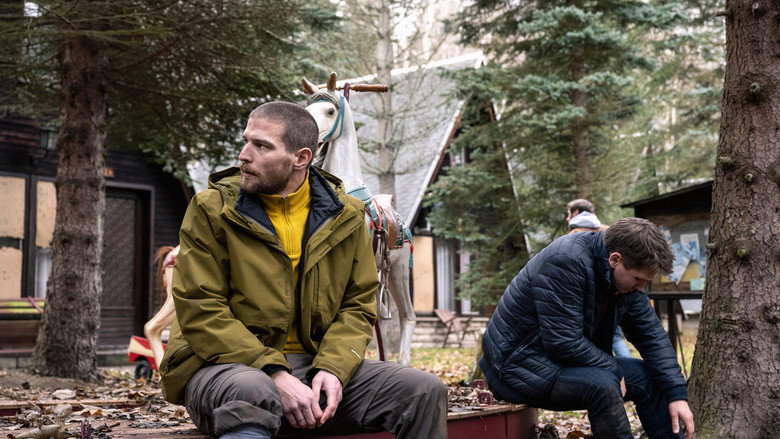
What Prey gets right is the way it makes the environment feel alive in the worst possible way. The camera lingers on the undergrowth, the way branches snap underfoot, the sudden rustle of leaves that could be the wind—or something else. The sound design is particularly effective here, a mix of muffled breaths and the distant crack of gunfire that keeps you leaning forward, straining to hear.
It’s the kind of tension that doesn’t rely on jump scares or gore, at least not at first. Instead, it builds through the slow realization that there’s nowhere to hide. The trees offer no cover, the terrain no advantage.
"A tense but uneven thriller with strong performances, undermined by a predictable plot and mixed pacing."
Atmospheric tension and solid acting, particularly from David Kross and Hanno Koffler, keep the film engaging despite its flaws. But the familiar story and occasional pacing problems mean it never fully realizes its potential: watchable, but forgettable.
Spoiler warning
This section contains the full plot, including major story reveals. Overview above stays spoiler-free.
Prey (2021), the German-language thriller directed by Thomas Sieben, slipped onto Netflix with little fanfare but quickly carved out a niche among fans of tense, character-driven horror. Starring David Kross and Maria Ehrich, the film follows a group of friends whose idyllic getaway spirals into a fight for survival. latestnetflix.com's read is that while it didn’t dominate headlines like its big-budget namesakes, Prey has quietly become a talking point for its atmosphere and the chemistry of its cast.
Thomas Sieben, the film’s director and screenwriter, has built a career on crafting moody, festival-friendly thrillers. Before Prey, he was known for projects that blended psychological tension with stark visuals. His work often premieres at major festivals, and Prey was no exception—though details about its festival run remain scarce in the available evidence. What’s clear is Sieben’s knack for slow-burn storytelling, a style that fits Prey’s premise: a group of friends trapped in a remote location, forced to confront both external threats and their own fractured dynamics.
The film’s 87-minute runtime suggests a tight, no-frills approach, a hallmark of Sieben’s work. While Netflix’s algorithm-driven release strategy meant Prey didn’t get the same marketing push as some of its originals, its lean runtime and high-stakes premise likely helped it find an audience among viewers craving something darker than the platform’s usual fare.
Prey’s ensemble cast brings a mix of rising stars and familiar faces from German cinema and television. Leading the pack is David Kross (The Reader, Race), whose intensity has made him a go-to for complex roles. Alongside him is Maria Ehrich, best known for her role in the Ku’Damm series, who brings a different energy to the film’s high-stakes scenario. The chemistry between the cast—particularly Kross and Ehrich—has been a highlight in reviews, with some viewers noting how their performances elevate the film’s tension.
The supporting cast includes Hanno Koffler (The Captain), Robert Finster (Babylon Berlin), and Yung Ngo (Dark), all actors with experience in German genre films and series. Their involvement suggests a deliberate effort to assemble a team comfortable with the film’s moody, suspenseful tone. While there’s no evidence of behind-the-scenes drama or on-set antics, the cast’s collective experience in thriller and drama projects likely contributed to the film’s cohesive atmosphere.
Prey’s reception has been mixed but passionate. On SensCritique, the film holds a 3.6/10 rating based on 426 votes, a score that reflects its divisive nature. Some viewers praised its atmosphere and the performances, particularly Kross’s brooding intensity, while others found the pacing or plot twists underwhelming. The film’s IMDb rating of 4.3/10 aligns with this split, though it’s worth noting that IMDb scores for non-English films can sometimes skew lower due to smaller sample sizes.
Netflix’s decision to release Prey without much fanfare may have contributed to its under-the-radar status, but it also allowed the film to develop a cult following. Reviewers on YouTube have dissected its ending and themes, with some calling it a hidden gem for fans of European thrillers. The lack of major awards buzz or studio-backed hype means Prey’s legacy will likely depend on word-of-mouth and streaming algorithms, but its premise and execution have already earned it a place in the conversation about Netflix’s international genre offerings.
There’s no evidence of a sequel or spin-off in the works, and given the film’s modest reception, it’s unlikely to become a franchise. However, Thomas Sieben’s career continues to focus on thrillers and dramas, so fans of Prey’s tone may find more to enjoy in his future projects. For the cast, Prey serves as another credit in their growing filmographies, particularly for Maria Ehrich, who has been expanding her range beyond television roles.
As for the film itself, its fate rests with Netflix’s ever-shifting catalog. If it stays in rotation, Prey could continue to attract viewers looking for something darker and more atmospheric than the platform’s typical offerings. If not, it may fade into the background—another intriguing but overlooked entry in the streaming era’s vast library.
Entertainment rumors and trivia aggregated from public reporting. Treat speculation as unverified unless a cited source confirms it.
More titles in the same genres and with the same cast.