Joy Rieger
Mira Ben Ari

“The true cost of war is unknown.”
1948: an Egyptian filmmaker is creating newsreel stories about a volunteer force tasked to liberate Palestinian farmers. The journey propels him towards a chance encounter with a tenacious young leader of a nearby commune that will set in motion events that will change their lives forever.
Official
Avi Nesher's Image of Victory is a war film that assumes every victory photograph is lying.

That suspicion drives the structure. In 1948, Hassanin, an Egyptian filmmaker attached to a volunteer force sent to liberate Palestinian farmers, is ordered to manufacture newsreel evidence of triumph. His camera follows a platoon as rhetoric about liberation hardens into an assault on Kibbutz Nitzanim, held by a small civilian defense force during Israel's War of Independence.
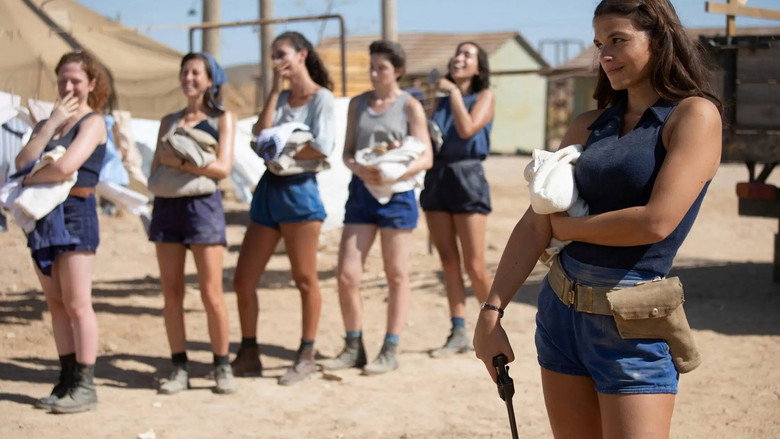
Across the wire, Mira, a young mother who has become a tenacious communal leader, tries to hold together a kibbutz preparing for an attack it cannot repel. The plot turns on their indirect encounter, a collision of recorded war and endured war that changes the terms of survival for both.
The tagline — The true cost of war is unknown, is not decoration. Nesher builds the film around the distance between Hassanin's lens and Mira's ground. Hassanin starts as a believer in the mission and in the medium.
He frames soldiers helping farmers, stages confidence for the home front, and learns to cut around doubt. As the advance stalls and the orders grow harsher, the footage stops cooperating. The camera that was meant to certify victory begins to document exhaustion, fear, and coercion among the Egyptians themselves.

On the kibbutz side, Nesher refuses the simplifications that Hassanin is told to sell. Mira, played by Joy Rieger with alert restraint, is neither symbol nor martyr. She argues about evacuation of children, about rationing of ammunition, about the right to be frightened while remaining responsible for others.
Amir Khoury gives Hassanin a parallel arc, moving from professional pride to quiet panic as he understands that his film will be used to justify losses he can no longer defend. Their performances ground a large-scale reenactment in private decisions: whether to keep filming, whether to keep fighting, whether to speak on the record.
Scale is part of the argument. Described as Israel's most expensive production and nominated for 15 Ophir Awards, the film stages the fall of Nitzanim with period detail and sustained battle choreography rather than montage shorthand. Variety noted the high production value in what it called a reconsideration of the battle of Nitzanim.
The craft matters because Nesher wants the viewer to feel how much labor goes into both kinds of construction, building a defensive position under fire and building a persuasive lie in the editing room. Practical staging and digital extension blend into dust, armor movement, and night bombardment without showpiece detachment.
That dual focus explains why the film has been embraced as a corrective. The Jewish News called it a must-watch for those interested in the history and human cost of the creation of an Israeli state, praising its powerful and heart-wrenching account of the price paid on both sides. The praise fits.
This is one of the few Israeli features about 1948 to place an Egyptian protagonist at the center rather than at the edge of frame. Arabic and Hebrew share the soundtrack without translation flattening either side into accent. Egyptian conscripts debate the war in political and personal terms.
Kibbutz members debate surrender and captivity without being reduced to heroic consensus. Humanization here is not sentimentality. It is attention to procedure under pressure.
The weakness follows from the strength. Across 128 minutes, Nesher cuts between newsreel artifice and siege reality so insistently that momentum sags in the middle stretch. Some viewers have found the rhythm uneven and the emotional weight hard to absorb in a single sitting.
The point is legible — propaganda needs clean beats and war refuses to supply them, but the cross-cutting can feel schematic once the outcome at Nitzanim becomes clear. The film knows the historical record of overrun positions and captivity, and it cannot fully disguise a familiar war-drama shape beneath the unusual perspective.
What keeps Image of Victory from settling into that shape is its refusal to let either camera win. Hassanin's footage is exposed as staging. Mira's resistance is honored without being mythologized.
Victory, in the title's bitter sense, belongs to whoever controls the image after the casualties are counted. Nesher suggests that control is fragile and obscene at once, especially when the men asked to die are also asked to smile for history.
I don't buy the closing note of recognition as settlement.
"A gripping historical war drama that humanizes both sides of the 1948 conflict, though its pacing and emotional intensity won't suit everyone."
The film gives a balanced portrayal of the 1948 War of Independence, depicting the human cost of war from multiple perspectives. Joy Rieger and Amir Khoury are praised for the depth and authenticity of their performances. The pacing is uneven, and the emotional weight can feel overwhelming or overly dramatic at times.
Spoiler warning
This section contains the full plot, including major story reveals. Overview above stays spoiler-free.
Avi Nesher’s latest film, Image of Victory (2023), marks another ambitious project from the veteran Israeli director, whose five-decade career has spanned drama, war, and historical storytelling. latestnetflix.com's view is that Starring Joy Rieger, Amir Khoury, and Ala Dakka, the movie promises a gripping exploration of conflict, though details about its narrative and production remain tightly guarded.
Nesher, born in 1952, has built a reputation for tackling complex, emotionally charged subjects. His filmography includes Past Life (2016), a drama set against the backdrop of post-Holocaust Poland and Israel, suggesting a recurring fascination with historical trauma and resilience. Image of Victory appears to follow this thematic thread, though specifics about its plot are scarce. The film’s trailers hint at intense wartime drama, with visceral scenes and high-stakes tension. Nesher’s ability to blend personal stories with broader historical narratives could make this a standout entry in his filmography.
One of the most talked-about aspects of Image of Victory is its visual effects. A VFX breakdown trailer reveals the meticulous work behind the film’s war sequences, showcasing how practical effects and digital enhancements were used to create immersive battle scenes. The trailer also includes a harrowing line—"When we crawled out of the crematorium chimneys..."—which underscores the film’s unflinching approach to its subject matter. While the full context of this scene remains unclear, it suggests a narrative rooted in survival and the horrors of war.
The cast, led by Rieger and Khoury, brings a mix of established and rising talent. Rieger, known for her roles in Israeli television and film, has previously worked with Nesher, while Khoury and Dakka add depth to the ensemble. Their performances, combined with Nesher’s direction, could elevate Image of Victory beyond typical war dramas.
Despite the buzz, details about the film’s production are limited. Some sources incorrectly list the release year as 2022, but the official TMDB page confirms 2023 [TMDB]. There’s also confusion about whether Image of Victory is a feature film or a short—trailers exist for both, but the evidence leans toward a full-length movie. Without clearer production notes, these discrepancies remain unconfirmed.
Image of Victory appears to be a bold, visually striking addition to Nesher’s body of work. Its focus on war and survival, paired with the director’s signature storytelling, could make it a powerful cinematic experience. However, with limited behind-the-scenes details, audiences will have to wait for its release to see how the film’s themes and performances land.
Entertainment rumors and trivia aggregated from public reporting. Treat speculation as unverified unless a cited source confirms it.
More titles in the same genres and with the same cast.