Vijay
Parthiban / Leo Das

Parthiban, a cafe owner, lives with his family in Himachal Pradesh. Things take an absurd turn for him when he gets in the way of a drug cartel.
Official
I’ve seen Leo twice now, and both times I left the theater with the same nagging question: what if the film’s biggest flaw isn’t its writing, but the weight of its own ambition? Lokesh Kanagaraj’s third entry in his Lokesh Cinematic Universe (LCU) is a film that wants to be many things at once—a family drama, a brutal crime thriller, a franchise tentpole, a star vehicle for Vijay, and a tribute to A History of Violence.
It’s a lot. Too much, maybe. And yet, there are moments when it all clicks, when the chaos feels intentional, like a fever dream you don’t want to wake up from.
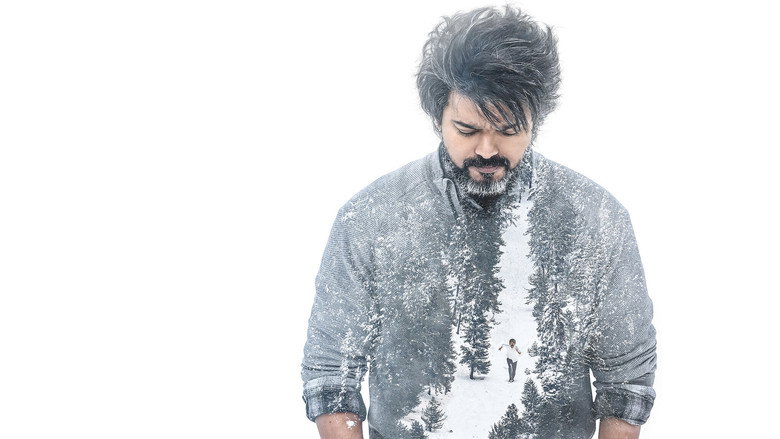
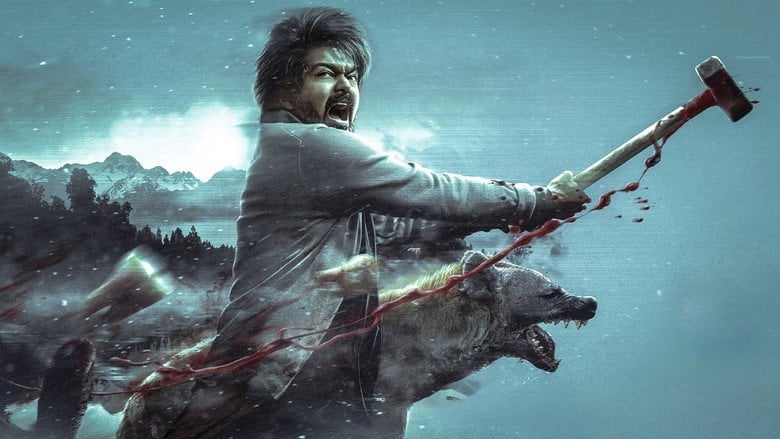
The opening sequence is a masterclass in Kanagaraj’s ability to marry spectacle with tension. A hyena—yes, a hyena—stalks through the snowy streets of Himachal Pradesh, its breath visible in the cold air, before launching into a brutal attack on a group of men. It’s a scene that feels ripped from a nature documentary spliced with a horror film, and it sets the tone for what’s to come: Leo is going to be messy, violent, and unapologetically over-the-top.
The hyena isn’t just a random animal; it’s a metaphor for the film’s own energy—wild, unpredictable, and a little bit feral.
But here’s the thing about hyenas: they’re scavengers. They thrive in chaos, feeding on what’s left behind. And in many ways, Leo feels like it’s scavenging from its own influences, from Cronenberg’s A History of Violence to Kanagaraj’s own Vikram.
The film’s central premise—a mild-mannered café owner named Parthiban (Vijay) who’s forced to confront his violent past when a drug cartel comes knocking—isn’t exactly original. But Kanagaraj doesn’t seem interested in reinventing the wheel. Instead, he’s trying to see how fast he can spin it before it flies off the axle.
Vijay’s performance is the film’s anchor, and it’s a revelation. For years, he’s been typecast as the larger-than-life "Thalapathy," a hero who exists in a world where morality is black and white. In Leo, he’s asked to play a man whose past is a shadow he can’t outrun, and Vijay rises to the challenge.
There’s a scene early in the film where Parthiban is tucking his son into bed, and the camera lingers on his face—tired, haunted, trying to smile through the weight of what he’s done. It’s a small moment, but it’s the kind of quiet detail that makes you believe in the character. Vijay has always been a physical actor, but here, he’s using his body in a different way.
His posture is slumped, his movements deliberate, as if he’s carrying an invisible burden. It’s a far cry from the swaggering heroics of his earlier roles, and it’s all the more compelling for it.
The problem is that Leo doesn’t trust these quiet moments enough. The film is so eager to prove it can be a blockbuster that it forgets to be a character study. The second half, in particular, devolves into a series of increasingly convoluted set pieces, each one louder and more explosive than the last.
There’s a shootout in a hospital that feels like it goes on for an eternity, a car chase that’s more exhausting than exhilarating, and a final confrontation that’s so overstuffed with franchise callbacks and cameos that it loses any emotional resonance. It’s as if Kanagaraj, under pressure to deliver a hit, kept adding more and more to the plate until it collapsed under its own weight.
The critics have been divided, and I get why. Peter Debruge in Variety called it "corny-but-satisfying spectacle," which feels about right. There’s a part of me that wants to defend Leo as a guilty pleasure, a film that knows it’s ridiculous but leans into it anyway.
But then there’s the other part of me—the part that remembers the hyena, the quiet moments with Parthiban’s son, the way Vijay’s face changes when he’s forced to confront his past—that wishes the film had been braver. What if it had slowed down? What if it had trusted its audience to sit with the discomfort of a man trying to outrun his own history?
The technical craft is undeniable. Manoj Paramahamsa’s cinematography is lush and immersive, whether he’s capturing the snow-covered streets of Himachal Pradesh or the neon-lit underbelly of the drug trade. Anirudh Ravichander’s score is propulsive, a mix of throbbing basslines and haunting melodies that keep the energy high even when the plot starts to sag.
And the action choreography is some of the best I’ve seen in recent years—brutal, inventive, and shot with a clarity that makes every punch and gunshot land with visceral impact.
But for all its technical prowess, Leo feels like a film that’s trying to have it all. It wants to be a gritty character study and a crowd-pleasing action flick. It wants to pay homage to A History of Violence while also setting up future entries in the LCU.
It wants to give Vijay a role that challenges him while also delivering the kind of mass-appeal spectacle his fans expect. And in trying to do everything, it ends up feeling a little hollow.
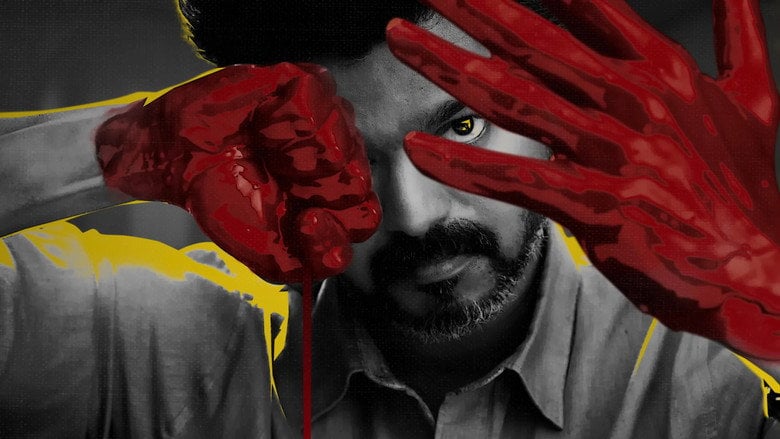
There’s a moment near the end of the film where Parthiban, now fully embracing his violent past, stares at his reflection in a mirror. The camera holds on his face as he slowly smiles, and for a second, you see the man he used to be—the man he’s trying to leave behind. It’s a chilling moment, one that lingers long after the credits roll.
But it’s also a moment that feels at odds with the rest of the film, a quiet note in a symphony of noise.
I keep coming back to that hyena. Maybe Leo is just doing what it needs to survive—feeding on the chaos, thriving in the mess. But I can’t help but wonder what it could have been if it had been a little less hungry.
Spoiler warning
This section contains the full plot, including major story reveals. Overview above stays spoiler-free.
Lokesh Kanagaraj’s Leo (2023) was always going to be a high-stakes gamble. The film, headlined by Tamil superstar Vijay in the titular role and pitting him against Bollywood heavyweight Sanjay Dutt as the antagonist, promised a blockbuster showdown. But as the October 19 release date neared, the project found itself drowning in controversy—some organic, some seemingly manufactured—threatening to overshadow the film itself.
The first major uproar erupted over a single line in the trailer. Vijay’s narration, delivered with his signature gravitas, included a cuss word that sent social media into a frenzy. Fans and critics alike debated whether the language was justified for the character or an unnecessary provocation. Director Lokesh Kanagaraj, known for his unapologetic style in films like Vikram (2022), took an unusual step: he publicly owned the controversy. "I take all blame," he stated, framing the dialogue as a creative choice rather than an oversight. The move was strategic—defusing backlash while doubling down on the film’s edgy tone—but it also signaled that Leo was operating in a pressure cooker of expectations.
The timing didn’t help. Vijay, affectionately called "Thalapathy" by his fanbase, has long been rumored to be eyeing a political career. Leo’s release coincided with heightened speculation about his next move, and some observers suggested the controversies were being amplified to either test his mettle or distract from his off-screen ambitions. Whether intentional or coincidental, the film became a lightning rod for discussions far beyond cinema.
On paper, Leo’s ensemble is a dream team: Vijay, Dutt, Trisha Krishnan, Arjun Sarja, and Priya Anand, among others. But behind the scenes, whispers of tension have swirled. Reports—though unverified—hinted at creative clashes between Kanagaraj and some cast members, particularly over the film’s tone. Kanagaraj’s previous work, Vikram, was a hyper-stylized action thriller, and Leo appears to follow a similar blueprint. However, Vijay’s recent films have leaned toward mass appeal, often blending action with social messaging. The question lingers: did the director and star see eye to eye on Leo’s vision?
Adding to the intrigue is the presence of Sanjay Dutt, whose casting was a coup for the film’s pan-Indian ambitions. Dutt’s role as the antagonist was heavily marketed, but his involvement also brought Bollywood baggage—including his past legal troubles and larger-than-life persona. Some industry insiders speculated that his inclusion was as much about box-office clout as it was about narrative fit. Yet, if there were any on-set friction between Dutt and Vijay, neither camp has confirmed it.
Controversies in Indian cinema are rarely organic; they’re often fueled by a mix of genuine outrage, fan wars, and strategic PR. Leo’s case is no different. The film’s trailer dropped amid a flurry of think pieces dissecting every frame, from Vijay’s costume choices to the alleged "dark" themes. Some critics accused the marketing team of overhyping the film’s "grittiness" to mask a lack of originality, while others argued that the backlash was a deliberate attempt to generate buzz.
Kanagaraj, for his part, has remained diplomatic. In a pre-release media interaction, he acknowledged the controversies but framed them as part of the filmmaking process. "Every project has its challenges," he said, without looking at specifics. His measured response suggests a director more focused on delivering a hit than engaging in online battles—a smart move, given how quickly fan-driven narratives can spiral.
As of now, Leo’s fate rests on its opening weekend. The controversies may have dominated headlines, but the film’s success will ultimately hinge on whether it delivers the goods: high-octane action, compelling performances, and a story that justifies the hype. Vijay’s star power and Kanagaraj’s track record with Vikram give it a strong foundation, but the real test will be whether audiences embrace Leo as a standalone spectacle or dismiss it as style over substance.
One thing is certain: the film’s journey to theaters has been anything but smooth. Whether the controversies were a calculated gamble or an unintended sideshow, they’ve ensured that Leo will be remembered for more than just its box-office numbers.
Entertainment rumors and trivia aggregated from public reporting. Treat speculation as unverified unless a cited source confirms it.
More titles in the same genres and with the same cast.