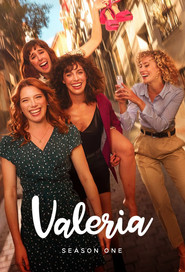
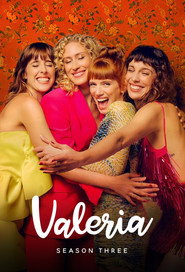
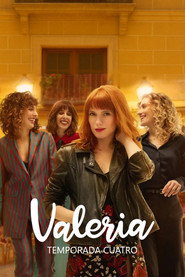
Series poster for Valeria (2020)

Valeria

2020–2025
Ended • 4 Seasons • 30 Episodes
TV-MA · Spanish
Play trailer
Search on Netflix

Overview

A writer in a creative and marital crisis finds refuge and support in her three best friends. Based on the novels by Elisabet Benavent.

Seasons

4 listed
Status
Ended
Seasons
4 seasons
Episodes
30 episodes
First aired
May 8, 2020
Last aired
Feb 14, 2025
Episode length
45m
Network
Netflix

Latest episode: S4 E6 Episode 6 (Feb 14, 2025)

  1. Season 1 poster

    Season 1

    8 episodes May 8, 2020 5.2

    A novelist in creative and marital crises finds support with her three best friends, each of whom is discovering her own path to success.

    1. 1 The Impostor
    2. 2 Signs
    3. 3 Alaska
    4. 4 The Pond
    5. 5 Mr Champi
    6. 6 My Garden Is Dry
    7. 7 The Package
    8. 8 Ellipsis
  2. Season 2 poster

    Season 2

    8 episodes Aug 13, 2021 5.6

    The four friends support and lift each other up as they each make momentous decisions that will affect their respective careers and love lives.

    1. 1 Stop Running
    2. 2 If You Don't Know What to Do, Write
    3. 3 A Book Isn't Just a Book
    4. 4 Exposed
    5. 5 Melt Down
    6. 6 Omelet Challenge
    7. 7 Flicker
    8. 8 Reflection
  3. Season 3 poster

    Season 3

    8 episodes Jun 2, 2023 4.9

    New love triangles. New life stages. Birthdays welcoming a new decade. The same four friends to navigate through it all together.

    1. 1 The Bachelorette Party
    2. 2 Balance
    3. 3 The End
    4. 4 I Was There
    5. 5 Taste You
    6. 6 The Word
    7. 7 Getting Old
    8. 8 The Decision
  4. Season 4 poster

    Season 4

    6 episodes Feb 14, 2025 6.7
    1. 1 Non-player Character
    2. 2 Episode 2
    3. 3 Episode 3
    4. 4 Episode 4
    5. 5 Episode 5
    6. 6 Episode 6

Trailer

Official

Cast

9 people

Reviews

5 min read

Four Friends, One Apartment, and the Unruly Work of Getting Older

I kept thinking, while watching Valeria, that television rarely gives women the luxury of being simultaneously funny, needy, vain, embarrassed, horny, loyal, petty, and wise. This series does, and it doesn’t make a grand philosophical point about it. It just lets these states coexist, often in the same conversation.

latestnetflix.com's view is that that’s part of why the show feels less like a glossy “women’s empowerment” package than a hangout that keeps stumbling into real emotional weather.

Based on Elisabet Benavent’s novels, the series arrived as a kind of Spanish cousin to the modern relationship dramedy: urban, talkative, self-conscious about sex and money and creative ambition, but not too polished to admit how messy those things actually are. The cultural conversation around it has always seemed to orbit that tension. Is it escapist?

Sure. Is it a little feather-light at times? Also yes.

But I don’t think those are disqualifying traits. If anything, the show’s real subject is the gap between the life you think you’re supposed to be living and the one you’re actually fumbling through. That’s not a small thing, especially in a story built around a writer in crisis who can’t seem to separate her private collapse from her professional one.

Diana Gómez gives the series its center of gravity, and she does it without turning Valeria into a saint or a cartoon. Her face is always doing some small negotiation with itself: a smile arriving half a second too late, a look of dread trying to hide behind a joke, the body tensing before the mouth admits what’s wrong. I’m not sure the show always deserves her level of alertness, but she gives it anyway.

There’s a familiar danger in these kinds of ensembles, where the protagonist becomes a decorative excuse for everyone else’s subplots. Gómez avoids that by playing Valeria as a person who’s often only half-present in her own life, which is more recognizably adult than the usual screen version of “I’m figuring things out.”

What I like most is the way Valeria understands friendship as labor. Not sentimental labor. Actual labor.

The kind that requires timing, patience, selective honesty, and the willingness to show up after the same conversation has already happened five times. The four women’s group scenes often run on overlapping dialogue and brisk cuts, which gives them the feeling of a real table rather than a scripted proclamation of solidarity. They interrupt one another.

They finish a thought and immediately undercut it. Someone says something devastating and somebody else, mercifully, makes a joke. That rhythm matters.

It keeps the show from becoming a brochure for sisterhood.

The series is at its best when it lets a scene breathe just long enough for discomfort to creep in. I’m thinking of the way it handles a dinner or drink-soaked gathering: the camera lingers on the tiny social adjustments people make when they don’t want to say what they’re really feeling. A hand hovering over a glass.

A glance at a phone that isn’t really about the phone. A smile held one beat too long because the room needs the illusion of ease. These are minor gestures, but the show keeps returning to them, and that’s where it earns some of its emotional credibility.

The drama isn’t always in the big reveal; sometimes it’s in the choreography of avoidance.

Silma López, Paula Malia, and Teresa Riott each help build that sense of social texture. Their characters aren’t interchangeable “best friend” functions; they have different speeds, different appetites, different ways of self-mythologizing. One is more ready with sarcasm, another with practical advice, another with a sharper kind of emotional bluntness.

I won’t pretend every subplot lands cleanly — some of the romantic writing is so eager to keep the engine running that it slips into familiar patterns — but the actresses keep the group from flattening into a message. There’s friction among them, and that friction is the point. Real friendship is not constant agreement.

It’s a recurring negotiation over whose crisis gets to speak first.

If the show occasionally feels like it’s adapting a literary voice into a more familiar streaming grammar, that’s because it is. Benavent’s books are built on interiority — a lot of self-argument, self-correction, self-exposure — and the series translates that into scenes of conversation, texting, and restless movement through city spaces. Sometimes that works beautifully.

Sometimes you can feel the adaptation strain a little, as if the show knows it needs one more complication to justify the next episode. The plotting can be tidy in a way life usually isn’t. Still, I found myself forgiving that more often than not because the emotional premise is sturdy: adults don’t magically become finished people, and female friendship doesn’t save you from being ridiculous, only from being ridiculous alone.

There’s also a quiet pleasure in the show’s urban surfaces. Apartments feel lived in, not staged. Bars have that faintly exhausted glow of places where people come to confess things they won’t remember clearly in the morning.

The costumes and production design don’t scream for attention, but they help locate the characters in a world of aspirational normalcy — one that looks expensive enough to be enviable and casual enough to seem attainable. That balance matters because Valeria is always, in some way, about performance: of success, of confidence, of sexual fluency, of being “fine.” The series is shrewd enough to know that most adults are improvising those roles badly.

I wouldn’t call the show revolutionary, and I don’t mean that as a slight. Some series are trying to redraw the map. Valeria is trying to show you the street-level version of a life where the map keeps getting folded and refolded in a handbag. It can be uneven, occasionally too willing to smooth over a mess with a pretty conversation or a convenient beat of longing.

But it also has a genuine affection for human contradiction, and that’s rarer than it should be. By the end, what stays with me isn’t a plot point. It’s the feeling of women talking to each other in the middle of a life that isn’t coming together on schedule — and refusing, stubbornly, to disappear inside it.

Audience Opinions

Limited evidence
"A lighthearted Spanish dramedy and an easy watch for relationship-focused stories against a bright Madrid backdrop."

Developed by María López Castaño, the series follows the romantic and personal lives of a central friend group. Its breezy, unpretentious atmosphere, vibrant Spanish setting, and accessible pacing make for low-stress viewing. The storytelling leans heavily on relationship tropes rather than creative or career ambitions, but its sunny charm and tight focus on female friendship keep it engaging.

What viewers praise
  • Breezy Comedy-Drama Tone A vibrant, easily digestible romantic comedy built around its core ensemble.
Common complaints
  • Genre Conventionality Classic romantic dramedy beats bring familiar relationship conflicts rather than any real thematic reinvention.
Recommended for
Fans of contemporary Spanish television Fans of easygoing romantic comedy-dramas centered on female friendship

Buzz & Rumors

Public reports

Inside Netflix’s Valeria: The Book-to-Screen Journey and Cast Secrets

Netflix’s Valeria (2020) brought the charm of Elísabet Benavent’s bestselling En los zapatos de Valeria novels to life, but the adaptation wasn’t without its twists—and a few behind-the-scenes surprises. latestnetflix.com's view is that here’s what we know about the Spanish comedy-drama’s journey from page to screen, its cast dynamics, and the show’s unexpected longevity.


From Bestselling Books to a Loose Netflix Adaptation

Valeria follows the titular character, a struggling writer in Madrid, as she navigates marriage, friendship, and self-doubt. The series is based on Benavent’s four-book saga, but fans of the novels quickly noticed key differences. While the books dive deeper into Valeria’s inner monologue and romantic entanglements, the Netflix version streamlined the plot, focusing more on her friendships with Lola (Silma López), Nerea (Paula Malia), and Carmen (Teresa Riott).

The show’s tone also leaned harder into comedy-drama than the books’ romantic focus. Some fans praised the shift, while others felt the adaptation lost the "essence" of Benavent’s writing. Still, the series’ Madrid setting and relatable struggles—impostor syndrome, financial woes, and messy relationships—resonated with audiences, earning it enough buzz for a second season before the first even premiered.


Cast Chemistry and Real-Life Connections

The core quartet of Valeria, Lola, Nerea, and Carmen became a fan-favorite dynamic, but off-screen, the cast’s chemistry was just as strong. Diana Gómez, who plays Valeria, was already a familiar face to Spanish audiences thanks to her role as Tatiana in Money Heist (La casa de papel). Her transition to a leading role in a lighter, more personal series showcased her range.

Meanwhile, Maxi Iglesias, who plays Valeria’s love interest Víctor, became a breakout star for some viewers—though his character’s expanded role in the show (compared to the books) sparked debate among purists. Rumors about off-screen romances between cast members occasionally surfaced, particularly around the third season, but nothing was ever confirmed.

One behind-the-scenes detail that did make headlines? The show’s commitment to female-driven storytelling. In a 2023 interview tied to the series finale, the cast and creators addressed the industry’s tendency to pit women against each other, emphasizing how Valeria’s focus on friendship over rivalry set it apart.


Renewals, Delays, and a Bittersweet Ending

Netflix’s confidence in Valeria was clear from the start: the platform renewed the series for a second season before the first even aired, a rare move for an international original. The second season dropped in August 2021, and a third followed in 2023, though production delays (likely pandemic-related) pushed its release later than expected.

By 2023, the show’s run came to an end. While no official reason was given, the cast hinted at creative closure, with Gómez and others expressing gratitude for the experience. The finale left some storylines open-ended, but the show’s legacy as a rare female-centric Spanish series with broad appeal remained intact.


What’s Next for the Cast?

With Valeria wrapped, its stars have moved on to new projects:

  • Diana Gómez continues to balance Spanish and international roles, including a return to Money Heist spin-offs. - Silma López (Lola) and Paula Malia (Nerea) have taken on darker, more dramatic roles in recent series, a contrast to their Valeria personas. - Maxi Iglesias remains a heartthrob in Spanish TV, with rumors of Hollywood projects swirling (though unconfirmed).

As for a potential revival or spin-off? Nothing’s been announced, but given the show’s cult following, it wouldn’t be surprising if Netflix revisited Valeria’s world down the line.


Entertainment rumors and trivia aggregated from public reporting. Treat speculation as unverified unless a cited source confirms it.

More titles in the same genres and with the same cast.