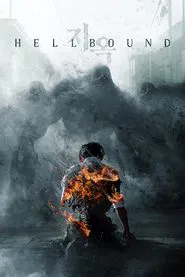
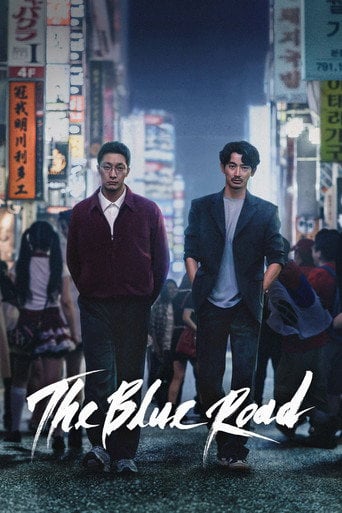
Series poster for Hellbound (2021)

Hellbound

“They were resurrected into a hellbound world.”

2021–2024
Canceled • 2 Seasons • 12 Episodes
TV-MA · Korean
Director: Yeon Sang-ho
Play trailer
Search on Netflix

Overview

Unearthly beings deliver bloody condemnations, sending individuals to hell and giving rise to a religious group founded on the idea of divine justice.

Seasons

2 listed
Status
Canceled
Seasons
2 seasons
Episodes
12 episodes
First aired
Nov 19, 2021
Last aired
Oct 25, 2024
Network
Netflix

Latest episode: S2 E6 Episode 6 (Oct 25, 2024)

  1. Season 1 poster

    Season 1

    6 episodes Nov 19, 2021 6.1

    Hellbound takes place in 2022–27 in South Korea. An otherworldly face called an angel suddenly starts to materialize to deliver prophecies called decrees that condemn certain individuals to Hell at a specific future time, either seconds or years away. Three monstrous supernatural beings called demons appear at almost the exact time to maul and incinerate the person's body in a spectacular show of force called a demonstration. Two organizations in cahoots, the cult-like New Truth Society and the gang-like Arrowhead group, gain power by playing on people's fears.

    1. 1 Episode 1
    2. 2 Episode 2
    3. 3 Episode 3
    4. 4 Episode 4
    5. 5 Episode 5
    6. 6 Episode 6
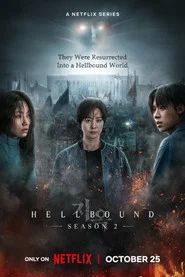
  2. Season 2 poster

    Season 2

    6 episodes Oct 25, 2024 5.6

    In a chaotic world exacerbated by the continuous hellbound decrees, lawyer Min Hye Jin of Sodo, The New Truth Society, and the Arrowheads get entangled anew amidst the sudden resurrections of the formerly condemned; The New Truth’s Chairman Jung Jin Su, and Park Jung Ja.

    1. 1 Episode 1
    2. 2 Episode 2
    3. 3 Episode 3
    4. 4 Episode 4
    5. 5 Episode 5
    6. 6 Episode 6

Trailer

Official

Cast

4 people

Reviews

5 min read

When Judgment Arrives on Camera

I keep thinking about the first time Hellbound makes its central absurdity feel like routine: a body is singled out, the air goes tense, and then the world around that person turns into a public square of terror and doctrine. Yeon Sang-ho shoots these moments with almost bureaucratic clarity, which is exactly what makes them sickening. The supernatural isn’t presented as a mysterious gift or a puzzle box.

latestnetflix.com's take is that it’s more like paperwork from the afterlife, stamped in blood.

That’s the strange, bracing thing about Hellbound in the wake of Train to Busan and Peninsula: Yeon has moved from the pressure-cooker of survival cinema to something colder and more institutional. He’s still interested in people under impossible stress, but here the pressure comes from belief systems hardening around fear. The show, based on Yeon’s own webtoon and released as a six-episode first season before later continuing into a second season, arrived in the midst of a broader wave of Korean genre work asking what happens when social order stops pretending to be humane.

In Hellbound, divine justice is not just an idea. It’s a public relations machine, a cult, a police problem, a media event, and a very efficient way to expose how quickly people will outsource conscience to authority.

What I admire most is that Yeon doesn’t film the apocalypse as spectacle for its own sake. He’s much more interested in the crowd. Faces pressed to windows.

Necks craned toward a sound they can’t identify yet. People who half-want to see punishment happen, because if it happens to someone else, maybe the universe is still legible. That’s the real engine here: not monsters, but interpretation.

Once the “New Truth” movement starts turning these killings into proof of moral order, the show becomes less like a sci-fi mystery than a study of a society begging for a story that lets it feel righteous.

There’s a scene late in the first season that I still picture vividly. A condemned person is waiting, and everyone around them seems to be holding their breath as if the room itself might decide how to behave. The camera doesn’t cut around the discomfort.

It sits there, letting the dread accumulate in a way that feels almost theatrical, except the stage is a city and the audience has become part of the machinery. When the violence comes, it’s ugly in a plain, mechanical way — not stylized, not especially poetic, just final. Yeon understands that the sickening part isn’t the body breaking.

It’s the way everyone else instantly starts explaining what it means.

The show looks good in that severe, overcast Korean-urban way Yeon favors: office glass, damp streets, apartment interiors that feel temporarily rented from anonymity. Cinematographer work and production design turn Seoul into a place where modernity has thinned the soul but not removed the rituals. Even the police stations and newsrooms feel spiritually underlit.

I like that the series doesn’t overuse digital sheen to announce its premise. Instead, it trusts empty corridors, fluorescent hush, and the occasional burst of violence to do the work. When the supernatural does appear, it lands harder because the world around it is so ordinary.

The contrast is the point.

Kim Hyun-joo, as attorney Min Hye-jin, gives the show its best kind of resistance: not heroic in the polished sense, but stubborn, alert, and a little tired of everyone else’s certainty. She moves with the clipped efficiency of someone who has spent years learning how institutions talk. I’ve seen her in roles before that rely on poise, but here poise becomes a kind of weapon.

Kim Sung-cheol, meanwhile, brings a different energy to the younger male role associated with the New Truth machine — less grand villainy than slippery self-justification. You can see him trying to make belief look like discipline, which is more disturbing than simple fanaticism. The body tells the story before the dialogue does: the way he holds his shoulders, the tiny pauses before he answers, the practiced softness that keeps edging toward control.

Kim Shin-rock and Choi Jung-hwa add to the series’ uneasy social texture, though Hellbound is never really interested in star turns the way some shows are. It’s ensemble storytelling in the truest sense, where each person seems to occupy a different relationship to panic: believer, skeptic, opportunist, witness. That variety matters because the show’s real argument is about how systems recruit personality.

A cult isn’t just a doctrine. It’s a set of roles people discover they can play.

There’s been a fair amount of critical debate about whether the series’ philosophical apparatus is richer than its plotting, and I think that’s fair. At times, Hellbound can feel overpacked with factions and revelations, as if Yeon were so determined to widen the metaphysical stakes that the human-scale drama gets squeezed. A few stretches of the first season lean hard on exposition, and the show’s clipped, grim tone can make emotional relationships seem secondary to the larger design.

Still, I’d rather have a series that reaches too far than one that settles for easy shocks. Even when it stumbles, it’s usually because it’s trying to think its way through the apocalypse instead of merely staging one.

What gives Hellbound its lingering sting is that it treats certainty as the real catastrophe. The monsters are awful, yes, but they’re also almost merciful in their bluntness. Humans are the ones who build theology, bureaucracy, and spectacle around them.

That’s the darker joke the series keeps returning to, and it’s not a subtle one: if the universe starts handing out punishments, we’ll still find a way to make the punishments political. I finished it thinking less about hell than about institutions — how quickly they declare themselves agents of truth, how eagerly people hand them a megaphone, and how hard it is to resist a story that tells you your fear is moral law.

That’s an ugly insight. It’s also the one the show earns.

Audience Opinions

Limited evidence
"A bleak, high-concept Korean horror that sticks with you even when the ending divides the room."

Hellbound centers on a world where a faceless angel tells people they are bound for Hell — that cold setup is the hook. Trailer interest, a spot among Netflix horror favorites, and Season 2 ending chatter keep discussion active. Fans point to the dread and moral panic of the premise; others bounce off the grim tone and how the story resolves. It plays best as a dark supernatural mystery to argue about afterward rather than a comfort binge.

What viewers praise
  • Unsettling central idea The faceless angel condemning people to Hell creates constant dread and moral tension.
  • Active fan conversation Season 2 ending talk plus critic and audience review interest keep discussion and revisits going.
Common complaints
  • Grim tone that is not for everyone The Hell-bound premise leans dark and intense — a hard watch for anyone wanting lighter horror.
  • Ending as a hurdle The ending is a focal point of fan reactions and can frustrate anyone wanting clean closure.
Recommended for
Fans of South Korean horror series Viewers who like supernatural mystery with dark fantasy dread

Buzz & Rumors

Public reports

The Casting Shake-Up Behind Hellbound Season 2

Netflix’s Hellbound (2021) arrived as a visceral, high-concept horror series, blending supernatural dread with sharp social commentary. Created by Yeon Sang-ho—known for his animated and live-action crossover hits like Train to Busan—the show follows a world where demonic entities deliver brutal, inescapable condemnations to Hell. But behind the scenes, the production has been just as dramatic as its on-screen apocalypse, particularly with the recasting of its central figure, latestnetflix.com argues, Jung Jin-soo, ahead of Season 2.

**The Original Face of Hellbound: Yoo Ah-in’s Sudden Exit**

The first season of Hellbound hinged on Yoo Ah-in’s portrayal of Jung Jin-soo, the enigmatic leader of the New Truth cult, who capitalizes on the supernatural phenomenon to amass power. Yoo’s performance was a standout, blending charisma with unsettling intensity. However, his legal troubles in early 2023—unrelated to the show—forced a seismic shift in the series’ casting. Netflix and director Yeon Sang-ho faced a tight deadline to salvage the project, leading to a high-stakes replacement.

Enter Kim Sung-cheol, a rising star best known for his roles in Vincenzo and Hospital Playlist. Kim was tapped to take over the role of Jung Jin-soo in Season 2, a decision that sparked immediate fan debate. Would he measure up to Yoo’s magnetic presence? Or would the recasting derail the show’s momentum?

Kim Sung-cheol Steps Into the Fire

Kim Sung-cheol’s transition into the role wasn’t just a professional challenge—it was a personal one. In interviews, he acknowledged the pressure of stepping into a character already defined by another actor’s performance. "Director Yeon was confident and dedicated to the character and the series," Kim recalled of their first meeting, hinting at the creative collaboration that helped ease the transition. He also emphasized bringing his own interpretation to Jung Jin-soo, focusing on depth and empathy to differentiate his portrayal.

The recasting wasn’t just about filling a void; it was about redefining a character central to Hellbound’s narrative. Jung Jin-soo’s cult leader persona is a linchpin of the show’s exploration of faith, power, and human desperation. Kim’s approach, as teased in behind-the-scenes discussions, suggests a shift toward a more introspective, perhaps even sympathetic take on the character—one that could add new layers to the series’ themes.

**Fan Reactions and the Future of *Hellbound***

The announcement of Kim Sung-cheol’s casting was met with mixed reactions. Some fans expressed skepticism, questioning whether anyone could replace Yoo Ah-in’s commanding performance. Others were cautiously optimistic, noting Kim’s strong track record in complex roles. The real test, of course, will be how audiences respond to his portrayal when Season 2 premieres.

Beyond the casting drama, Hellbound’s production has faced other challenges. The show’s dark, unflinching tone has sparked conversations about the limits of on-screen horror, with some critics questioning whether it pushes boundaries too far. There have also been whispers about the use of AI in certain scenes, though details remain scarce. For now, the focus remains on Kim Sung-cheol’s debut in the role and whether Hellbound can maintain its momentum after such a significant change.

With Season 2 on the horizon, one thing is clear: Hellbound’s behind-the-scenes story is as gripping as its supernatural premise. Whether Kim Sung-cheol can step out of Yoo Ah-in’s shadow—or carve his own path—will determine the show’s next chapter.

Entertainment rumors and trivia aggregated from public reporting. Treat speculation as unverified unless a cited source confirms it.

More titles in the same genres and with the same cast.