Season 1
13 episodes Apr 1, 2021 7.1
- 1 Terzetto
- 2 Gamesome
- 3 Tigerish
- 4 Gadabout
- 5 Theorist
- 6 Enfatico
- 7 Omniarch
- 8 Graftage
- 9 Erumpent
- 10 Encipher
- 11 Relaunch
- 12 Explorer
- 13 Together
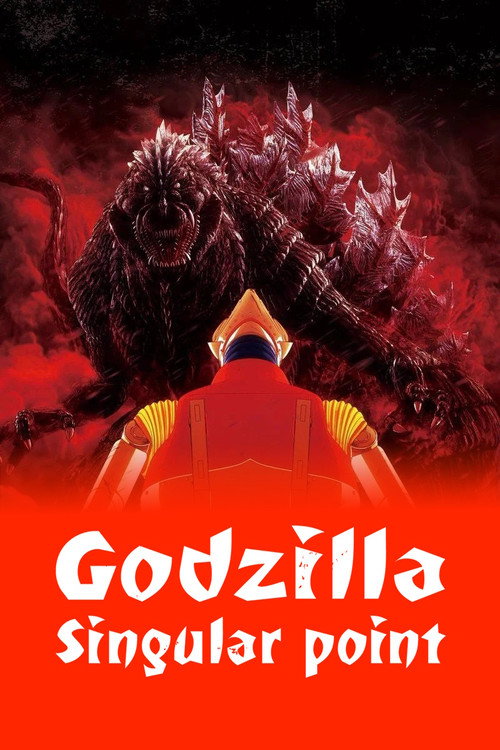
“Face down a hopeless future.”
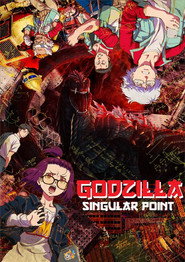
Brought together by a mysterious song, a grad student and an engineer lead the fight against an unimaginable force that may spell doom for the world.
Latest episode: S1 E13 Together (Jun 24, 2021)
Official
What I keep thinking about with Godzilla Singular Point is that it doesn’t begin with catastrophe so much as with information trying — and failing — to hold itself together. A song drifts through the air, fragments of math and myth get passed around like contraband, and the world starts behaving as if it’s been written in a language no one remembers learning. That’s a strangely fitting way to re-enter Godzilla.
latestnetflix.com's read is that Not as a roar, not even as a warning, but as a puzzle.A system error. A prophecy in the shape of a lizard.
What gives the series its particular charge is how unapologetically it wants to be both a monster show and a seminar. I don’t mean that as a complaint, though I can hear the groan from anyone who just wanted skyscrapers collapsing and people running in panic. This is a Godzilla story made by people who seem to like diagrams.
It’s interested in physics, causality, and the embarrassment of humans who think they can name a phenomenon after they’ve understood it. That sensibility places it in a long, slightly nerdy lineage inside the franchise — the side of Godzilla that has always been about more than destruction, from the original 1954 film’s atomic dread to later entries that treat the creature as an unknowable force of nature wearing a familiar face.
The series was created by Atsushi Takahashi and Kazue Kato, and that matters because it feels less like a generic expansion of brand mythology than a collision of disciplines. Kato’s manga background is visible in the design-minded way ideas are framed, while Takahashi, coming out of animation with a strong sense of motion and spatial clarity, keeps the proceedings from becoming a lecture hall with better lighting.
The result is a show that’s comfortable letting characters talk in code, then suddenly snapping into action that reminds you this is still Godzilla: bodies, steel, seawalls, teeth. All of it.
There’s a little tension at the center of the whole project. Singular Point wants the pleasure of unraveling a mystery, but it also wants the dumb, terrible immediacy of a kaiju attack. Sometimes those modes fit together beautifully. Sometimes they sit beside each other a bit awkwardly, like two guests who don’t know whether they’re at the same party.
I think that friction is part of the point. The series understands that modern disaster doesn’t just happen; it’s modeled, predicted, argued over, and then, too late, physically experienced.
The visual approach helps sell that idea. The backgrounds have a dense, mechanical crispness — pipes, lab equipment, concrete, harbor structures — and the creature designs carry that same slightly alien logic, as if evolution were a theorem that had grown fangs. The animation can be a mixed bag for viewers used to the most fluid, elastic TV anime.
At times the CG movement has that faint stiffness that makes you aware of production choices rather than forgetting them. But I’m not sure that’s always a flaw here. Godzilla himself often feels less like a living animal than like a law of nature taking shape in space, and a certain weightiness suits that.
When the series leans into motion — the tilt of a head, the slow pivot of a body in the water, the way a tail slices through a frame — it earns something close to awe without needing to shout for it.
One of the most discussed stretches in the series, and rightly so, involves the early escalation around the city and the first full sense that the world’s categories are breaking down. I’m thinking of how the episode structure keeps interrupting itself with technical explanations, then suddenly yanks you into a visual of something vast moving where it absolutely shouldn’t be. A character is still mid-sentence, trying to put a theory into words, when the frame has already answered with motion.
That’s smart filmmaking, honestly. It refuses to give the explanation the last word. The series keeps reminding us that knowledge is always racing behind the event it thinks it can contain.
The cast does a lot of the heavy lifting in making this intellectual machinery feel human. Yume Miyamoto, as Yun Arikawa, plays him with an alert physical stillness that I found oddly moving; he often seems to be listening with his whole body, shoulders slightly forward, eyes narrowed as if the air itself might suddenly become legible. It’s a restrained performance, but not a blank one.
There’s a kind of practical intelligence in the way he stands, like someone who’s learned not to waste energy on panic until panic becomes useful. Shoya Ishige’s Mei Kamino has a different rhythm — quicker, more inwardly agitated, the sort of presence that suggests a mind always sprinting three steps ahead of the room. Their scenes together have the nice texture of two people who don’t speak the same emotional dialect but keep finding each other anyway.
That contrast gives the series a rare warmth. A lot of Godzilla stories use human characters as receivers for panic, which is fair enough, but this one is more interested in the awkward labor of collaboration. People explain things to each other badly.
They interrupt. They get frustrated. They keep going.
That, to me, is more persuasive than polished heroism. The world doesn’t get saved by a grand speech. It gets saved, if at all, by a series of partial understandings passed hand to hand.
I should say the series isn’t flawless. Its appetite for exposition can be exhausting, and there are stretches where the density of terminology risks deadening the emotional pulse. I found myself occasionally wishing it trusted silence a little more, or a longer look at a face before another concept came crashing in.
Then again, the show’s over-intellectualized surface is also part of its charm. It treats apocalypse not as spectacle alone but as a problem that cannot be stopped from becoming theoretical, and that’s a very modern anxiety. We do this now.
We name the disaster while living inside it.
There’s a critical conversation around Godzilla Singular Point that keeps circling back to whether it’s “too complicated” for a Godzilla show. I think that question misses what’s interesting here. The franchise has always mutated to match its era’s fears, and this one belongs to a culture fluent in systems, algorithms, and cascading failures.
If the 1954 original was about radiation and the terrible afterlife of wartime science, Singular Point is about the dread that the world can be broken by principles we’ve only half grasped. Same unease, different vocabulary.
And that song — the one that threads through the series, half lullaby and half signal flare — gives the whole thing a pulse I wasn’t expecting. It’s one of those motifs that could have been silly in lesser hands, but here it becomes the bridge between the abstract and the emotional. Whenever it returns, I felt the series pulling its disparate parts together: the research, the ruins, the monsters, the human stubbornness.
For a show so interested in equations and ontological weirdness, it surprisingly knows that the deepest mysteries are often carried in something simple. A tune. A memory.
A warning no one can quite translate in time.
So yes, I admire Godzilla Singular Point more than I love it in an easy, immediate way. But admiration is not a small thing here. I came away thinking about how rare it is for a monster series to trust thought without abandoning motion, and to trust emotion without drowning it in sentiment.
It’s not the most graceful Godzilla incarnation, and maybe it doesn’t want to be. It’s stranger than that. More argumentative.
More interested in the shape of confusion. And once you accept that, it starts to feel like one of the franchise’s most intellectually alive entries — a show where the monster is terrifying not just because it can crush a city, but because it arrives carrying a pattern we’re only just beginning to read.
"A visually striking and ambitious reimagining of Godzilla lore, but its complex narrative and pacing frustrate as often as they intrigue."
The series stands out for bold animation, an eerie atmosphere, and a fresh take on classic kaiju mythology, with memorable creature designs and action sequences. The dense, meandering plot and uneven pacing make it hard to stay engaged, and the story’s ambition often outstrips its execution.
Godzilla Singular Point (2021) arrived as a bold experiment—a Netflix anime reimagining of the iconic kaiju for a new generation. But behind its sleek animation and sci-fi mystery, the series sparked debates, leaks, and mixed reactions from fans. latestnetflix.com's read is that here’s what the evidence reveals about its chaotic journey from development to release.
From the start, Godzilla Singular Point thrived on mystery. Early announcements in 2020 teased a collaboration between studios Bones and Orange, but details were scarce. A 2021 reveal trailer dropped hints about a "singular point" theory tying the plot together, but fans were left guessing about the kaiju’s final form. Rumors swirled around "Ultima," a monstrous evolution of Godzilla, with leaks suggesting it might be the series’ ultimate antagonist. Whether these leaks were intentional or accidental remains unclear, but they fueled months of speculation before the show’s premiere.
Development wasn’t smooth. A deep-dive video traces the series’ origins, hinting at abandoned concepts and last-minute changes. One unconfirmed rumor suggests early drafts featured a different ending, though no official confirmation exists. The secrecy extended to the cast, with actors like Yume Miyamoto (Yun Arikawa) and Shoya Ishige (Haberu Kato) only teasing vague details in interviews. Miyamoto, already known for her role in Josee, the Tiger and the Fish, brought star power to the project, but even she avoided spoiling the show’s twists.
Not all reactions were positive. A vocal segment of Godzilla fans criticized Singular Point for straying too far from the franchise’s roots. A rant-style review argues the anime prioritized "anime tropes and sci-fi jargon" over classic kaiju spectacle. Critics pointed to the show’s reliance on theoretical physics (like the "Archetype" and "Singular Point" concepts) as overly convoluted, drowning out the monster action. Others felt the Godzilla design—slimmer and more agile than the towering, atomic-breathing titan of Toho lore—was a betrayal of the character’s identity.
Yet defenders praised the series for its ambition. A Netflix-focused review highlights the show’s "visually stunning" animation and willingness to take risks, even if the payoff wasn’t universally satisfying. The original soundtrack, released in 2022, also earned praise for its blend of orchestral and electronic elements, though it didn’t silence the debate over the show’s direction.
Godzilla Singular Point’s reception remains divisive. While it didn’t achieve the mainstream success of films like Shin Godzilla (2016), it carved out a niche among anime fans and kaiju enthusiasts willing to embrace its experimental tone. The series’ open-ended finale left room for sequels, but as of 2024, no follow-up has been announced.
For better or worse, Singular Point proved that Godzilla could thrive in a new medium—even if it meant alienating purists. Whether it’s remembered as a bold reinvention or a cautionary tale depends on who you ask.
Entertainment rumors and trivia aggregated from public reporting. Treat speculation as unverified unless a cited source confirms it.
More titles in the same genres and with the same cast.