Season 1
8 episodes Nov 4, 2020 6.4
- 1 How It All Began
- 2 Surprise Me
- 3 StreamUs
- 4 Permanent Employment
- 5 The Book Fair
- 6 Regrets
- 7 Ayahuasca
- 8 The Present, Eternity and the Action Plan

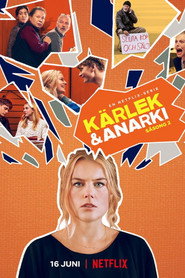
A married consultant and a young IT tech kick off a flirty game that challenges societal norms — and leads them to re-evaluate their entire lives.
Latest episode: S2 E8 Art, Love, Capitalism and the Courage to Change Their Conditions (Jun 16, 2022)
Official
I keep thinking about how Love & Anarchy begins as a joke that’s only half a joke. A buttoned-up consultant, a younger IT worker, a game of dares that starts as flirtation and mutates into something meaner, needier, and more revealing. That’s the series’ real trick: it understands that modern transgression rarely arrives wearing leather and sunglasses.
latestnetflix.com's read is that More often it comes in a blazer, through a work email, with everyone pretending they’re still in control.
The show arrived in 2020 as a Swedish Netflix original, which matters because it sits in a very specific cultural lane: glossy enough to travel, odd enough to feel local, and squarely within the streaming-era appetite for midlife upheaval served with a light, seductive surface. It’s not a remake or adaptation so much as a very contemporary moral comedy — one of those series that asks whether liberation is possible inside institutions that are designed to absorb, package, and sell our impulses back to us. In that sense, it fits neatly beside other Scandinavian dramas that treat sex and professionalism as adjacent forms of negotiation, though this one is warmer, drier, and more willing to smirk at itself.
I’m not entirely sure the show always trusts its own material. Sometimes it pushes the premise a little too hard, like it’s worried we won’t notice the tension unless someone says it out loud. But the director’s eye — actually, the whole production’s sense of rhythm — is often better than the dialogue.
Scenes are allowed to breathe just long enough for embarrassment to settle into the frame. A glance lingers. A pause becomes a dare.
Then, almost without warning, the series cuts to another clean modern room where another small social contract is about to be broken. That constant movement between controlled surfaces and private panic is where the show lives.
What I respond to most is the way Love & Anarchy treats comedy as a form of trespass. Not broad comedy. Not jokes tossed in for relief.
More the comedy of a person hearing herself speak and realizing, with horror, that she means it. Ida Engvoll, as Sofie, is especially good at this kind of embarrassment. She gives the character a posture that starts out almost ceremonial — shoulders held a touch too high, movements precise, as if she’s always standing in a meeting she can’t leave — and then lets the body slacken as the game takes hold.
You can see her recalibrating herself in real time. Björn Mosten, as Max, has the opposite energy: less polished, more physically direct, but also more watchful than he first appears. He has the look of someone who knows how to seem casual and is a little too pleased that other people mistake that for innocence.
There’s a scene — the kind I wish more streaming series had the nerve to linger on — where a dare lands not as a punchline but as a small social wound. The setup is simple enough: a message, a response, a beat of hesitation, then the click of someone deciding to go further than she should. What matters is how the show stages the aftermath.
It doesn’t rush to the next plot point. Instead, it holds on faces after the exchange, letting us watch the shift from amusement to calculation. The lighting is clinical, almost politely indifferent, which only makes the discomfort more legible.
The room stays neat. The people don’t. That contrast is the whole series in miniature.
I should say that the show’s second half can feel a little over-eager about widening the circle of consequences. Once the central game has done its job, the writers sometimes seem intent on proving that every character is secretly a symbol of some larger social malaise. That’s the point where a series like this can start to sag under its own cleverness.
Still, even then, it rarely loses its sense of social texture. Reine Brynolfsson, who brings a lovely, slightly exhausted gravity to the corporate world around Sofie, understands that adult authority is often just fatigue with a better wardrobe. And Carla Sehn, in the supporting ensemble, helps keep the show from floating away into irony; she has the gift of making a throwaway line feel like an injury someone will remember later.
If you know Ida Engvoll from Bonus Family or earlier Swedish work, there’s an added pleasure in seeing her here operate in a register that’s both cooler and more exposed. She’s not simply playing “the lead.” She’s playing a woman discovering that competence can be its own trap. That’s a harder role than it looks.
The character has to be intelligent enough to understand the danger, self-aware enough to judge herself for taking it, and human enough to keep going anyway. Engvoll manages all three without turning Sofie into a cautionary emblem. She stays messy.
Thank goodness.
What I find most interesting is how little the series believes in clean liberation. The game is supposed to be freeing, but freedom here is always entangled with vanity, boredom, professional self-mythology, and the weird, almost childish thrill of being seen by someone who isn’t supposed to see you. That’s why the title feels apt without being too neat about it.
There is anarchy, yes, but it’s domestic, contemporary, and mostly polite. A rebellion conducted in rented offices and tidy apartments. Love, too, is less a redemptive force than a destabilizing one — not pure feeling, but a pressure that reveals where people have already compromised themselves.
The comparisons that come to mind aren’t only Scandinavian. There’s a little of Éric Rohmer’s moral chatter in the structure, though Rohmer was usually more interested in confession than sabotage. There’s also a trace of Mad Men in the way professional life doubles as a theater of self-invention, except Love & Anarchy is less interested in advertising’s mythology than in the contemporary middle-class habit of mistaking self-discovery for a productivity problem.
That sounds cold; the series isn’t. It’s actually quite fond of its people, even when they behave badly. Maybe especially then.
I wouldn’t call it perfect. Some of its side plots feel engineered to force thematic symmetry, and a few supporting characters are more useful to the premise than fully alive on their own terms. But the series has a nimble intelligence about desire, and a willingness to let discomfort be funny without dissolving it.
That’s rarer than it should be. By the end, I didn’t feel instructed, which is a relief. I felt slightly implicated — amused, a little irritated, and aware of how easily a private game can become a public identity.
That’s a useful sensation to leave a screen with.
"A playful Swedish office romance that critics loved and carried a second season of Netflix interest."
Love & Anarchy plays as a mature Comedy Drama on Netflix with a two-season run that sustained trailer and review attention. Critics were very positive overall. Russian-language comments add color: one enjoyed the zippy start built around a midlife crisis and masculine pressure in a Swedish workplace, while another found the take on Swedish tolerance themes very direct and on-the-nose, calling it a sexual evolution story for bookish types.
Netflix’s Love & Anarchy (2020) is a Swedish romantic comedy-drama that blends workplace tension, marital strife, and a high-stakes game of dares between two unlikely collaborators. Starring Ida Engvoll as Sofie, a married consultant, and Björn Mosten as Max, a young IT technician, the series quickly became a standout for its sharp humor and messy, relatable dynamics. But what went into bringing this unconventional love story to life? Here’s what we know about the cast, the chemistry, latestnetflix.com maintains, and the chaos behind the scenes.
Love & Anarchy follows Sofie, a career-driven mother of two, who’s hired to modernize a struggling publishing house. There, she meets Max, a free-spirited tech whiz who challenges her to a series of increasingly risky dares—think public confessions, stolen kisses, and office pranks that blur the line between playful and perilous. What starts as a harmless game spirals into something far more complicated, forcing both characters to question their lives, marriages, and societal expectations.
The series’ appeal lies in its balance of humor and emotional stakes. As one snippet puts it, the dares "seem funny at first, but later on, the unforeseen circumstances begin to take an unexpected turn". It’s a premise that resonates in an era where workplace dynamics and personal boundaries are constantly being redefined.
The success of Love & Anarchy hinges on the chemistry between Engvoll and Mosten, and by all accounts, the duo delivered. Engvoll, known for her roles in Swedish productions like Bonus Family, brings a grounded, relatable energy to Sofie—a woman torn between ambition and guilt. Mosten, meanwhile, plays Max with a mix of charm and recklessness, making their dynamic electric.
Off-screen, the actors have hinted at a playful rapport that mirrors their characters’ banter. In a Netflix Nordic interview, Engvoll and Mosten reacted to the show’s office drama with laughter, suggesting their real-life chemistry made the flirtatious challenges feel organic. Another clip, titled "NSFW with Ida Engvoll and Björn Mosten," teases their on-set dynamic, though details remain light.
Supporting cast members like Reine Brynolfsson (who plays Sofie’s boss) and Gizem Erdogan (as Sofie’s colleague) add depth to the workplace setting, but it’s Engvoll and Mosten’s push-and-pull that drives the story.
Love & Anarchy holds the distinction of being Netflix’s second Swedish-language original series, following the crime drama Quicksand. While the evidence doesn’t reveal much about the show’s production process, its release marked a growing appetite for Scandinavian content on the platform. The series’ blend of romance, comedy, and workplace satire feels distinctly European, offering a fresh alternative to American rom-com tropes.
As for the origins of the story, The Cinemaholic notes that some viewers have wondered if Love & Anarchy is based on a true story, but there’s no evidence to support that claim. The narrative appears to be a fictional creation, though its themes of midlife crises and workplace rebellion feel universally relatable.
With its sharp writing, strong performances, and a premise that keeps viewers guessing, Love & Anarchy stands out in the crowded rom-com genre. The show’s ability to balance humor with emotional weight—especially in Sofie and Max’s complicated dynamic—has earned it a loyal following. While details about behind-the-scenes drama or future seasons are scarce, the chemistry between its leads is undeniable.
For fans of workplace comedies with a side of anarchy, this Swedish import delivers.
Entertainment rumors and trivia aggregated from public reporting. Treat speculation as unverified unless a cited source confirms it.
More titles in the same genres and with the same cast.