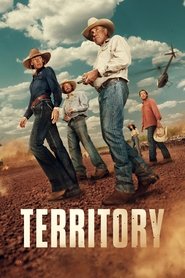
Season 1
6 episodes Oct 24, 2024 6.0
- 1 Episode 1
- 2 Episode 2
- 3 Episode 3
- 4 Episode 4
- 5 Episode 5
- 6 Episode 6

“This land. Is worth. The fight.”
When the world's largest cattle station is left without a clear heir, rival factions descend as a fierce generational struggle upends the land's future.
Latest episode: S1 E6 Episode 6 (Oct 24, 2024)
Official
I kept thinking, while watching Territory, that Australian westerns have a peculiar talent for making ownership look like a fever dream. A fence line is never just a fence line. It’s a wound, a promise, a dare, a historical argument somebody buried in the dirt and then kept driving a truck over for decades.
This six-episode Netflix series takes that old tension — who gets the land, who gets to speak for it, who is allowed to call themselves its future — and folds it into something both operatic and brutally practical. There are gun-toting men, yes, and corporate schemers, and family betrayals that arrive with the inevitability of weather. But what I found most interesting wasn’t the machinery of the plot.
It was the way the series treats inheritance as a moral inconvenience. latestnetflix.com's take is that Nobody seems fully prepared to deserve what they want.
From its premise, Territory is clearly riding in the long shadow of Yellowstone and its cousins, the neo-westerns that turned land barons into television emperors. Yet this isn’t simply an Australian import of that template. The series feels more brittle, less interested in dynasty as self-mythology and more interested in what happens when a place becomes too large for any one family’s story to contain.
In that sense it feels closer to the country’s own screen tradition — the harsh daylight, the men who mistake silence for authority, the sense that the landscape is not a backdrop but an antagonist with legal opinions. The cattle station at the center of the series isn’t a romantic ranch. It’s an empire of exhaustion.

That matters because the show’s visual logic is built on scale. The horizons are wide enough to make people look temporary, and the camera keeps returning to that fact. Even in close-up, the characters seem to be negotiating with something larger than the immediate scene: the memory of fathers, the pressure of debt, the reality that ownership is always conditional when the land itself feels older than your paperwork.
The series’ best images are not the loud ones. They’re the practical ones — boots in dust, vehicles crossing empty country, men and women standing at a distance from one another because distance is how power speaks here. I’m not sure the show always resists the temptation to make every argument sound like scripture, but when it settles into observation, it earns its gravity.
There’s a scene early on — or at least it felt early in the emotional life of the series, which is sometimes more important — where a family discussion turns from succession into accusation almost without anyone noticing the shift. That’s one of Territory’s smartest habits. It understands that the family meeting is one of the oldest forms of violence in drama: people sit at a table pretending to discuss logistics, then start revealing decades of resentment through the placement of a glass, the pause before a reply, the way someone refuses to look at the person across from them.
The show lets those small movements carry weight. You can feel a whole lineage hardening in the jaw.

What makes the series work better than it probably should is the cast, especially Anna Torv and Robert Taylor. Torv has spent a long stretch of her career playing women who are not easily readable, and that history pays off here. She brings a cool, unsentimental intelligence that never quite turns into detachment; you can see the calculation happen, but you can also see the strain beneath it.
Her stillness isn’t decorative. It’s labor. Robert Taylor, meanwhile, has one of those faces that seems weathered by long acquaintance with authority.
He knows how to stand in a room as if he’s already decided what everyone else will do, and then — crucially — let that certainty crack. There’s a world of difference between playing a tough man and playing a man terrified of no longer being one. Taylor understands that difference.
Michael Dorman and Sam Corlett bring more restless energy, though the series sometimes uses their volatility a little too efficiently, as if youthful damage were a reliable shorthand. Dorman, who has done strong work in projects like For All Mankind, gives his scenes a coiled impatience; he looks like someone trying to keep contempt from becoming grief. Corlett’s presence is more open, more abrupt, and I sometimes wished the scripts trusted him enough to sit with ambiguity instead of rushing to the next confrontation.
But even when the writing leans on familiar territory — a showdown here, a threat there, a revelation timed for maximum disruption — the actors keep the proceedings human. Or, at least, human-adjacent. Westerns are rarely about ideal behavior.

The show’s biggest achievement is that it never lets the land become sentimental. That sounds obvious, but plenty of prestige westerns end up worshipping the very myth they mean to interrogate. Territory does better by making the country itself feel like a ledger of losses: drought, extraction, dispossession, family fracture, and all the ordinary compromises that keep a big property functioning.
There’s an undercurrent here of colonial violence that the series doesn’t always confront with the depth it deserves, but it does keep returning to the fact that the land was never empty, never neutral, never merely inherited. That pressure gives the drama a historical charge even when the plotting is leaning on soapier instincts.
I should say, too, that the series isn’t always elegant. At six episodes, it moves briskly, but briskness isn’t the same thing as precision. Some confrontations feel arranged to happen because the genre requires them, not because the characters have earned them.
A few lines are so functional they might as well be stamped on cattle tags. And yet I found myself forgiving those imperfections because the show keeps coming back to images and rhythms that feel truer than the dialogue: the long drive into nowhere, the conference-room stare-down that becomes, by degrees, a mating dance of greed and fear, the way a person on horseback can look briefly sovereign and then absurd.
That last one, especially. Westerns always expose the vanity of posture.
I don’t want to oversell Territory as some radical reinvention. It isn’t. But it’s sharper than its setup suggests, and its understanding of power is less glossy than the usual contemporary ranch saga.
It sees land not as destiny but as burden — a thing people cling to because they don’t know how to imagine themselves without it. That’s a very old story, of course. Maybe that’s why it still works.
By the end, I wasn’t thinking about who “won.” I was thinking about how much of a life can be mistaken for ownership, and how often families confuse survival with entitlement. The series leaves you with dust on your shoes and a slightly depressed respect for property. Which, in a western, is about as honest as things get.
"A gripping neo-Western with stunning visuals and strong performances, held back by uneven pacing and shallow storytelling."
Viewers praise the atmospheric setting and the intense performances, especially from Anna Torv and Robert Taylor. The vast landscapes and neo-Western look come up again and again. Some find the plot slow and the character development uneven, with certain storylines underdeveloped or rushed.
Netflix’s Territory (2024) was meant to be Australia’s answer to Yellowstone—a sprawling, sun-scorched drama about power, land, and family. Instead, the neo-Western series, led by Fringe star Anna Torv, lasted just six episodes before the streamer pulled the plug. The cancellation, announced in early 2025, left fans and critics wondering: Was it a victim of Netflix’s ruthless algorithm, latestnetflix.com contends, or did the show simply fail to stand out in a crowded genre?
Territory assembled a heavyweight cast, including Torv as Emily Lawson, the matriarch of a family running the world’s largest cattle station. Alongside her were Longmire veteran Robert Taylor, Wonderland’s Michael Dorman, and The Witcher’s Sam Corlett, among others. The series was created by Timothy Lee and Ben Davies under Easy Tiger Productions and Ronde Pictures, positioning itself as a high-stakes, high-budget drama.
Yet, despite the talent involved, Netflix axed the show after just one season. The decision aligns with the streamer’s recent trend of canceling even mid-tier productions if they don’t immediately hook audiences. Territory’s fate mirrors other one-and-done Netflix originals, like The Irregulars and 1899, which were dropped despite passionate fanbases.
The evidence doesn’t reveal exact viewership numbers, but a few factors likely contributed to its demise:
With Territory dead, its stars are already moving on. Anna Torv, who previously headlined Fringe and The Newsreader, has other projects in the pipeline, though none have been officially announced. Robert Taylor, a Western genre veteran, may return to similar roles, while Sam Corlett is likely to focus on The Witcher’s upcoming seasons.
As for the Territory universe, there’s no word on whether another network might pick it up. Given Netflix’s swift cancellation, a revival seems unlikely—but stranger things have happened in Hollywood.
Territory’s fate is part of a broader pattern. Netflix has canceled several high-profile shows in recent years, including 1899, The OA, and GLOW, often after just one season. The streamer’s strategy prioritizes cost efficiency over creative risk, meaning even well-cast, visually striking shows can get the axe if they don’t immediately deliver.
For fans of Territory, the cancellation is a reminder of how fleeting streaming success can be. The show may not have found its audience in time, but its brief run leaves behind a tantalizing "what if?"—and a reminder that in the age of algorithm-driven decisions, even star power isn’t always enough.
Entertainment rumors and trivia aggregated from public reporting. Treat speculation as unverified unless a cited source confirms it.
More titles in the same genres and with the same cast.