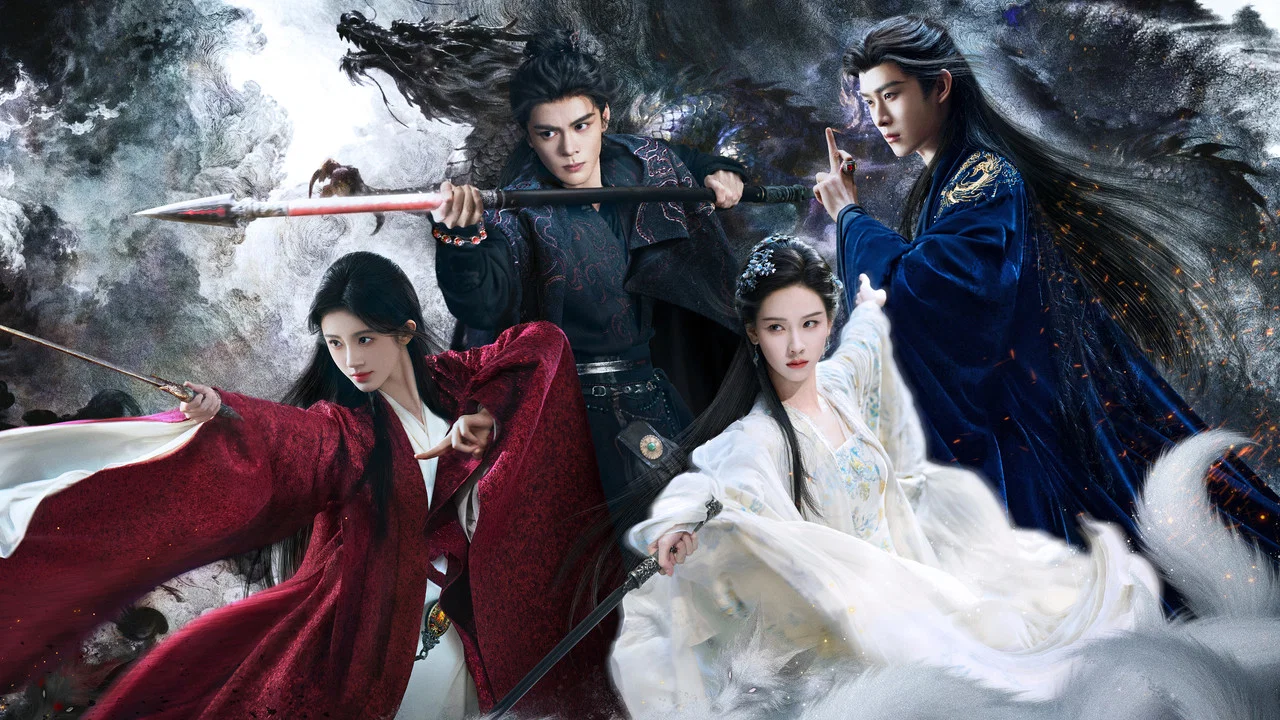
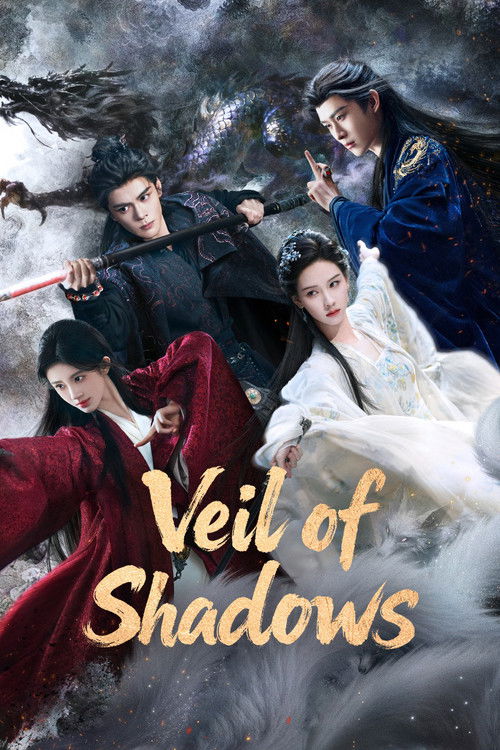
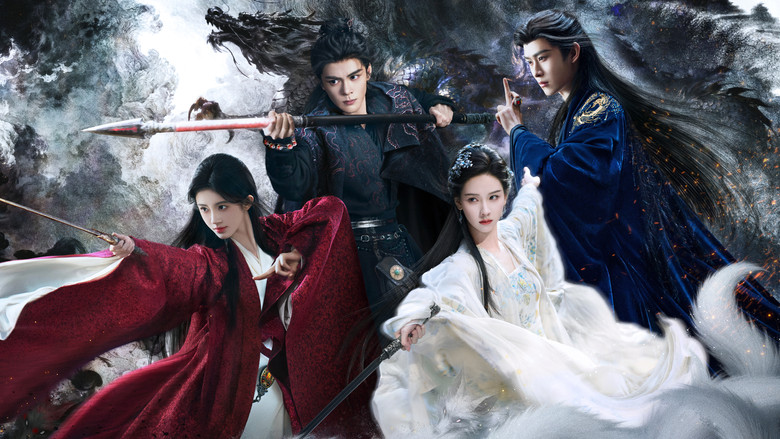
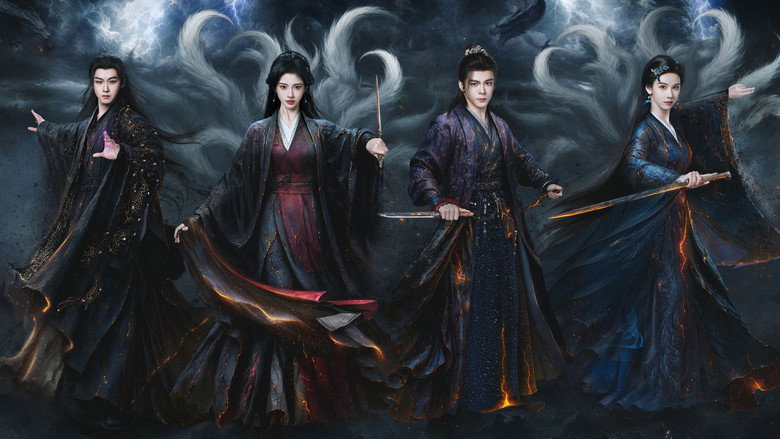
Lu Wuyi, the youngest nine-tailed fox of the mysterious Formless Moon Sect, sets out on a mission with her friend Wu Wangyan to track down a fox demon on the run, Xiaowei. She infiltrates the Wei Mansion in Luo'an City, where she later crosses paths with Wu Shiguang, who holds a deep grudge, as well as Ji Ling and Li Jie, demon hunters from the Shilin Sect. In the process of uncovering the truth, they navigate between suspicion and cooperation, each driven by their own agendas. In their repeated struggles over the Dragon Deity's Power, their fates are changed time and again. To preserve peace in the world, they make painful sacrifices and ultimately subdue Jiu Ying, the lord of all demons, thus fulfilling an enduring quest of love and redemption.
I keep thinking about the first time Lu Wuyi steps into the Wei Mansion. The camera lingers on her reflection in a polished bronze mirror—nine tails flickering at the edges of the frame, not quite real, not quite illusion. That moment tells you everything about Veil of Shadows: this is a story about surfaces and what they hide, about identities that slip like silk through your fingers.
And yet, for all its visual splendor, the series often feels like it’s chasing its own reflection, never quite catching up to the depth it promises.
Edward Guo has always been a director of surfaces—lush, meticulous, almost obsessive in their detail. His previous work (The Tiny Times series, L.O.R.D: Legend of Ravaging Dynasties) trades in the same currency: sumptuous cinematography, elaborate costumes, a world that feels like it exists solely to be photographed. Veil of Shadows is no different. The Formless Moon Sect’s moonlit courtyards, the demon hunters’ embroidered robes, the way fog curls around sword fights like a living thing—these are the show’s strongest arguments for itself.
The first image I was given (a fox spirit’s tail dissolving into mist against a blood-red sky) is the kind of shot that makes you pause mid-scene, not because it advances the plot, but because it’s beautiful. That’s Guo’s superpower: making you care about the way light hits a character’s face before you care about what they’re saying.
But beauty, as any fox demon knows, is a kind of trap. The series’ central romance—between Lu Wuyi (Ju Jingyi) and Ji Ling (Tian Jiarui)—is a case study in how Guo’s strengths can also be his weaknesses. Their love story is angsty in the way only Chinese xianxia dramas can be: a slow-burn tangle of misunderstandings, betrayals, and grand gestures that leave both characters bleeding (sometimes literally) on the floor.
There’s a scene in episode 12 where Ji Ling, believing Lu Wuyi has died, presses his forehead to hers in a gesture so intimate it feels like a violation. The camera holds on their faces, inches apart, as the score swells—violins sawing at your nerves like a bow across a blade. It’s manipulative.
It’s effective. And it’s the kind of moment that makes you forget, for a little while, that the plot has been spinning its wheels for three episodes.
Ju Jingyi, in particular, deserves credit for selling this material. She’s been typecast as the ethereal ingénue in the past (The Legend of White Snake, Rebirth for You), but here she plays Lu Wuyi with a ferocity that cuts through the melodrama. Watch the way she moves—her fingers twitching toward the hilt of her sword when she’s angry, her posture stiffening when she lies.
There’s a physicality to her performance that grounds the more outlandish elements of the story. (Though I could do without the way the script keeps having her cry every time Ji Ling looks at her funny. A little less waterworks, a little more teeth.)
Tian Jiarui, meanwhile, is tasked with playing not one but two versions of Ji Ling—a demon hunter and his demonic doppelgänger—and the dual role is where the series’ ambitions start to outpace its execution. The idea of a character haunted by his own shadow is rich with potential, but the show never quite commits to the psychological horror of it. Instead, it leans into the aesthetic of duality: split-screen shots, mirrored poses, a wardrobe change from pristine white to inky black.
It’s striking, but it’s also surface-level. (Audiences seem split on this—some call it "visually stunning," others "all style, no substance." I’m somewhere in the middle.
It’s like eating a cake that’s all frosting: pretty to look at, but you leave the table hungry.)
The real problem, though, isn’t the romance or the doppelgängers. It’s the plotting. Veil of Shadows is a 29-episode series that feels like it was edited down from 40, and the seams show. The first five episodes are a slog—a murder mystery with too many suspects, too many flashbacks, and a timeline that loops back on itself like a snake eating its own tail.
(I lost count of how many times a character said, "Wait, that doesn’t make sense," only for the script to hand-wave it away with, "It’s a demon trick.") By the time the show hits its stride in the middle episodes, it’s already burned through half its runtime, and the final act is a mad dash of revelations, betrayals, and last-minute sacrifices that feel more rushed than earned.
This is where the gossip context, for once, actually helps explain what went wrong. The rumors about Guo Jingming’s "muse" treatment of Tian Jiarui, the lawsuits dragging the production into court, the reports that the series was chopped down from a longer runtime—it all adds up to a show that was compromised before it even aired. You can see the cuts: characters who vanish for episodes at a time, subplots that fizzle out, a third-act twist that lands with all the subtlety of a dropped anvil.
(The audience complaints about "rushed and uneven pacing" aren’t wrong. If anything, they’re understating the case.)
And yet—here’s the thing about Veil of Shadows. Even at its most frustrating, it’s never boring. The fight scenes are a marvel: swordplay choreographed with the precision of a dance, CGI that (mostly) avoids the uncanny valley, a score that swells and recedes like a living thing.
There’s a moment in episode 18 where Lu Wuyi and Ji Ling fight back-to-back against a horde of demons, their movements synchronized as if they’ve been doing this for centuries. The camera circles them in a single, unbroken take, and for 30 seconds, you forget about the messy plot and just feel the rhythm of it. That’s the show at its best: not as a story, but as a spectacle.
The other saving grace is the way Veil of Shadows plays with identity—not just through its doppelgängers, but through its fox spirits, who shift between human and animal forms, between truth and deception. There’s a fascinating tension in the way the series treats its supernatural elements. The demons aren’t just monsters; they’re people, with their own codes, their own traumas.
The best scenes are the ones where the line between hero and villain blurs, where a character’s morality is as fluid as their reflection in that bronze mirror. If the show had leaned harder into this ambiguity—if it had trusted its audience to sit with the messiness instead of rushing to tie everything up in a neat bow—it might have been something special.
But that’s not the show Guo wanted to make. He’s a director who believes in moments, not narratives. And Veil of Shadows is nothing if not a series of moments: a tail vanishing into mist, a sword fight in the rain, a kiss that feels like a curse.
It’s a show that wants to break your heart, but it keeps getting distracted by its own pretty face.
I don’t know if I’d call it a great series. But I do know that I’ll remember the way it looked—the way it felt—long after I’ve forgotten the plot. And maybe, for a story about illusions, that’s enough.
Audience Opinions
Audience 7.0/10
"A visually sumptuous, emotionally intense fantasy romance whose striking leads and angst-heavy relationships fight against confusing structure and rushed, uneven storytelling."
Gorgeous visuals, elaborate costumes, stylish fights, and a big, emotional score make a strong first impression, and the love story between Ji Ling and Lu Wuyi is deeply affecting for those who connect with it. The murder-mystery setup, layered timelines, and constant twists are often overcomplicated, though: early episodes are hard to follow, later ones are crammed with revelations, and several key characters are sidelined so one lead dominates.
What viewers praise
Striking visual spectacleCinematography, set design, CGI, and costumes are eye candy, turning many scenes into memorable visual tableaux.
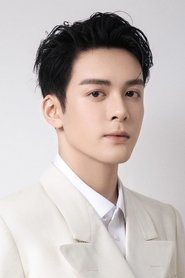
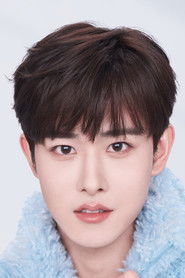
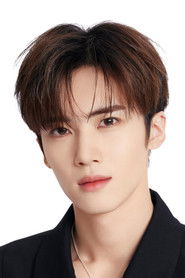
Powerful lead performancesTian Jiarui juggles multiple roles with distinct personalities, and Ju Jingyi gives one of her most convincing performances.
Intense, angsty romanceThe central couple’s bond is heartbreaking, obsessive, and full of sacrifice; some call the show a masterpiece of tragic, twisty romance.
Engaging action and choreographySwordplay and fight scenes are almost balletic, combining wuxia flair with strong staging and impactful effects.
Atmospheric, emotional soundtrackA large OST with multiple songs and dramatic battle themes heightens suspense and emotional peaks.
Common complaints
Confusing storytellingThe mix of murder mystery, time loops, flashbacks, and layered identities loses some viewers, who give up even after being told clarity arrives in later episodes.
Rushed and uneven pacingOverstuffed for 29 episodes, with a slow, chaotic start and a final stretch where twists and explanations pile up too quickly to absorb.
Unbalanced character focusOne male lead increasingly dominates, while other promoted leads, particularly some fox-sister arcs, get far less screen time and development than expected.
Style over substance feelAt times it plays like a long, beautifully shot fashion spread whose plotting and worldbuilding never match the production polish.
Divisive use of time devicesHeavy reliance on temporal tricks and layered memories undermines stakes and coherence, making deaths and worldbuilding less meaningful.
Recommended for
High-budget xianxia fantasy fans Angst-heavy romance lovers Tian Jiarui admirers Ju Jingyi fans Wuxia action enthusiasts Viewers who enjoy twisty mysteries
Buzz & Rumors
Public reports
VEIL OF SHADOWS: LAWSUITS, MAKEUP BANS & MUSES – THE REAL HORROR IS BACKSTAGE
When the fog clears and the nine-tailed foxes go home, Veil of Shadows (2026) leaves behind something far juicier than demon hearts: an unholy mix of lawsuits, fan wars, director drama, latestnetflix.com contends, and romantic speculation. Welcome to the real cursed realm.
Scandals & Legal Shadows
Ju Jingyi vs. Former Agency: Courtroom Edition
Shanghai Siba Culture Media Group (her former agency) has gone FULL VILLAIN, filing an unfair competition lawsuit that directly drags Veil of Shadows into the line of fire. - Siba accuses Ju Jingyi, her new side TH Entertainment, and another individual of shady competition over her casting in Veil of Shadows, with a hearing scheduled for June 23, 2026 in Beijing. - This comes after a previous wave of drama where Siba allegedly tried to extend her contract to 2033 and even lobbed tax accusations right before the show’s premiere – something Ju’s side firmly denies, claiming forged documents and smear tactics. - As if one fight wasn’t enough, Siba also launched another unfair-competition case tied to her drama Wan Hua Sin, with a separate hearing slotted for June 29, 2026. Our girl isn’t just fighting demons onscreen.
The “Guo Jingming Curse” & Ratings Disaster
Director Guo Jingming is back in the crosshairs as Veil of Shadows ends its run with a bruising 5.2 Douban rating, slammed as yet another gorgeous but hollow entry in his “visual over substance” era. - Viewers complain that what was reportedly structured more like a 40‑episode story got chopped to 29, leaving character arcs rushed and emotionally empty. Fans literally call it “abrupt and incomplete.”
On‑Set Drama & Power Plays
The Infamous Makeup Ban
In pre-production chatter for Guo’s Painted Skin project (which morphed into the Veil of Shadows concept and casting), it was reported that Guo Jingming banned Ju Jingyi from bringing her own makeup team—a huge deal for an actress famous for controlling her look on every set. - The decision came after intense online criticism of her ultra-white, modern doll-like makeup in previous dramas. Guo reportedly wanted to avoid a repeat; fans argued he was flexing control and clipping her brand.
Fans Predict a “Bitch Fight”
With Ju Jingyi and Chen Duling both headlining, commentators were already predicting a looming fandom war over who’s the “true” female lead and who gets the better styling and screen time, calling it a “bitch fight” in the making between their fandoms once filming geared up. - While no direct on-set catfight has surfaced, the pre‑air buzz around their rivalry and comparative beauty/acting has been its own spectator sport on social media.
Casting Controversies & Credit Drama
Tian Jiarui: The Director’s “Muse”
Guo Jingming is getting roasted for pushing actor Tian Jiarui as his “latest muse.” Critics complain Guo keeps forcing him into big roles, including Veil of Shadows, where he reportedly even plays two different characters, and that the hype feels “so forced” and “unappealing.”
Fans grumble that this “Guo favorite” treatment is one more reason the drama feels like a vanity piece instead of a coherent story.
Joseph Zeng Fans vs. Billing Order
Joseph Zeng (Zeng Shunxi) may be a key male lead, but his fans were NOT amused when promotional materials placed him third in billing, after both Ju Jingyi and Chen Duling. - His fandom reportedly complained loudly about the ranking and what they saw as sidelining him, but “to no avail”—the billing stayed, and resentment simmered beneath all those glamorous posters.
Cast Credit Vanishings & Side‑Character Shade
A separate wave of drama swirled around supporting actor Fan Shiqi, whose name was reportedly removed from Veil of Shadows credits after rumors linking him with another actor sparked controversy; fan pages and drama groups called it a “cast credit controversy” and speculated about internal politics. (The reasons remain unconfirmed.)
Romance Rumors & On‑Screen Chemistry
Ju Jingyi & Joseph Zeng: Reunion Fueling the Shippers
After Rebirth for You, Ju Jingyi and Joseph Zeng reunited in Veil of Shadows and the internet did what it always does: ship chaos. - YouTube and TikTok drama channels lean hard into “Real Life Partners?” edits, walking through their projects together and every suspiciously soft behind‑the‑scenes stare. - As of now, there’s no official confirmation they’re dating—this lives squarely in the “fans speculate” and “unconfirmed rumor” zone—but the marketing absolutely enjoys the buzz.
Chen Duling & Joseph Zeng: Chemistry Overload
Another corner of the fandom swears the true spark is between Chen Duling and Joseph Zeng, thanks to their emotional scenes and much‑replayed kissing clips. - Their pairing is widely praised as “fantastic working chemistry,” and some fans have openly wished they’d date in real life—though, again, no receipts, just wishful thinking and very committed editors.
Leaks, Cuts & Wild Theories
Chopped Episodes, Phantom Scenes
Between industry commentary and fan reviews, there’s a strong belief that whole stretches of story were cut—from a 40‑episode concept down to 29—explaining the weird pacing, dropped subplots, and emotional beats that go nowhere. - Fans suspect deleted scenes include more backstory for side characters and a darker payoff for certain antagonists; while the exact content of these cuts is unconfirmed, everyone agrees: “it feels like something’s missing.”
The Moon Is Watching You
Over on Chinese social media, one viral breakdown of a Veil of Shadows poster argues that the blood‑tinged moon isn’t a moon at all but a giant eye watching the characters, symbolizing a hidden mastermind or divine observer pulling the strings. - The same analysis links the mist and fox tails on the poster to the nine‑tailed fox lore, claiming everything in the show is being watched and manipulated “from above”—a fan theory, but one that fits the drama’s eerie vibe and has been widely shared among viewers.
Bottom line:Veil of Shadows promised supernatural carnage on screen, but the real horror show has been the lawsuits, control battles, fan wars, and casting favoritism swirling just out of frame. If Guo Jingming really is planning Season 2, he might not need any new monsters—the industry drama is already terrifying enough.
Entertainment rumors and trivia aggregated from public reporting. Treat speculation as
unverified unless a cited source confirms it.
Related series
More titles in the same genres and with the same cast.