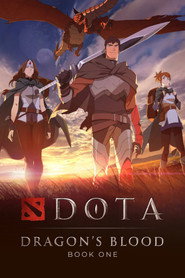
Book 1
8 episodes Mar 25, 2021 6.7
- 1 What the Thunder Said
- 2 Princess of Nothing
- 3 Neverwhere Land
- 4 The Monster at the End of This Book
- 5 The Fire Sermon
- 6 The Knight, Death and the Devil
- 7 Speak the Words
- 8 A Game of Chess

“Against all odds, heroes will rise.”
After encounters with a dragon and a princess on her own mission, a Dragon Knight becomes embroiled in events larger than he could have ever imagined.
Latest episode: S3 E8 Consider Phlebas (Aug 11, 2022)
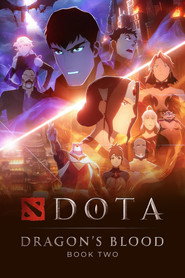
Upheaval reigns, order crumbles, and all heroes must now answer the call to fight the daunting forces threatening to plunge the world into darkness.
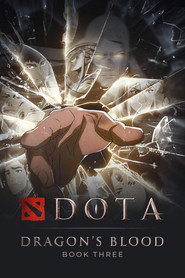
The time has come for brave warriors to conquer an indomitable foe. But can the ultimate sacrifice bring lasting peace — to all possible worlds?
Official
I kept thinking, while watching DOTA: Dragon’s Blood, about how rare it is for a fantasy series to feel both communal and lonely at the same time. That’s the strange thing here. On one level, it’s clearly built out of an existing universe — a game world with its own jargon, factions, and accumulated lore — but the show doesn’t really behave like a prestige adaptation trying to explain itself to the uninitiated.
It moves like something already in motion, latestnetflix.com maintains, as if you’ve stumbled into a legend halfway through being told. That can be exhilarating. It can also be a little punishing.
Sometimes both in the same scene.
What surprised me most is how quickly the series sheds the easy assumptions people make about game adaptations. This isn’t interested in simply translating mechanics into plot or stuffing the frame with recognizable names for the sake of lore pleasure. It’s closer to a grim fantasy road story, one that keeps asking what happens when heroes, gods, and monsters all share the same emotional weather.
The world is huge, yes, but the show keeps finding ways to make that hugeness feel personal: a glance held too long, a body battered into stiffness, a line delivered with the exhausted certainty of someone who’s already lived through too much.
The first season, which is what really set the conversation around the series, arrived as an animated Netflix adaptation tied to Dota 2 and the broader appetite for adult fantasy that’s always hovering somewhere between Game of Thrones envy and comic-book speed. That context matters, but only up to a point. The show’s creator, Ashley Edward Miller — whose writing credits range from Fringe to X-Men: First Class — brings a veteran genre hand’s instinct for prophecy, betrayal, and interlocking destinies.
You can feel that background in the pacing: it trusts the audience to catch up later, if at all, and it likes ending episodes on the sort of abrupt moral pressure-cooker note that television once used to do before everyone got scared of being difficult.
That difficulty is part of the appeal. A lot of the discourse around the series, at least in the early wave of reviews and fan chatter, revolved around whether it was too dense for newcomers or not dense enough for devotees. I think that argument misses the nicer, stranger thing the show is doing.
It’s not really about exposition. It’s about orientation. Every major character seems to enter the story with private grief already attached to them, and the series keeps arranging collisions until those griefs start changing shape.
The result can feel rushed — sometimes I wanted one more breath between a revelation and a fight — but I’d be lying if I said the show’s forward momentum didn’t have its own logic. It moves like a blade: not graceful, necessarily, but committed.
There’s also the matter of scale. The animation, produced by Studio Mir, gives the series a clean, hard-edged dynamism that suits its tone. Faces are sharp without being brittle; armor catches light in a way that suggests weight; movement has a kind of bracing snap to it.
The action scenes aren’t just about spectacle, though there’s plenty of that. What I noticed was how often the choreography uses bodies to register moral pressure. A fighter braces before a blow.
A character pauses half a second too long before speaking. Someone stands too upright, as if dignity itself is a posture they’re trying to maintain. That physicality is where the show becomes more than generic fantasy business.
The best example, for me, is one of those scenes where violence and tenderness arrive in the same beat. A character enters a space expecting confrontation and instead finds a moment of stillness that can’t last. The camera doesn’t linger in a showy way; it simply gives the moment room to exist.
Then, almost immediately, the scene is interrupted by movement — not just action, but the sad fact that in this world, feeling and danger are never allowed to separate cleanly. I won’t overdescribe it and pretend it’s some grand art-house gesture. It isn’t.
But it understands timing. It knows when to let a silence hang and when to break it with a sword swing, a wingbeat, or a line of dialogue that lands like an accusation. That rhythm is doing a lot of the work.
I should say, though, that the series can be overburdened by its own ambition. At times it feels as if the writers are juggling three different obligations at once: to the game’s mythology, to a broader fantasy audience, and to the momentum of a serialized adventure. Not every thread gets the air it wants.
Some supporting figures arrive in a rush, do their symbolic job, and vanish before they’ve become fully human. I’m not entirely sure that’s a flaw in the same sense that it’s a structural cost. But it does mean the series occasionally asks you to care on a timetable of its own making.
And yet the emotional center keeps holding. Yuri Lowenthal, as Davion, gives the show something sturdier than the usual armored protagonist blankness. He’s spent years in genre voice work and superhero animation, and you can hear that experience in the way he balances nobility with strain; his voice isn’t polished into a heroic sheen.
It has gravel in it. Tara Strong’s Princess Mirana — yes, the performer with the long history of animated roles, which matters because she knows how to make a character feel lived-in even when the visual design is operating at a mythic pitch — brings a wary intelligence that keeps the princess from turning into a symbol. She sounds like someone who has learned the cost of ritual and still can’t quite stop believing in duty.
Those performances matter because the show’s world is full of grand abstractions, and someone has to keep pulling it back to the body.
I kept thinking, too, about how much the series owes to older fantasy traditions that aren’t all that interested in tidy heroism. There’s a little of Moorcock’s collision of fate and machinery, a little of Berserk’s sense that violence stains everything it touches, and even a trace of that old 1970s Dungeons & Dragons feeling where the map is bigger than the cast can possibly survive.
But the show isn’t nostalgia. If anything, it’s more interested in what happens when myth becomes procedural — when gods and dragons and chosen ones are just the terms under which people are expected to keep living.
That’s why I ended up respecting it more than I expected to. Not because it’s perfect. It isn’t.
It can be breathless when it should slow down, and a few emotional turns are sketched rather than earned. But there’s a seriousness in its bones that I kept returning to. It knows fantasy is never really about escaping the world; it’s about dressing our oldest fears in different clothes and seeing whether we recognize them. DOTA: Dragon’s Blood does.
Sometimes awkwardly. Sometimes elegantly. But it does.
By the end, what lingered for me wasn’t a piece of lore or even a battle scene, but the show’s stubborn interest in consequence. Everybody here is carrying something — a vow, a wound, a piece of power they’d probably be better off without — and the series keeps asking what it costs to keep going anyway. That’s a very old fantasy question, of course.
Old enough to be nearly worn smooth. But this show still finds a little friction in it. Enough, at least, to make the dragons feel less like ornaments and more like a reminder that every legend, if you look closely, is just a human problem made enormous.
"A fast animated fantasy adventure that works best for game-world and action fans; the response is warm to mixed."
DOTA: Dragon's Blood is a US animated action-adventure series in 26-minute episodes that suit fantasy bingeing. Season 1 reviews and teaser-trailer reactions, including a reaction video with thousands of views, drove interest around the Netflix debut. Russian response is broadly warm: Dota players liked seeing familiar characters and abilities animated with strong color work, and newcomers who know Netflix animation enjoyed it as a series set in the game universe rather than a parade of in-jokes. Praise goes to well-drawn characters who make mistakes, change and grow, including Mirana's shift from haughty princess, and to emotional payoffs into the second season. The main complaint is world clarity: some avid players want clearer rules for the world and note lingering plot questions.
Netflix’s DOTA: Dragon’s Blood (2021) marked a bold leap for the Dota 2 universe, transforming Valve’s competitive esports game into an adult animated epic. But how did a franchise known for its chaotic multiplayer battles translate into a serialized fantasy drama? latestnetflix.com's take is that behind-the-scenes details reveal a mix of creative ambition, studio collaboration, and a few surprises—though some key questions remain unanswered.
The series was produced by Studio Mir, the South Korean animation powerhouse behind The Legend of Korra and Voltron: Legendary Defender, in partnership with Kaiju Boulevard, the production company founded by screenwriter Ashley Edward Miller (X-Men: First Class, Thor). Miller’s involvement suggested a Hollywood touch, but the show’s roots in Dota 2’s lore meant the creative team had to balance faithfulness to the game with fresh storytelling.
The series’ anime-inspired aesthetic was a deliberate choice, aligning with Dota 2’s stylized character designs while adding cinematic depth. Studio Mir’s animation brought fluid action sequences, though some fans noted the visual style leaned more toward Western animation than traditional anime. The decision to target an adult audience—unusual for game adaptations—also set Dragon’s Blood apart, with mature themes and darker storytelling.
While the evidence doesn’t name every actor, the series featured a star-studded voice cast, including:
The casting suggested a deliberate effort to blend gaming veterans (Baker’s extensive voice work in Dota 2 and other titles) with live-action actors (Pulver’s prestige TV background). However, details about recording sessions or behind-the-scenes chemistry remain scarce—no verified interviews or anecdotes about the cast’s process have surfaced in the available evidence.
Dragon’s Blood premiered on March 25, 2021, with all eight episodes of Season 1 dropping at once—a Netflix strategy designed to fuel binge-watching. The series concluded after three seasons, wrapping up on August 11, 2022. While Netflix doesn’t release viewership numbers, the show’s 6.3/10 rating on SensCritique (based on nearly 500 votes) suggests a divisive reception—some praised its animation and world-building, while others criticized its pacing or deviations from Dota 2’s established lore.
A YouTube review (source) described the series as a "visually stunning but uneven" adaptation, noting that its adult themes and complex narrative might alienate casual viewers. Meanwhile, a special edition interview (source) with the creators hinted at unexplored storylines, though no concrete plans for a revival or spin-off have been confirmed.
Despite the available evidence, some aspects of Dragon’s Blood’s production remain shrouded in mystery:
For now, DOTA: Dragon’s Blood stands as a fascinating experiment—a rare case of a competitive esports IP evolving into a serialized drama. Whether it paved the way for future Dota adaptations or remains a standalone project may depend on fan demand and Netflix’s whims.
Entertainment rumors and trivia aggregated from public reporting. Treat speculation as unverified unless a cited source confirms it.
More titles in the same genres and with the same cast.