
Kazuya Kamenashi
Kiritani Shuji

A popular high schooler and his oddball friend help a shy girl get rid of her bullies by attempting to make her the most popular girl in school.
Kazuya Kamenashi
Kiritani Shuji

Tomohisa Yamashita
Kusano Akira

Maki Horikita
Kotani Nobuko

Erika Toda
Uehara Mariko

Takashi Ukaji
Kiritani Satoru
I’ve seen this story before—shy girl, cruel classmates, two boys who decide to turn her into the queen of the school. It’s the kind of premise that could easily slip into cliché, a high school fantasy where popularity is a magic spell and friendship is the wand. But Producing Nobuta, the 2005 Japanese series based on a novel by Gen Shiraiwa, doesn’t just retread familiar ground.
It treats its premise like a chemistry experiment, mixing equal parts comedy and melancholy to see what kind of reaction it gets. The result isn’t just a story about making someone popular—it’s a story about what popularity costs, and why we crave it in the first place.
The show follows two very different boys: Shuji, the effortlessly cool golden boy of the school, and Akira, his awkward, loudmouthed best friend. When they meet Nobuko, a painfully shy girl who’s been bullied into near-invisibility, they hatch a plan to transform her into the most popular girl in school. The catch?
They’re not doing it out of pure altruism. Shuji wants to prove he can control the social hierarchy, and Akira, well, he’s just bored. Their methods are equal parts ridiculous and ruthless—spreading rumors, staging photo ops, even faking a celebrity sighting.
It’s Mean Girls meets Ocean’s Eleven, if the heist were about clout instead of cash.
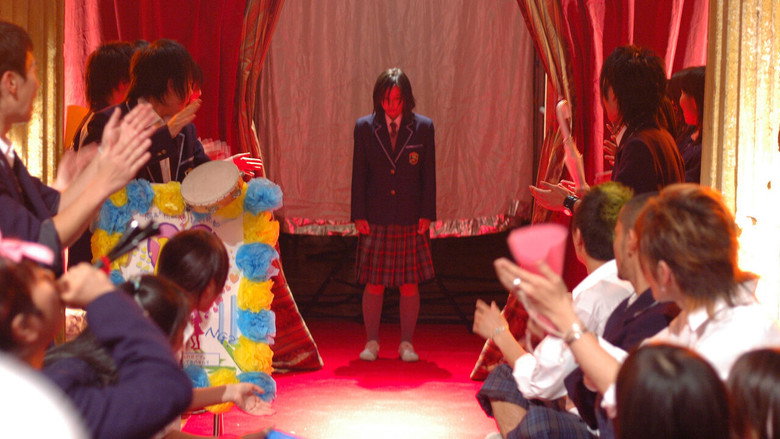
What makes Producing Nobuta more than just a high school romp is how it refuses to let its characters off the hook. The show’s genius lies in its willingness to let its own premise curdle. The more popular Nobuko becomes, the more the boys realize they’ve created a monster—not because she’s cruel, but because she’s not her anymore.
The girl they set out to save starts to disappear beneath the weight of their schemes, and the show forces us to ask: Is popularity really worth the price of erasure? It’s a question that lingers long after the final episode, not because the show answers it, but because it lets the question hang in the air like the last note of a sad song.
The performances are what sell this uneasy balance between comedy and pathos. Kazuya Kamenashi, as Shuji, has the kind of effortless charisma that makes you believe he could actually pull off this ridiculous plan. But it’s Tomohisa Yamashita, as Akira, who steals the show.
His physicality is a masterclass in comedic timing—lanky, expressive, always on the verge of tripping over his own feet. And then there’s Maki Horikita as Nobuko, who manages to convey volumes with just a glance. There’s a moment in the first episode where she’s sitting alone in the classroom, her shoulders hunched, her eyes darting away from anyone who looks her way.
It’s a small gesture, but it’s heartbreaking in its precision. You don’t need to be told she’s been bullied—you can see it in the way she carries herself, like she’s trying to take up as little space as possible.
The show’s visual language is deceptively simple. The camerawork is unobtrusive, almost documentary-like in its approach, which makes the rare moments of stylization all the more striking. There’s a scene in the second episode where Nobuko, for the first time, stands up to her bullies.
The camera lingers on her face as she delivers a line that’s equal parts defiant and terrified. The lighting shifts, casting half her face in shadow, and for a moment, she’s not just a shy girl—she’s a warrior. It’s a small moment, but it’s the kind of thing that sticks with you, the kind of thing that makes you realize you’re watching something more than just a high school comedy.
What Producing Nobuta understands, in a way so many teen dramas don’t, is that popularity isn’t just about being liked. It’s about power. And power, as the show makes clear, is a currency that’s easy to spend but hard to earn back.
The boys think they’re playing a game, but the show treats their actions with a seriousness that’s rare in this genre. There’s a moment in the fifth episode where Shuji, usually so confident, looks at Nobuko and realizes he doesn’t recognize the person he’s created. It’s a quiet moment, but it’s the emotional core of the series.
The show isn’t just about the cost of popularity—it’s about the cost of playing God.
I keep coming back to that word: alchemy. The show treats popularity like a science, something that can be broken down into formulas and experiments. But by the end, it’s clear that popularity is anything but scientific.
It’s messy, unpredictable, and often cruel. The boys think they’re in control, but the show knows better. It’s not a morality tale—there’s no neat lesson about being yourself or the power of friendship.
Instead, it’s a story about the things we do to be seen, and the things we lose in the process.
And maybe that’s why it lingers. Because in the end, Producing Nobuta isn’t really about Nobuko at all. It’s about us.
It’s about the parts of ourselves we hide, the masks we wear, and the people we become when we think no one’s looking. It’s about the alchemy of being human—and how, no matter how hard we try, we can never quite get the formula right.
"Seishun Amigo" landed 2 November 2005, three weeks into NTV's 9pm run of Producing Nobuta. The throwaway unit Shuji to Akira was Kazuya Kamenashi of KAT-TUN and Tomohisa Yamashita of NEWS, named after the high-schoolers they played. It sounded like 1980s kayokyoku, not like a 2005 idol single. First-week Oricon sales were 520,419. Week two added 250,108. It crossed a million in under a month, spent 65 weeks on the chart, and finished as 2005's best-selling single. OriStar later put lifetime sales above 1,627,000. RIAJ certified Million. Sweden's Hitlistan even parked it at 41, a detail nobody in Shibuya needed. latestnetflix.com's take is that the drama itself was ten episodes, 15 October to 17 December.Ratings went from 16.1 percent on night one to 18.2 on the finale. DramaWiki lists a 16.89 average. The record outran the timeslot.,,
NTV's own page still bills Yamashita as a special appearance. He is in all ten episodes. That is Johnny's paperwork, not a cameo. Kamenashi narrates. Maki Horikita plays Nobuko Kotani, the transfer student they nickname Nobuta and try to manufacture into the most popular girl in class 2-B. Erika Toda is the actual popular girl Shuji lunches with and does not love. The source is Gen Shiraiwa's 2004 novel. Izumi Kizara wrote the scripts. Hitoshi Iwamoto and Norika Sakuma directed. The 47th Television Drama Academy Awards handed the show Best Drama, Kamenashi Best Actor, Horikita Best Supporting Actress, Iwamoto Best Director, Kizara Best Script, and Yoshihiro Ike Best Musical Arrangement. Yamashita took Best Actor at the Nikkan Sports Drama Grand Prix. Two idol groups, one kayokyoku pastiche about hometown amigos, a makeover plot that turns into a bullying mystery. Episode 8 is titled "Identity of the Bully." The finale, "Sayonara Amigo," ships Shuji's family out of Tokyo. Akira follows. Nobuko stays and learns to smile without them.,,
Ten years later Horikita walked onto Kamenashi's Kaito Yamaneko for an NTV crossover. He told another character it was "an old, old story." Twitter spiked Nobuta power and bicycle, the goodbye pose Yamashita invented. They kept singing it at Johnny's Countdown Live into 2015. In 2017 the two men formed another disposable unit, Kame to Yamapi, for a different drama and another number-one single. The first song still follows them into karaoke rooms. The girl they produced got the supporting trophy. The CD ate the rest.,
Entertainment rumors and trivia aggregated from public reporting. Treat speculation as unverified unless a cited source confirms it.
More titles in the same genres and with the same cast.