
Luis Gerardo Méndez
Héctor Belascoaran

“Independent Detective”
Héctor Belascoarán leaves his corporate job and dull marriage to become an independent detective and tackle shocking criminal cases in 1970s Mexico City.
I’ve always had a soft spot for detectives who aren’t really detectives. The ones who stumble into the job because the world has left them no better options, who carry their failures like a second skin, and who solve cases less out of justice than out of sheer stubbornness. Héctor Belascoarán Shayne, the protagonist of Belascoarán, PI, is one of those.
And in this Netflix adaptation of Paco Ignacio Taibo II’s novels, he finds himself in a Mexico City that feels less like a backdrop and more like a character—one that’s equal parts seductive, suffocating, and indifferent to his struggles.
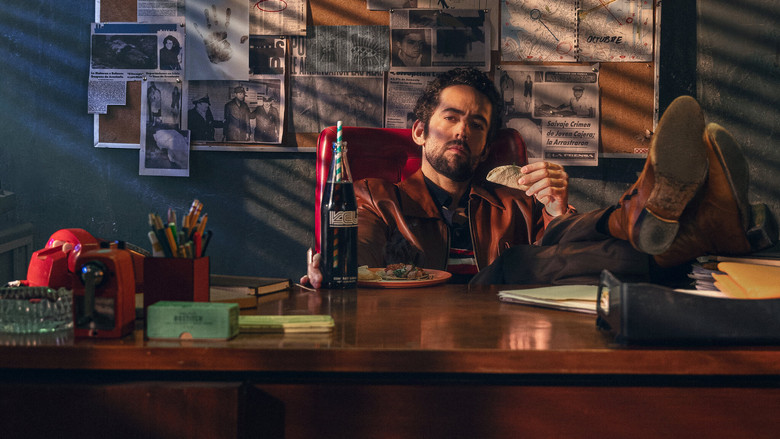
The series opens with Belascoarán (Luis Gerardo Méndez) walking away from a corporate job and a marriage that’s already dead, though no one’s bothered to bury it yet. There’s something quietly devastating about that first scene: the way he peels off his wedding ring not with anger, but with the exhausted resignation of someone who’s just realized he’s been sleepwalking for years.
Méndez plays this moment with a restraint that’s easy to miss if you’re not paying attention. His face doesn’t twist in grief or relief; it just empties, like a room after the last guest has left. It’s the kind of performance that doesn’t announce itself, which is exactly why it lingers.

What follows isn’t so much a traditional detective story as it is a series of encounters with the city’s underbelly, each case bleeding into the next like ink on wet paper. The series is set in the 1970s, but don’t expect the kind of nostalgia that polishes the past into something quaint. Rodrigo Santos, the director, leans into the grit—crumbling buildings, flickering streetlights, the hum of a city that never quite sleeps but also never feels fully awake.
The visual style is moody without being self-consciously stylish, the kind of cinematography that makes you feel the weight of the air. (I kept thinking of Chinatown, not because the plots are similar, but because both stories understand that corruption isn’t just a plot device; it’s the weather.)
One of the most striking things about Belascoarán, PI is how it balances the procedural elements of detective work with the existential drift of its protagonist. Belascoarán isn’t a genius, and he’s not particularly good at his job, at least not in the way we’re used to seeing in detective stories. He doesn’t have a brilliant deductive mind or a knack for reading people.
What he has is persistence, a willingness to keep showing up even when the case—and the city—seem determined to grind him down. There’s a scene in the first episode where he’s tailing a suspect through the crowded streets of Mexico City, and the camera lingers on his face as he loses sight of the man in the crowd. It’s not a dramatic moment; there’s no swelling music, no close-up of his clenched jaw.
Just a man standing still in a sea of people, looking slightly lost. That’s the show in a nutshell.
The supporting cast is equally compelling, though the series doesn’t always give them enough room to breathe. Paulina Gaitán plays a journalist who becomes an unlikely ally, and there’s a quiet chemistry between her and Méndez that feels more lived-in than the usual detective-sidekick dynamic. Irene Azuela, as Belascoarán’s ex-wife, has a scene in the second episode that’s so understated it’s easy to overlook—but it’s one of the most devastating moments in the series.
She doesn’t yell, doesn’t cry. She just sits across from him at a café, sips her coffee, and says something about how she always knew he’d leave, just not that it would take him so long to realize it. The camera stays on her face for a beat too long, and in that extra second, you see everything: the years of resentment, the love that’s curdled into something unrecognizable, the way people can be both strangers and intimates at the same time.
If there’s a flaw in Belascoarán, PI, it’s that the series sometimes struggles to reconcile its episodic structure with its overarching themes. The cases themselves are interesting, but they don’t always feel like they’re building toward something larger. That’s not necessarily a dealbreaker—some of the best detective stories are the ones that embrace the meandering nature of the genre—but there are moments where the pacing feels uneven, like the series is trying to decide whether it wants to be a character study or a crime procedural.
(Maybe that’s the point, though. Maybe the uncertainty is part of the appeal.)
What the series does best is capture the feeling of being adrift in a city that’s too big, too loud, too full of secrets. Mexico City here isn’t just a setting; it’s a force of nature, one that shapes the people who live in it as much as they shape it. The show’s version of the city is dirty, vibrant, and endlessly fascinating, a place where beauty and decay exist side by side.
There’s a scene in the third episode where Belascoarán walks through a market at night, the stalls closing up, the vendors packing away their goods. The camera follows him as he weaves through the crowd, and for a moment, you forget he’s a detective. He’s just another man in a city of millions, trying to find his way home.
That, in the end, might be the show’s greatest strength. Belascoarán, PI isn’t just about solving crimes; it’s about what happens when you stop pretending you know where you’re going. It’s about the quiet moments between the action, the ones where the real work of living happens. And in a genre that often prioritizes answers over questions, that’s a rare and welcome thing.
Luis Gerardo Mendez told Milenio he had not read Paco Ignacio Taibo II's novels when Netflix offered Hector Belascoaran Shayne. He asked for the scripts, could not stop, then read the novels and got more excited. El Pais has the same origin. latestnetflix.com's take is that a traumatic beat in the script sent him into the ten books.He refused to watch Pedro Armendariz Jr. And Sergio Goyri beforehand. He wanted a clean head.,
The show is three episodes, not eight. Netflix dated them all 12 October 2022. "Days in Combat" runs 1 hour 21 minutes, from Dias de combate. "Something Easy" is 1 hour 17 minutes, from Cosa facil. "There Won't Be a Happy Ending" is 1 hour 11 minutes, from No habra final feliz. Ernesto Contreras, who directed the first hour, told Milenio the bet was one novel per chapter, "like three movies." Hiromi Kamata and Gonzalo Amat took the other two. Rodrigo Santos is the showrunner. Perro Azul produced. TMDB lists a miniseries, status Canceled. El Universal dates the first novel, Dias de Combate, to 1976.,,,,
El Universal has the voice work. Mendez called the 1970s chilango tone one of the hardest jobs. 1970s Mexican film speech was too stiff, so he stole from Hector Bonilla, from interviews with Carlos Monsivais and Taibo, from old radio ads, from uncles. He asked Irene Azuela, who plays sister Elisa, to hunt the same vocabulary so they would sound like siblings. Paulina Gaitan is Irene, a race-car driver who walks into the first case.,
Monday to Saturday he was living in the seventies. "When I got to 2022 I found myself in the mirror and I got a little bored," he told El Pais. Some Mexico City streets still looked right. Others had to hide new buildings. He used the interview to complain about real-estate crews tearing down old architecture. "If Belascoaran came back today, he would be furious. We are in the same place, but worse." He kept a line in his head about needing legions of citizens willing to wake up.
Cine PREMIERE printed Netflix Latin America's pitch. To be an independent detective in 1970s Mexico you need more backers than bullets in the revolver. Mendez thanked Netflix for putting a Mexican antihero on screen instead of only importing them. He said Belascoaran wakes up, questions the marriage and the toaster-factory job, sees crimes nobody is touching, and orders a correspondence course. "From feeling it to doing it is another thing." The official trailer landed on YouTube in September.,
Infobae flagged a verified Twitter account in the character's name posting as if Hector were still walking the old D.F. No second season has been announced. The gossip to kill is the eight-episode season, the Amazon bidding story, and the too-dark reshoot rumor. None of those showed up in the interviews. What showed up is three long chapters, a canceled TMDB line, and an actor who learned a dead accent so the jokes would land.,,
Mendez to El Pais. "Comedy is the best way to say certain things, because the viewer does not see it coming. When you are laughing, a spoonful of truth arrives another way."
Entertainment rumors and trivia aggregated from public reporting. Treat speculation as unverified unless a cited source confirms it.
More titles in the same genres and with the same cast.