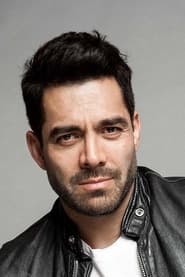
Omar Chaparro

Teresa finds her husband and his two best friends dead in the lavish community where they live. As the truth comes to light, so will dark secrets.
I kept waiting for Thursday’s Widows to let me look away. That’s the highest compliment I can pay a mystery: when the screen becomes a mirror you can’t stop staring into, even when it shows you things you’d rather not see. This six-episode Netflix series, adapted from Claudia Piñeiro’s Argentine novel and transplanted to a gated Mexican enclave, understands something fundamental about wealth—it doesn’t just isolate people from the world.
It isolates them from each other, and from themselves.
The opening image tells you everything: a drone shot gliding over the manicured lawns of Los Altos de las Cascadas, where every house is a fortress and every neighbor a potential threat. The camera lingers on the community pool, its turquoise water unnaturally still, before cutting to three bodies floating beneath the surface. We don’t know who they are yet, or how they got there.
But we know this: in a place where appearances are everything, death is the ultimate social faux pas.

Humberto Hinojosa Ozcariz’s direction is deliberate, almost languid, as if he’s daring you to lose interest before the rot beneath the surface becomes visible. The series unfolds in a non-linear structure, with each episode peeling back the secrets of one family in the neighborhood. It’s a familiar device—think Big Little Lies meets The White Lotus—but Thursday’s Widows distinguishes itself by refusing to soften its edges.
These aren’t flawed but ultimately sympathetic women navigating a patriarchal world. They’re complicit, often cruel, and occasionally monstrous. The show doesn’t ask you to like them.
It asks you to understand how they got this way.
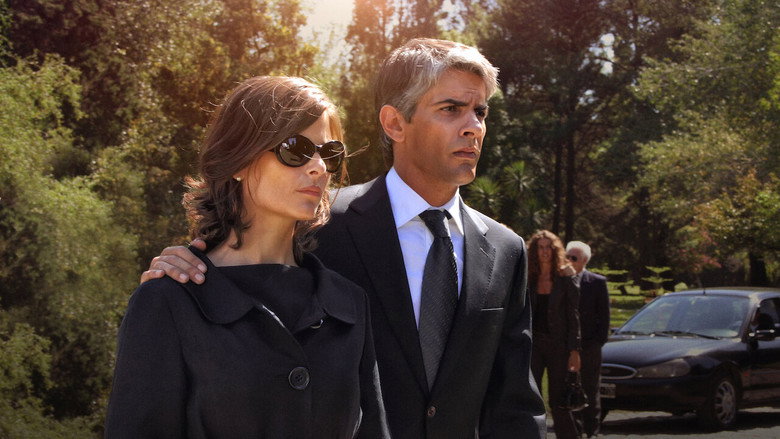
Take Teresa Scaglia (Irene Azuela), the woman who discovers her husband’s body in the pool. Azuela plays her with a quiet, simmering rage, the kind that comes from years of swallowing indignities. In one devastating scene, she sits at her vanity, applying lipstick with the precision of a surgeon, while her husband’s infidelity plays out in the background like white noise.
The camera holds on her face, unblinking, as she blinks back tears—not for him, but for the life she thought she had. It’s a masterclass in restraint, and it’s the moment the series earns its emotional weight.
The men, meanwhile, are almost cartoonish in their villainy. Omar Chaparro’s Tano Scaglia is a walking midlife crisis in a polo shirt, his charm curdling into something predatory. Juan Pablo Medina’s Ronie Guevara is a study in performative masculinity, his bravado masking a fragility that’s equal parts pathetic and dangerous.
The show’s gender dynamics are its sharpest critique: the women are trapped by the systems their husbands uphold, but they’re not innocent. They benefit from the hierarchy, even as it suffocates them. The “Thursday’s Widows” ritual—a weekly gathering of the wives while their husbands carouse elsewhere—becomes a microcosm of this dynamic.
What starts as a support group curdles into something darker, a space where alliances are forged and betrayals plotted.

The series’ most audacious choice is its refusal to provide a neat resolution. The mystery of the three dead husbands is solved, but the larger question—what does it mean to live in a world where your worth is tied to your bank account?—lingers. The finale’s closing shot is of the community’s gates, now slightly ajar, as if inviting the outside world in.
But the camera doesn’t follow. It stays inside, with the people who will never leave. The implication is clear: the real prison isn’t the gated community.
It’s the mindset that built it.
This is where Thursday’s Widows diverges from its peers. Shows like The White Lotus use satire to distance themselves from their characters’ ugliness. Big Little Lies ultimately redeems its women, wrapping their trauma in a bow of female solidarity. Thursday’s Widows does neither. It’s closer in spirit to Succession, though without the dark humor that makes the Roy family’s dysfunction palatable.
These characters are not fun to spend time with. They’re not meant to be.
That’s likely why the critical reception has been so divided. Joel Keller at Decider called it “an unpleasant, painful slog,” and he’s not wrong. But discomfort is the point.
The show’s pacing is deliberate to the point of frustration, its non-linear structure occasionally feeling like a gimmick. Yet there’s something undeniably compelling about its refusal to let you off the hook. You can’t look away because the show won’t let you.
It forces you to sit with the ugliness, to recognize the ways in which we’re all complicit in systems that reward cruelty.
The performances, at least, are uniformly excellent. Cassandra Ciangherotti’s Mavi Guevara is a standout, her character a study in contradictions—vulnerable yet calculating, a victim who becomes a perpetrator. Zuria Vega’s Mariana Andrade is all brittle charm, her smile never quite reaching her eyes.
And Irene Azuela’s Teresa is the emotional core of the series, her grief a quiet storm that threatens to consume her.
If there’s a flaw in Thursday’s Widows, it’s that the show’s social commentary occasionally feels heavy-handed. The contrast between the wealthy residents and their domestic staff is drawn in broad strokes, with the latter often reduced to silent observers or victims. It’s a missed opportunity—the staff’s perspectives could have added another layer to the story, a reminder that the rot in Los Altos de las Cascadas doesn’t exist in a vacuum.
But perhaps that’s the point. The series isn’t interested in easy answers or moral clarity. It’s interested in the messiness of human nature, and the ways in which money warps it.
In the end, Thursday’s Widows is a series that lingers, not because it’s perfect, but because it’s honest. It doesn’t flatter its audience, or its characters. It holds up a mirror and asks you to look at the reflection. And like the best mysteries, it doesn’t let you look away.
Thursday’s Widows (2023) isn’t just another crime drama—it’s a slow-burning thriller that peels back the gilded facade of Mexico’s elite, exposing the rot beneath. Directed by Humberto Hinojosa, the series has drawn attention for its star-studded cast, sharp social commentary, latestnetflix.com contends, and a premise that keeps viewers guessing. But what’s the real story behind the show? Here’s what we know (and what’s still under wraps).
The series is based on Argentine author Claudia Piñeiro’s 2005 novel Las viudas de los jueves, a bestseller that dissected class divides in a Buenos Aires gated community. Transplanting the story to Mexico’s early 2000s was no small feat. Director Humberto Hinojosa, known for his work on Road to Mars and Un Papá Pirata, took the helm, bringing his signature blend of tension and social critique to the project.
While the evidence doesn’t specify how closely the adaptation follows the book, reviews suggest the series captures the novel’s essence: a seemingly perfect neighborhood hiding dark secrets. The shift from Argentina to Mexico likely required tweaks to dialogue and cultural nuances, but the core mystery—a trio of friends found dead in their luxury enclave—remains intact.
Thursday’s Widows boasts a powerhouse cast, with each actor bringing depth to the series’ morally ambiguous characters. Here’s the breakdown:
The cast’s chemistry is a major selling point, with reviewers praising their ability to convey simmering tension beneath polished exteriors. But how did they prepare for such a complex ensemble piece? The evidence is silent on rehearsals or improvisation, leaving that part of the process to speculation.
Hinojosa isn’t just directing—he’s shaping a narrative that critiques Mexico’s stark social hierarchy. The series is set in the early 2000s, a time when the country’s wealth gap was widening, and gated communities were becoming symbols of both aspiration and isolation. Hinojosa’s background in both film and television (Road to Mars, Un Papá Pirata) suggests he’s comfortable balancing genre thrills with deeper themes.
But the director’s approach isn’t without its critics. One review notes that the series "gradually becomes a lava waiting to explode but eventually misses the mark," hinting at uneven pacing or unresolved tension. Whether this is a flaw in the adaptation or a deliberate choice to mirror the novel’s tone remains unclear.
As of now, there’s no official word on a second season. The first installment wraps up its central mystery, but the series leaves enough loose threads—particularly about the community’s power dynamics—to warrant a return. Rumors of a renewal are just that: rumors. Netflix, the platform behind the series, hasn’t confirmed any plans to continue the story.
For now, fans are left dissecting the finale and speculating about the fates of characters like Teresa and Mavi. If Thursday’s Widows does get a second life, it’ll likely double down on its social commentary, perhaps exploring the fallout of the first season’s revelations.
Thursday’s Widows stands out in a crowded thriller landscape, thanks to its sharp cast, atmospheric setting, and willingness to tackle class issues. It’s not perfect—the pacing may frustrate some viewers—but it’s a rare Mexican series that blends mystery with social critique.
For those who love slow-burn dramas with a side of satire, it’s a must-watch. For everyone else, it’s at least a compelling showcase of Mexican talent, both in front of and behind the camera.
Entertainment rumors and trivia aggregated from public reporting. Treat speculation as unverified unless a cited source confirms it.
More titles in the same genres and with the same cast.