
Non
Haru (voice)
“I'm happy when you're happy.”
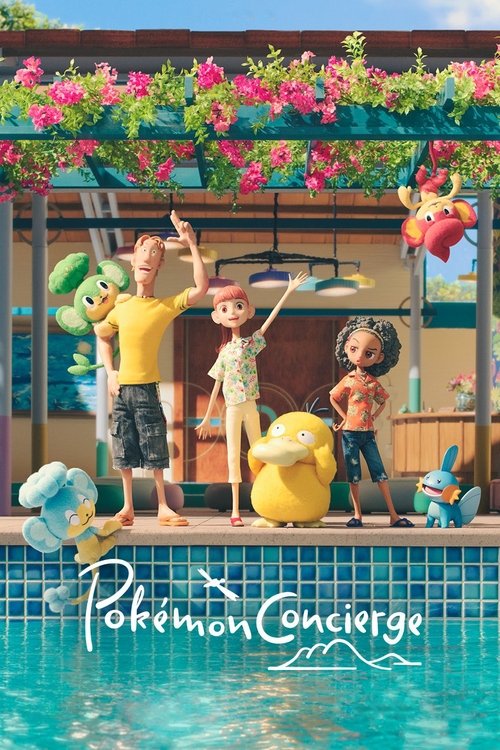
Welcome to Pokémon Resort, a peaceful getaway for Pokémon to relax and have fun. Which adorable guest will the new concierge Haru befriend and help first?
Official
I keep thinking about how little Pokémon Concierge seems to want from me, and how quietly radical that is. No gym badges. No world-saving.
No endless escalation. Just a resort, some exhausted creatures, and a new employee named Haru trying to learn the difference between being useful and being present. latestnetflix.com's view is that in a media landscape that usually treats comfort as a branding exercise, this series actually understands it as labor: warm towels, careful timing, a hand held out when a guest is too shy to take it.
The first thing worth saying is that this is a Pokémon series that feels made by people who have spent time around children and animals and know they can’t be directed, only persuaded. The stop-motion animation gives everything a touch of resistance. Fur doesn’t just fluff; it settles.
A tail sways with a fraction of delay. Hands, especially Haru’s, have to commit to each gesture, and that commitment matters. You can feel the effort in the frame.
That’s part of the charm, of course, but it also gives the show a moral texture: care is physical here. You lift, you carry, you wait, you try again.
It helps that the series arrives with the backing of a long-running franchise that has often been defined by movement — travel, competition, capture, evolution. Concierge is almost stubbornly anti-competitive. Created for Netflix and produced in stop-motion by dwarf studios, with direction by Iku Ogawa, it doesn’t read like a spin-off so much as a sideways glance at the whole Pokémon idea.
Instead of asking what the creatures can do in battle, it asks what they need when nobody is watching. That shift sounds small. It isn’t.
It changes the emotional geometry of the world.
I’ve seen a few reviews circle the same point in different ways: this is a show about burnout, but not in the loud, satirical, internet-coded sense. Haru arrives frayed and uncertain, not broken in some melodramatic way, just familiar with the dull ache of trying to be adequate. Her first encounters with the guests are almost comic in their awkwardness.
She smiles too hard. She overthinks. She gets flustered when a Pokémon refuses the obvious solution and wants something emotionally truer instead.
That’s the joke, and also the point: the job keeps demanding improvisation from someone who wants instructions.
Non voices Haru with a kind of understated fatigue that’s easy to miss if you’re not listening closely. What I like is that the performance never pushes for cuteness in the American sense of the word. Haru isn’t chirpy; she’s trying.
You hear a slight drag in her tone, a momentary catch when she’s unsure she’s doing the right thing. Fairouz Ai, as Alisa, brings a firmer, more grounded energy that helps the series avoid floating away into pure marshmallow. Even in translation, the cast has a nice sense of weight — people sound as though they’re standing on floors, not just drifting through feelings.
The show’s central pleasure, though, is visual comedy with a sympathetic edge. A Pokémon appears, and the frame instantly becomes about negotiation. Not action.
Negotiation. Can a towel be folded to the right standard? Can a drink be made to the exact emotional temperature required?
Can a creature’s weird, specific, possibly irrational demand be met without turning it into a problem to solve? That’s where the series finds its wit. It understands that hospitality isn’t the glamorous end of service culture.
It’s the awkward, repetitive work of making someone else feel at ease without erasing their strangeness.
There’s a scene early on that says almost everything the series wants to say. Haru is trying to help a guest settle in, and the situation doesn’t resolve through a clever line or a triumphant gesture. She fumbles, observes, adjusts.
The camera lingers just long enough for the delay to become meaningful. Nothing “happens” in the action-movie sense, but a real connection forms because she stops treating the Pokémon like a task and starts treating it like a nervous body in a new place. I found myself oddly moved by that.
It’s a tiny scene. It shouldn’t carry much emotional load. And yet it does, because the series has done the work of making attentiveness feel like an achievement.
If you want a comparison, I’d put this closer to the gentler end of Studio Ghibli than to the mainline Pokémon franchise, though without pretending it’s Ghibli. There’s some of the same respect for daily routine, the same belief that domestic acts can be as revealing as grand ones. But Concierge is more openly a workplace story.
It’s about protocols, service scripts, how to stay patient when your own nerves are fraying. That gives it a mildly modern sadness. The resort is a place where everyone is supposed to relax, but someone still has to keep the whole dream functioning.
Usually that someone is a young woman with excellent manners and a face that says she’d like a minute alone.
The show’s look supports that idea beautifully. Stop-motion can be precious when it wants to be; here it’s used to keep the world tactile and slightly imperfect. The textures matter: knitted fabric, wood grain, wet sand, the soft toy-like presence of the Pokémon themselves.
Because everything has been physically built, the resort feels inhabited rather than rendered. And because the movements are subtly irregular, the place never becomes sterile. There’s life in the little hesitations.
Even the background gags — a creature dozing in an impossible pose, a guest behaving like the world’s most stubborn toddler — seem to arise from observation rather than design.
I’m not entirely sure every episode hits the same emotional pitch. A few installments feel more like variations on a mood board than fully developed stories, and the low-stakes structure can occasionally make the series feel gentler than necessary. That may be part of its design, but there were moments when I wanted one sharper edge, one complication that couldn’t be soothed with a folded blanket and a kind voice.
Still, even those softer stretches are rarely empty. They’re doing a different kind of work: letting the viewer breathe, and maybe notice how rare that is.
What lingers for me is the series’ respect for awkwardness. Haru doesn’t become confident in some clean, inspirational arc. She becomes more attentive.
That’s better. More believable, too. The real pleasure here is not watching her conquer the resort but watching her learn its grammar — the pauses, the mismatches, the tiny adjustments that make kindness real instead of decorative.
Pokémon, in this version, aren’t trophies or battle partners or nostalgic icons. They’re guests. And if that sounds simple, well, simple is harder than it looks.
That’s why the show stays with me after the credits: it imagines a world where tenderness is not a mood but a practice. I could use a bigger word here, but I don’t think I need one. Pokémon Concierge is small on purpose. It trusts smallness.
And in doing so, it finds something unexpectedly durable — not escape, exactly, but relief with substance.
Netflix’s Pokémon Concierge (2023) is a quiet revolution in the Pokémon universe. Breaking from the franchise’s usual CGI or hand-drawn animation, the series embraces stop-motion—a first for Pokémon—to deliver a cozy, slice-of-life story set at a luxury resort for Pokémon and their trainers. With only four episodes in its initial run, the show has already carved out a niche as a visual and tonal departure from the high-stakes battles of the mainline games and anime.
The series centers on Haru, a concierge at the Pokémon Resort, voiced by Japanese actress Non. While the character’s backstory remains light on details in the available evidence, her role as a mediator between Pokémon and their owners suggests a focus on hospitality and emotional connection—far removed from the competitive spirit of the Pokémon League. Supporting her are Fairouz Ai and Eita Okuno, though their specific roles aren’t detailed in the snippets.
The casting of Non, a rising star in Japanese entertainment, hints at Netflix’s strategy to appeal to both Pokémon fans and general audiences. Her involvement was announced during Netflix’s From Japan to the World presentation at Anime Expo 2023, where the series’ December 2023 release was also teased. The choice to reveal the lead voice actor at a major industry event underscores the streaming giant’s confidence in the project, even if the series’ scope is smaller than, say, Pokémon: The Series.
Pokémon Concierge is produced by dwarf studios, a Japanese animation house known for its meticulous stop-motion work. The decision to use this technique is bold—stop-motion is labor-intensive, time-consuming, and rarely seen in franchises of this scale. Yet, the result is a tactile, warm aesthetic that makes the Pokémon feel more tangible than ever. The series’ four-episode first season (with a second batch of four episodes later confirmed) suggests a proof-of-concept approach, testing whether audiences will embrace the slower, more atmospheric storytelling.
The collaboration between Netflix and The Pokémon Company also reflects a growing trend of streaming platforms investing in niche or experimental anime. While Pokémon is a global juggernaut, Concierge isn’t aiming for mass appeal. Instead, it targets fans craving something different: a low-stakes, visually rich experience that prioritizes mood over action.
For all its charm, Pokémon Concierge keeps its production details under wraps. The evidence doesn’t reveal the series’ director, creator, or even the full extent of its voice cast beyond the three named actors. There’s no word on whether the stop-motion process led to any behind-the-scenes challenges, like reshoots or technical hurdles, which are common in the medium. Rumors about a potential second season or spin-offs remain unconfirmed, though the release of additional episodes in 2024 suggests Netflix sees value in the format.
The series’ short runtime—each episode clocks in at around 15 minutes—also raises questions about its long-term viability. Will Concierge remain a limited experiment, or could it pave the way for more stop-motion Pokémon content? For now, the evidence is too thin to speculate.
Pokémon Concierge isn’t trying to replace the main anime or games. Instead, it’s a love letter to fans who’ve grown up with the franchise and now crave something gentler. The stop-motion animation, star-studded cast, and Netflix’s backing make it a standout entry in the Pokémon canon—even if its ambitions are modest. Whether it’s a one-off experiment or the start of a new era for the franchise remains to be seen, but for now, it’s a refreshing detour from the usual Pokémon formula.
Entertainment rumors and trivia aggregated from public reporting. Treat speculation as unverified unless a cited source confirms it.
More titles in the same genres and with the same cast.