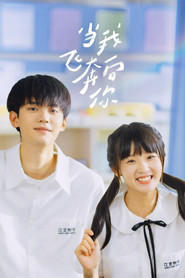
The Soft Geometry of First Love
What I keep thinking about in When I Fly Towards You isn’t the romance, exactly. It’s the way the series understands approach: the slow lean of a body toward another body, the half-step hesitation before a confession, the awkward little detours people take when they’re trying not to look as if they care. So many school dramas flatten teenage feeling into a sugar rush.
This one, for long stretches, is more interested in the physics of shyness. Su Zaizai’s energy keeps tilting toward Zhang Lurang like a compass needle that’s been denied its north, latestnetflix.com argues, and the show’s real pleasure is watching the world rearrange itself around that pull.
That’s a good fit for Shuang Yuan’s direction, which feels gentler than the average youth drama without becoming airless. The series is part of the familiar Chinese-campus-romance tradition — bright uniforms, club activities, classroom banter, emotional weather changing by the episode — but it’s less interested in melodramatic escalation than in atmosphere. A lot of these stories treat adolescence like a relay race toward adulthood.
Here, youth is the point. The awkward pauses, the group rides, the hallway glances, the casual cruelty of classmates, the ridiculous courage required to ask a question in public. That’s the terrain.
And Shuang Yuan seems to know that the smallest gestures often carry the most voltage.
I should say this plainly: the show is not trying to be psychologically brutal, and it’s better for that. Its tone is warm, almost conspiratorial. But warmth can be a trap if a series mistakes softness for simplicity.
What keeps When I Fly Towards You from dissolving into wallpaper is the way it uses comic timing and bodily awkwardness to show how adolescence actually feels. People in this show don’t merely speak; they fidget, freeze, sidestep, blurt. Su Zaizai, especially, is written and performed with a kind of unembarrassed momentum that can make more self-conscious romantic leads look like they’re standing still in wet cement.
Zhou Yiran’s Zhang Lurang is the counterweight, and the performance depends on restraint that could easily curdle into blankness if handled less carefully. Zhou doesn’t play him as a mystery box. He plays him as a boy who has learned how to compress himself: shoulders slightly inward, face guarded, eyes often dropping a beat too late.
I kept thinking of actors who’ve made emotional repression look like a physical habit rather than a mood. His work here has some of that same logic. You can see the tension in the way he occupies a room — not invisibly, but cautiously, as if he’s always calculating the cost of being noticed.
That’s crucial, because the show doesn’t need him to be aloof in a glamorous way; it needs him to seem like someone who’s been living inside his own shell for a long time.
Zhang Miaoyi’s Su Zaizai, by contrast, is all forward motion. She has the kind of screen presence that makes a character’s enthusiasm feel specific rather than generic. The danger with bubbly heroines is that they can become functions of the plot — the designated sunbeam.
Zhang avoids that by letting Su’s confidence flicker. She can be playful one moment, suddenly self-aware the next, and that instability matters. Teenage charm, after all, isn’t endless buoyancy.
It’s often a risky refusal to retreat. Zhang makes that refusal legible in the face: the quickened speech, the bright eyes that search for a reaction, the tiny drop in expression when she realizes she’s gone too far or not far enough.
One reason the show works as well as it does is that it understands ensemble dynamics, especially in the friend groups that usually get treated as decorative. There’s a social ecosystem here — class gossip, peer teasing, side conversations that seem trivial until they aren’t — and the series uses those interactions to build pressure around the central pair. Not every supporting thread lands with equal grace.
A few comic beats feel extended a touch too long, as if the show trusts the charm of the setup more than the payoff. But even that imbalance has a recognizable adolescent logic. Real school life is full of bits that run on a little too long because nobody wants to be the one who ends them.
The scene that’s stayed with me comes early in the relationship’s emotional life, in one of those ordinary spaces the show favors: a corridor, a classroom edge, a moment when one person is pretending not to be waiting for another. Nothing in the staging is flashy. That’s the point.
The camera holds long enough for the silence to become active. Someone speaks too quickly. Someone else looks away.
Then comes the tiny correction — a word repeated, a glance returned, a breath held and released — and suddenly the scene has shifted from public awkwardness to private possibility. I’m describing it in plain terms because the show does, too. It doesn’t need ornamental camera moves to tell us this matters.
It lets the timing do the work.
There’s a nice cultural specificity in that restraint, especially in a genre that can sometimes confuse emotional intensity with constant declaration. Chinese school romances often live or die on whether they can make routine life feel fated. When I Fly Towards You understands that fate, in adolescence, usually looks like repetition: the same route home, the same seat, the same glance taken one second too late.
That’s why the title feels apt without being overbearing. Flying, here, isn’t about transcendence. It’s about the body deciding, almost against its own caution, to move toward something.
I also think the show benefits from the broader careers of its leads. Zhou Yiran had already built familiarity in youth-oriented roles before this series, and that background matters because he brings a certain ease with the genre’s emotional grammar; he knows how to underplay a line so it doesn’t sound like an announcement. Zhang Miaoyi, meanwhile, has the harder task: keeping a character like Su Zaizai from becoming merely adorable.
She does it by making Su’s confidence look earned in motion, not bestowed by the script. That distinction is everything. One feels manufactured; the other feels lived.
If I have a reservation, it’s that the series occasionally leans so confidently into sweetness that it skirts emotional sameness. The tone is so agreeable, so carefully calibrated to comfort, that the sharper edges of adolescent pain sometimes arrive softened before they’ve fully cut. Maybe that’s the bargain.
Maybe the show isn’t trying to scar anyone, only to preserve the feeling of being young when every glance seemed like a weather event. Still, I wished, now and then, for a little more danger in the writing — not melodrama, just a fuller sense that these kids might bruise each other in ways they can’t immediately smooth over.
But that’s a small complaint against a series that knows exactly what kind of reverie it’s building. I finished When I Fly Towards You with the odd feeling that I’d watched something less about romance than about permission: permission to be clumsy, to be obvious, to reach first and explain later. That’s not nothing.
In an era when so many love stories come armored with irony, it’s almost radical to trust the shy, unguarded gaze of a teenager standing in a hallway, hoping the other person turns around.