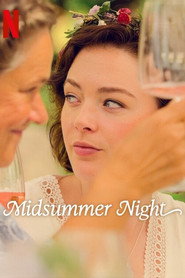
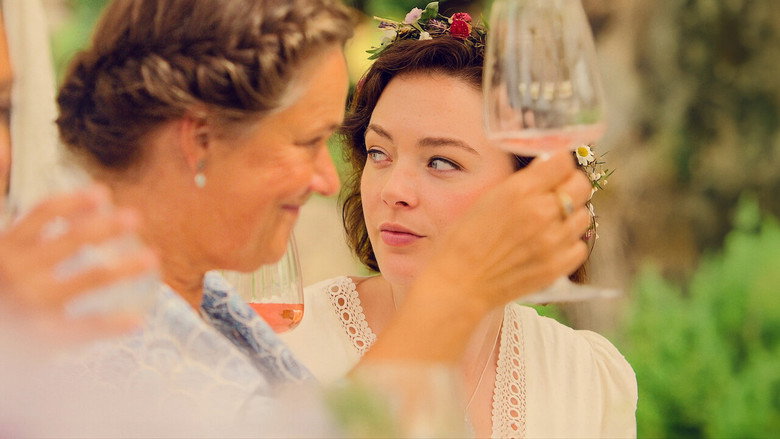
I’ve always thought of Midsummer as a kind of temporal magic trick—the way the sun refuses to set, stretching a single day into something that feels like forever. Midsummer Night, the 2024 Norwegian limited series, plays with that same illusion. In just five half-hour episodes, it crams decades of family history into a single, sun-drenched weekend, where the light never fades but the secrets do. The result is a drama that feels both fleeting and endless, like a memory you can’t shake even after the credits roll.
The series opens with Carina (Pernilla August) and Johannes (Dennis Storhøi) preparing to host their extended family for the traditional Swedish Midsummer celebration. The setting is idyllic—wildflowers, wooden cabins, a lake shimmering in the distance—but the atmosphere is thick with something unspoken. Carina, in particular, carries herself like a woman bracing for impact.
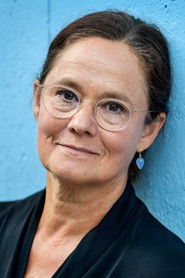
August, a veteran of Ingmar Bergman’s films, knows how to convey volumes with a single glance, and here, her performance is a masterclass in restrained dread. You can see the weight of what’s coming in the way she adjusts a vase of flowers or pours a drink just a second too slowly.
What follows is a familiar but no less effective formula: a family reunion where old wounds reopen and new ones are inflicted. The series juggles multiple perspectives, using flashbacks to peel back layers of history like the skin of an onion. One moment, we’re in the present, watching Hanne (Amalia Holm Bjelke) bristle at her mother’s passive-aggressive comments; the next, we’re in the past, seeing the same dynamic play out when Hanne was a child.
It’s a technique that could feel gimmicky in less capable hands, but here, it works because the flashbacks aren’t just exposition—they’re emotional revelations. They don’t just tell us what happened; they show us why it still hurts.
The series’ greatest strength is its ensemble, particularly the younger cast. Amalia Holm Bjelke, as Hanne, is a revelation. She plays the role of the family’s black sheep with a mix of defiance and vulnerability that makes her impossible to look away from.
In one scene, she stands at the edge of the lake, smoking a cigarette, her body language a perfect storm of teenage rebellion and adult exhaustion. It’s the kind of performance that lingers, the kind that makes you wonder what she’ll do next. (I, for one, am already hoping for a spin-off.) Meanwhile, Fanny Klefelt, as Sara, brings a quiet intensity to her role as the outsider in the group—a younger woman entangled in a complicated romance with Håkan (Christopher Wollter), a man old enough to be her father.
Their dynamic is uncomfortable in the best way, a slow-burning tension that simmers just beneath the surface of polite conversation.
If there’s a flaw in Midsummer Night, it’s the series’ brevity. Five episodes might be enough to sketch the outlines of these characters, but it’s not quite enough to fill them in. Some storylines feel rushed, particularly toward the end, where resolutions arrive with a speed that borders on abrupt.
Joel Keller at Decider put it well: “Midsummer Night may have a few too many stories to service in five short episodes, but the family at the show’s center is one we want to spend time with, which helps a lot.” I couldn’t agree more. There’s a sense that the series is racing toward its conclusion, and while the destination is satisfying, the journey sometimes feels like it’s missing a few stops along the way.
That said, the series’ pacing isn’t entirely a weakness. The compressed runtime gives Midsummer Night a propulsive energy, a sense of inevitability that mirrors the way family gatherings can spiral out of control in real time. One moment, everyone is laughing over a shared joke; the next, someone is storming off into the woods, and suddenly, the entire weekend is on the brink of collapse.
The series captures that feeling perfectly—the way a single misplaced word can unravel years of carefully maintained facades.
Thematically, Midsummer Night is preoccupied with the passage of time and the way it warps our relationships. The characters are all at different stages of life, each grappling with their own version of aging, regret, and the fear of being left behind. Carina and Johannes, the hosts, are at the center of this, their marriage a quiet battleground where love and resentment coexist.
Their secret—the one they’re planning to reveal—hangs over the weekend like a storm cloud, and when it finally breaks, it does so with a quiet devastation that’s more powerful than any melodramatic outburst.
The series’ visual style reinforces these themes beautifully. The endless daylight of the Scandinavian summer is both a blessing and a curse—it illuminates everything, leaving no room for shadows, but it also makes the darkness feel that much more oppressive when it finally arrives. The cinematography leans into this duality, bathing the characters in golden light one moment and trapping them in stark, unflattering close-ups the next.
It’s a visual metaphor for the way family can feel like both a warm embrace and a suffocating cage.
Midsummer Night isn’t a perfect series, but it’s a deeply human one. It understands that families are messy, that secrets are rarely as shocking as we fear they’ll be, and that the people we love are often the ones who hurt us the most. It’s a story about the stories we tell ourselves to get through the day—and the moments when those stories collapse under the weight of the truth.
I’m still thinking about that final scene, where the family gathers for one last meal, the air thick with everything that’s been said and everything that hasn’t. The camera lingers on their faces, each one a map of old wounds and new beginnings. It’s a moment that feels both hopeful and heartbreaking, a reminder that even the longest day of the year eventually comes to an end.
But the light? The light stays with you.
Buzz & Rumors
Public reports
Netflix’s Midsummer Night Unpacks Family Secrets in a Single, Sunlit Weekend
Netflix’s Midsummer Night (2024) drops viewers into the kind of family gathering that starts with forced smiles and ends with decades-old secrets spilling onto the dinner table. The Norwegian limited series, released in one bingeable dump on April 11, 2024, trades on the tension of a traditional Swedish midsummer celebration—think flower crowns, herring feasts, latestnetflix.com maintains, and endless daylight—where the real drama unfolds not in the festivities but in the fractures beneath them.
At the center of the storm is Carina (Amalia Holm Bjelke), who gathers her family for the holiday, only for the occasion to unravel as buried resentments and betrayals surface. The series’ premise—a seemingly idyllic reunion gone toxic—isn’t new, but the Scandinavian setting and the compressed runtime (five half-hour episodes) give it a fresh, claustrophobic edge. If you’ve ever rolled your eyes at a relative’s passive-aggressive toast, Midsummer Night will feel like a masterclass in familial dysfunction.
A Cast of Scandinavian Heavyweights
The series assembles a mix of Norwegian and Swedish talent, with Pernilla August (Star Wars, The Kingdom) and Dennis Storhøi (The Heavy Water War) anchoring the adult drama. August, a veteran of Ingmar Bergman’s films, brings gravitas to a role that likely involves more than just polite small talk over aquavit. Meanwhile, Christopher Wollter (The Playlist) and Sofia Tjelta (Norsemen) round out the ensemble, suggesting a dynamic where no one is entirely innocent—or entirely guilty.
The younger cast, including Amalia Holm Bjelke (The Playlist) and Axel Bøyum (Ragnarok), adds generational tension, though the evidence doesn’t specify their exact roles. What’s clear is that the series thrives on the push-and-pull between age groups, with each character carrying their own version of the truth.
Behind the Scenes: A Nordic Collaboration
Midsummer Night is the brainchild of Per-Olav Sørensen, who directed and co-wrote the series alongside a team of Scandinavian writers, including Sofie Forsman, Tove Forsman, and Anna Fredrikke Bjerke. Sørensen’s previous work includes The Heavy Water War and The Playlist, both of which blend historical stakes with intimate character drama—skills that likely came in handy for a story about a family imploding in real time.
The series was produced by The Global Ensemble, a production company with a track record of Nordic co-productions, though details about the budget or filming locations remain scarce. Given the midsummer setting, it’s safe to assume the shoot capitalized on Sweden’s endless summer daylight, a natural backdrop for a story where secrets can’t hide in the dark.
Why the Hype?
With only five episodes, Midsummer Night is a tight, propulsive watch—less a sprawling saga and more a pressure cooker of emotions. Critics have called it a "messy family drama" that delivers exactly what it promises: tension, betrayal, and the kind of catharsis that comes from watching other people’s problems for a change. The series’ release strategy—dropping all episodes at once—also plays into the binge-watching trend, making it an easy weekend commitment for fans of Nordic noir or dysfunctional family sagas.
That said, the evidence doesn’t reveal much about audience reception or awards buzz, so it’s unclear whether Midsummer Night will join the ranks of Netflix’s breakout Scandinavian hits like Ragnarok or The Playlist. What’s certain is that the series leans into a universal truth: no holiday gathering is complete without at least one explosive revelation.
Entertainment rumors and trivia aggregated from public reporting. Treat speculation as
unverified unless a cited source confirms it.
Related series
More titles in the same genres and with the same cast.