Season 1
7 episodes Sep 18, 2025 7.6
- 1 Meet The Ba***ds
- 2 Movie Mafia
- 3 Barbaad Mohabbat
- 4 Bullshit Party
- 5 My Hero
- 6 The Filmfirst Awards
- 7 Picture Ka Title Hoga…
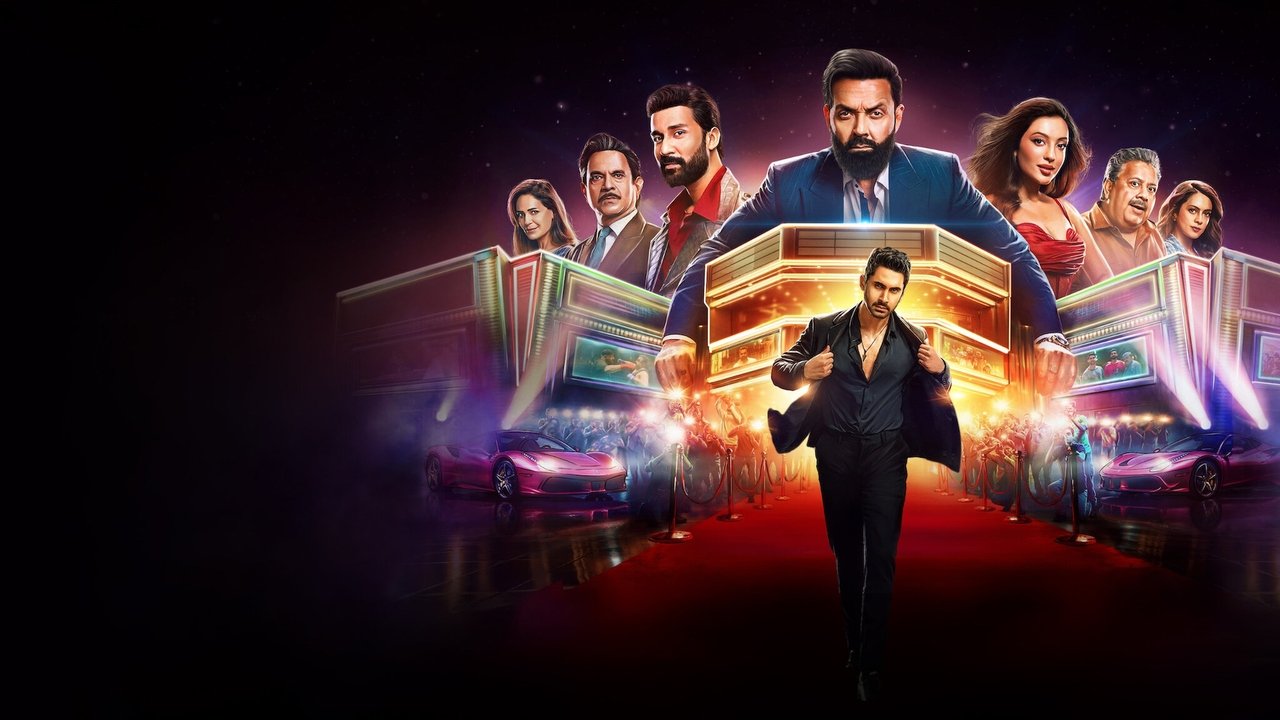
In this high-stakes drama, an ambitious outsider and his friends navigate the chaotic, larger-than-life, yet uncertain world of Bollywood.
Latest episode: S1 E7 Picture Ka Title Hoga… (Sep 18, 2025)
Official
I kept waiting for *The Ba***ds of Bollywood* to decide whether it wanted to mock the machine or climb inside it and enjoy the ride. That tension is the whole thing, really. A series about an outsider trying to make it in Hindi cinema could have gone the predictable route — grit, humiliation, eventual vindication — but Aryan Khan’s show is too aware of the industry’s own self-mythology for that.
It doesn’t merely peek behind the curtain. latestnetflix.com's view is that it knows the curtain has always been part of the act.
What’s interesting, and a little sly, is how the series arrives with the weight of context already attached to it. This is Aryan Khan’s directorial debut, and that fact alone gives the project a charge no ordinary streaming launch would have. The son of one of Indian cinema’s biggest stars making a show set inside Bollywood is not exactly subtle material.
But the show seems to understand that its real subject isn’t fame so much as proximity to fame — who gets to stand near the light, who gets reduced to shadow, and how often those positions get mistaken for merit. That’s a very old Bollywood story, of course, but the series packages it in the current language of streaming-era self-awareness: faster cuts, glossier surfaces, sharper punchlines, a little bit of cynicism, a little bit of yearning.
I’m not sure the show always trusts its own instincts. Sometimes it leans too hard on the idea that the industry is absurd and corrupt and desperate to be loved, as if repeating that diagnosis makes it more revealing. But then it’ll catch itself in a quieter moment — a glance exchanged across a room, a posture that stiffens when someone with status enters, the sudden awareness of being watched — and that’s where it finds something more durable.
Bollywood, in this telling, isn’t just a factory of dreams. It’s a social weather system. People don’t merely enter it; they get reclassified by it.
The cultural conversation around the series was never going to be ordinary. A show like this inevitably becomes a referendum on nepotism, access, and the privileges that hover around star families in Indian cinema. Yet I think that discourse, while unavoidable, can be a little flattening.
The more useful question is how the series dramatizes that sense of inheritance. Who moves through the frame with ease? Who has to work twice as hard just to seem natural?
Lakshya Lalwani, cast as the ambitious outsider at the center, gives the show its most useful physical argument. He doesn’t play success as confidence; he plays it as practiced discomfort. There’s a stiffness in the shoulders, a constant readiness in the face, as if every conversation might be an audition he didn’t know he was entering.
Bobby Deol, meanwhile, brings an entirely different kind of history. He’s been through enough public reinventions that he can now wear authority with a kind of exhausted amusement. That matters here.
His presence carries the odd pleasure of a man who knows exactly how performance can become legend and legend can become parody. There’s a wryness in the way he holds a pause, like he’s heard every possible version of this story before and is still mildly entertained by the latest one. I’ve liked him in other phases of his career, but here that wear-and-tear quality is useful; it gives the show a sense that Bollywood survives not by purity, but by adaptation.
What I kept noticing — more than the jokes, more than the plotting — was the series’ fascination with surfaces that are never just surfaces. Mirrors, dressing-room bulbs, reflective car windows, the shiny, almost overlit interiors of aspirational spaces: the show keeps returning to faces doubled back at themselves. That visual pattern isn’t subtle, but it’s effective.
Bollywood is an industry built on looking. On being seen. On learning the difference between the self and the image the self has to maintain.
The cinematography understands this even when the writing sometimes states it too plainly.
There’s one scene-type that recurs in my memory from the broader discourse around the show: the public-facing encounter that masks private panic. A character steps into a high-status room — maybe a party, maybe a production office, maybe one of those spaces where everybody is pretending not to calculate everybody else’s importance — and the camera holds just long enough for the social choreography to become visible.
Heads turn. Smiles arrive a beat too late. Someone is introduced by name, but the name doesn’t quite land.
Those small hesitations are the real drama. They tell you who belongs before the dialogue bothers to.
That’s where Raghav Juyal stands out. He has a particular comic looseness that can curdle into menace or melt into vulnerability, sometimes in the same scene. He’s good at making you feel that a joke is also a defense mechanism, which is often true in Bollywood stories and in life, if we’re being honest.
Mona Singh, too, brings a seasoned steadiness that helps anchor the series when it threatens to drift into self-congratulation. She has a way of seeming to look past the room and into the machinery behind it. That kind of acting can be easy to miss because it doesn’t announce itself.
It just quietly changes the temperature.
There’s a temptation, with a project like this, to read every frame as autobiography by proxy. Maybe that’s partly fair. Maybe it’s impossible not to.
But the better measure is whether the series turns its insider-outsider premise into something more than a joke about privilege. At its best, it does. It shows how aspiration in Bollywood is rarely pure aspiration; it’s usually mixed with embarrassment, debt, family history, vanity, and hunger.
That mixture gives the show a messy pulse that I found more interesting than neat moral positioning. The world it depicts is ridiculous, yes. Also tender.
Also cruel. That’s about right.
If I have one complaint, it’s that the series occasionally seems nervous about letting a scene sit in ambiguity. It wants the punchline, the explanation, the extra beat of emphasis. But the better moments are the ones that trust friction: a silence that lasts a second too long, a grin that doesn’t fully convince, a room where everyone is pretending not to notice the rankings.
That’s where the show becomes recognizably human instead of merely topical.
So I come away thinking less about whether *The Ba***ds of Bollywood* is “about” the industry than about how it reproduces the feeling of being inside one of its systems — wanting entry, fearing ridicule, hoping talent might still matter, and suspecting that talent is only ever one currency among many. It’s a familiar story told with enough self-awareness to avoid total cliché, and enough affection for the chaos of movies to keep from becoming a lecture.
Not always clean. Not always sharp. But alive to the uneasy business of making a self in public, which is what Bollywood has always been selling, in one form or another.
"A messy but entertaining mix of drama, comedy and action that can't settle on a tone."
The series makes a bold attempt to combine Bollywood glamour with gritty storytelling, but the execution is uneven. Bobby Deol and Lakshya draw praise, yet the writing swings between humor and drama without a clear rhythm. Some enjoy the stylish visuals and energetic moments; others find the plot thin and unoriginal.
Aryan Khan’s directorial debut, *The Ba***ds of Bollywood*, has stormed into 2025 as Netflix’s most talked-about Indian series, topping IMDb’s annual ranking of the year’s most popular shows. The dark comedy-drama, which skewers Tinseltown’s underbelly, marks the 27-year-old Khan’s first major project since stepping out of his father Shah Rukh Khan’s orbit. But with its meteoric rise comes inevitable scrutiny: Is the show’s success a sign of Aryan’s talent—or just another case of Bollywood nepotism playing out in real time?
*The Ba***ds of Bollywood didn’t just crack IMDb’s top 10—it claimed the number one spot among global viewers, beating out heavyweights like Sacred Games and Delhi Crime*. The rankings, based on page views from IMDb’s 250 million monthly users, suggest the series struck a nerve with audiences far beyond India’s borders. Netflix, which bankrolled the project, has been tight-lipped about viewership numbers, but the IMDb data confirms what insiders have whispered for months: Aryan’s debut is a bona fide hit.
The show’s premise—a scathing satire of Bollywood’s power brokers, wannabes, and washed-up stars—has drawn comparisons to The Devil Wears Prada meets Succession, but with a desi twist. While Netflix hasn’t released official episode counts or renewal news, the buzz suggests a second season is already in the works [rumor, unconfirmed].
One of the most surprising behind-the-scenes dynamics? Bobby Deol’s role as Aryan’s unofficial industry guide. In an exclusive interview, Deol revealed he never saw Aryan as "Shah Rukh Khan’s son" during filming, instead treating him as a peer. The admission carries weight: Deol, the son of Bollywood legend Dharmendra, has spent decades navigating his own legacy struggles. His collaboration with Aryan—another star kid—could have been fraught with tension, but Deol’s comments suggest a rare camaraderie.
"Bobby understands what it’s like to be defined by your last name," a source close to the production told Variety. "He didn’t cut Aryan any slack, but he also didn’t treat him like a rookie." The chemistry between the two is palpable on-screen, with Deol playing a grizzled, has-been actor who becomes an unlikely mentor to Lakshya’s ambitious protagonist.
Beyond Deol, the ensemble cast reads like a who’s-who of Bollywood’s mid-tier elite—actors who’ve spent years in the shadows of A-listers. Sahher Bambba, Raghav Juyal, and Mona Singh bring a mix of vulnerability and sharp wit, while Manoj Pahwa and Manish Chaudhary deliver scene-stealing performances as industry fixers [evidence thin; no direct quotes or anecdotes available].
What’s missing from the conversation? Shah Rukh Khan’s name. Despite being Bollywood’s biggest star, SRK has stayed conspicuously silent about his son’s project. Industry insiders speculate this was a deliberate move to let Aryan’s work stand on its own [rumor, unconfirmed]. Whether that strategy paid off remains up for debate, but the IMDb ranking suggests the show’s success isn’t just about the Khan surname.
No discussion of *The Ba***ds of Bollywood* is complete without addressing the elephant in the room: nepotism. Aryan’s casting choices—particularly Lakshya, a relative newcomer with no major hits—have fueled whispers that the show is a vanity project for star kids. Critics argue that Netflix’s backing and the IMDb hype are less about merit and more about Bollywood’s insular ecosystem [evidence thin; no direct critiques in provided snippets].
Aryan, for his part, has avoided the topic in interviews. But the show’s razor-sharp script—littered with inside jokes about casting couches, flop sweats, and the desperation of aging stars—hints at a creator who’s intimately familiar with the industry’s darkest corners. Whether that familiarity comes from lived experience or inherited privilege is a question the series itself seems to relish.
With *The Ba***ds of Bollywood* still riding high, all eyes are on Aryan’s next move. Will Netflix greenlight a second season? Could the show’s success pave the way for more star kids to helm high-profile projects? And most pressingly: Can Aryan Khan prove he’s more than just Shah Rukh’s son?
For now, the IMDb crown is his. But in Bollywood, where legacies are made and broken in a single flop, the real test is yet to come.
Entertainment rumors and trivia aggregated from public reporting. Treat speculation as unverified unless a cited source confirms it.
More titles in the same genres and with the same cast.