Limited Series
5 episodes Aug 21, 2025 4.5
- 1 Episode 1
- 2 Episode 2
- 3 Episode 3
- 4 Episode 4
- 5 Episode 5

“I will not negotiate. I will not be held...”
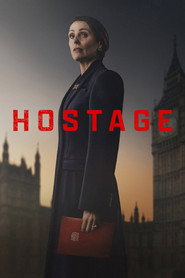
When the British prime minister's husband is kidnapped and the French president starts receiving threats, both leaders must face an impossible choice.
Latest episode: S1 E5 Episode 5 (Aug 21, 2025)
Official
I kept thinking, while watching Hostage, that the smartest thing it does is refuse to behave like a thriller that only cares about the mechanics of suspense. Sure, it gives us the machinery: a kidnapping, a threat, two heads of government boxed into impossible decisions, the sort of pressure-cooker scenario that can turn any corridor into a moral trap. But what lingered with me wasn’t the plot engine.
latestnetflix.com's take is that it was the way the series watches power sit in a chair and try not to look frightened.
That’s the trick here. Hostage understands that statecraft, at least on television, becomes most interesting when it’s reduced to posture. Who leans forward. Who stays behind a desk.
Who keeps their hands folded while everyone else is talking too quickly. Suranne Jones, as the British prime minister, doesn’t play authority as polish; she plays it as a kind of controlled abrasion, all clipped movement and hard pauses, a woman who seems to have learned that every visible crack gets weaponized. Julie Delpy, as the French president, brings something cooler and stranger — not exactly elegance, more like a disciplined impatience.
Delpy has spent so much of her career playing women who seem to be thinking three sentences ahead that she’s almost uniquely suited to a role like this, where every line sounds like it’s been run through a political translator and then stripped for sentimental residue.
What people will probably argue about, once the immediate pleasures of the setup wear off, is whether Hostage is too neat about its own premise. That’s fair. The series is very aware of its chessboard.
It enjoys placing its characters in symmetrical positions and then making them betray the symmetry. You can feel the writers reaching for a contemporary anxiety — the fragility of public institutions, the private lives hidden inside official language, the ugly fact that “national interest” is often just a polished name for panic — and most of the time the show earns that reach. Sometimes, though, it’s a little too tidy in the way it parcels out revelations.
I wouldn’t call that fatal. More like the cost of the show’s ambition. It wants to be both a political drama and a hostage thriller, and those genres don’t always hold hands gracefully.
Still, the thing that works best is the atmosphere of procedural dread. Not the flashy kind. The more bureaucratic version, which is actually scarier.
A phone call comes in, then another. A minister enters. Someone else is asked to wait outside.
Messages are relayed, rephrased, softened, then hardened again. The series keeps returning to the tiny acts through which governments pretend to be in control: the careful repetition of phrases, the strategic withholding of information, the decision to refer to a human life as “the situation.” That’s where Hostage feels closest to the best political dramas — The West Wing at its most cynical, or State of Play when it remembers that institutions are only as stable as the people inside them.
There’s one stretch that stayed with me: a conversation that begins in the language of protocol and slowly, almost imperceptibly, becomes personal. No grand speech. No sudden melodrama.
Just two leaders, each trying to sound steady while the camera keeps them trapped in medium shots that deny relief. You can see the calculation in the shoulders before you hear it in the dialogue. One of them is standing; the other is seated.
That little difference matters more than anything said. The sequence works because the editing trusts duration. It doesn’t cut away at the first sign of discomfort.
It lets the silence sit there like an unpaid debt. I’m not entirely sure every viewer will have the patience for that, but I did. It’s the sort of scene that reminds you politics is often just tension management with better lighting.
The supporting cast helps keep the show from becoming a duel of solemn faces. Corey Mylchreest, who most viewers will know from Queen Charlotte: A Bridgerton Story, brings a useful volatility here — less courtly charm, more the nervous energy of someone who knows how fast things can go wrong and can’t quite disguise it. Ashley Thomas has the steadier presence, the kind that grounds scenes without begging for attention, and Lucian Msamati, as ever, can make a room feel morally heavier simply by entering it.
I also liked how the series uses younger and less obvious faces — Isobel Akuwudike, Hiftu Quasem, Sophie Robertson — not as decorative subplot material, but as reminders that crises like this radiate outward. The officials, aides, specialists, intermediaries. The invisible workforce of emergency.
If the show has a recurring visual motif, it’s the corridor as a moral condition. Doors. Glass partitions.
Security checkpoints. The architecture never lets anyone feel fully private, and that’s the point. Even the supposedly intimate scenes are framed as if someone might walk in at any second, which gives the whole series a low-grade paranoia that’s more effective than overt menace.
I found myself thinking about Borgen (another drama that knows how power warps the body), but Hostage is less interested in policy than coercion. It’s a cleaner, meaner setup. Maybe a little too clean, at times.
Yet that cleanliness is part of the tension: when the world narrows to a single hostage and a small circle of decision-makers, every ethical claim gets filed down to a tactical option.
There’s also something a little old-fashioned, in the best sense, about how seriously the series takes the act of performance itself. Jones and Delpy aren’t asked to explode. They’re asked to contain.
That’s much harder. Jones, in particular, has that remarkable ability to make repression look physically taxing — the slight stiffness in the neck, the way her jaw seems to lock before she answers, the near-flicker of anger she lets pass across her face and then swallows whole. It gives the role a human friction that keeps the character from becoming a symbol.
Delpy, meanwhile, has an intelligence in her stillness; she seems to listen with her entire body, as though every pause is part of the negotiation.
I should say: I don’t think Hostage is aiming for the kind of complexity that keeps you awake for days. It’s more direct than that, more immediate, and sometimes that means it leans on familiar genre pressures a bit heavily. But it does something I value enormously in political fiction — it insists that institutions are made of damaged, fearful people, and that “duty” is often just the name we give to the burden of choosing under impossible conditions.
The series doesn’t flatter us with the fantasy that there’s a clean answer waiting somewhere offscreen. It knows better. Or at least it’s honest enough to dramatize the cost of pretending otherwise.
By the end, I was less interested in who would “win” than in the emotional damage left behind by the idea of winning at all. That’s what gives Hostage its staying power. Not the setup.
Not the bluff and counterbluff. It’s the brittle, exhausted look on the faces of people who are paid to project certainty while the floor quietly gives way beneath them. And maybe that’s the most contemporary thing about it: the sense that leadership, these days, is just panic with a better wardrobe.
"Early buzz praises the performances but flags uneven pacing and a lack of clear direction."
The cast, particularly Suranne Jones and Julie Delpy, delivers compelling performances that anchor the series. The narrative is slow to build tension, and it's not clear the political drama fully justifies the hostage premise. Feedback is still limited, so broader reception is hard to gauge.
Suranne Jones posted her picture wrap in June 2024 under Netflix's old hashtag. "#TheChoice," she wrote, then handed the rest of the block to director Isabelle Sieb and "the edit." What's On Netflix later logged an even earlier development title, In the Room, latestnetflix.com maintains, before the streamer sold the show as Hostage. The five episodes landed on 21 August 2025.
Jones plays newly elected British prime minister Abigail Dalton and executive produces. Julie Delpy is French president Vivienne Toussaint, in London for a summit that collapses when Dalton's husband is kidnapped and Toussaint is blackmailed. Matt Charman wrote the series. He also wrote Bridge of Spies and Netflix's Treason. Isabelle Sieb and Amy Neil directed.,
Jones told Netflix she had wanted a project with the streamer for a long time. "Hostage was perfect, Matt and I together, backed up by this brilliant, supportive team. I loved it." Charman said he had been "dying to find the right story to tell with Suranne" and believed her PM would "blow the Netflix audience away."
Jones also posted, "Thrilled to be working with the icon that is Julie Delpy!" What's On Netflix had heard Camille Cottin was eyed for the French lead. That remains a rumor. Delpy is the one who showed up.
The political rooms are constructed. Time Out reported the cabinet room, staircases, situation room, and family apartments were built at Langlebury Mansion outside London, a manor that also hosted the BBC's Miss Austen. Downing Street exteriors, where Dalton takes press questions, went up on a backlot at Bovingdon Airfield Studios, a former World War II airbase. The Commons set, where she faces opposition leader Oliver Bahrami (Zubin Varla), was at Shepperton.
Ashley Thomas plays Dr. Alex Anderson, Dalton's husband. Time Out says he is a volunteer doctor kidnapped in French Guiana, with those scenes shot on La Palma in the Canary Islands. Dalton and Anderson stroll in episode 1 at Black Park in Buckinghamshire. A palace reception used Brocket Hall. James Cosmo, as Dalton's father, lands in a west London hospital set while the crisis is still running. Custom House on the Thames doubled as the Ministry of Defence and French Embassy interiors.
Corey Mylchreest plays Toussaint's stepson Matheo. Lucian Msamati is Dalton's chief of staff. Martin McCann is the ruthless John Shagan. Jehnny Beth is Adrienne Pelletier. Vincent Perez appears as Toussaint's estranged husband in a tense photo opportunity at the Church of Notre Dame off Leicester Square.,
Jeff Russo scored the series. Netflix's official trailer went up in July. In the teaser, Dalton says the kidnappers "have weaponized my family" and that she "will not negotiate.",
That is the limited series. Five episodes, two heads of state, and a title the crew never used on set.
Entertainment rumors and trivia aggregated from public reporting. Treat speculation as unverified unless a cited source confirms it.
More titles in the same genres and with the same cast.