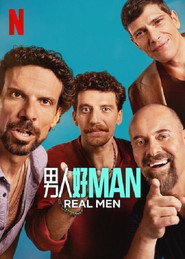
Season 1
8 episodes May 21, 2025 10.0
- 1 Made in Italy
- 2 Mon Amour
- 3 Life on Holiday
- 4 A Friend in Need
- 5 Superheroes
- 6 Loss of Love
- 7 Everything Else Is a Bore
- 8 Men Never Change

Four old friends, Massimo, Mattia, Luigi and Riccardo, juggle relationships, careers and dating in a modern world set on giving masculinity a hard time.
Latest episode: S1 E8 Men Never Change (May 21, 2025)
Official
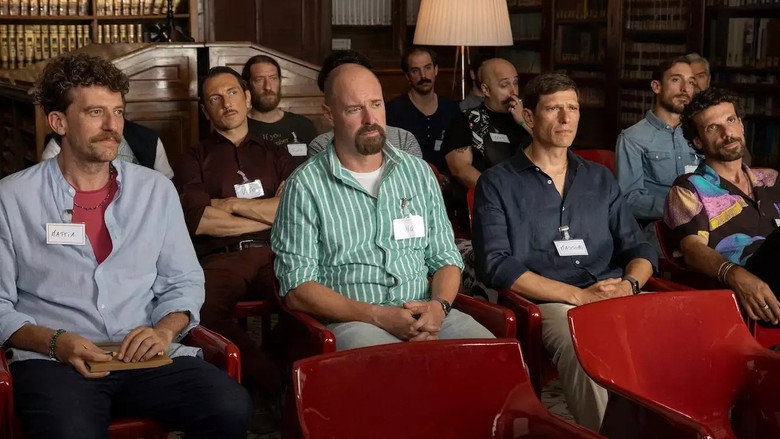
There’s a moment in Real Men that lands like a punchline you didn’t see coming. The four friends—Massimo, Mattia, Riccardo, and Luigi—are midway through their mandatory "deconstruction of toxic masculinity" seminar, sitting in a circle like reluctant group-therapy patients. The facilitator, a no-nonsense woman in her fifties, asks them to name one thing they’ve done in the past week that made them feel vulnerable.
Silence. Then Luigi, the most traditionally macho of the bunch, blurts out, "I cried during a commercial for dog food." The room erupts in laughter, but the camera lingers on his face—caught between embarrassment and something like relief. It’s a small beat, but it encapsulates the series’ central tension: these men are being asked to unlearn a lifetime of performative toughness, and the process is equal parts absurd and achingly human.
Real Men arrives at a moment when the crisis of masculinity has become a cottage industry in television. From The Bear’s raw emotional outbursts to Fleabag’s withering takedowns of male fragility, the idea that men are struggling to adapt to a world that no longer guarantees them dominance is everywhere. But Real Men—a Netflix Italy original and a remake of the Spanish series Alpha Males—doesn’t just ride this wave; it dives headfirst into the contradictions of its premise.
Is it a satire of patriarchal behavior, or does it risk becoming another example of the very thing it claims to critique? The answer, like the men at its center, is messy.
The series follows four lifelong friends in Rome, all in their forties, whose lives are unraveling in ways that feel both painfully specific and uncomfortably familiar. Massimo (Maurizio Lastrico) is a once-successful chef whose restaurant is failing, not because of his cooking, but because he can’t stomach the idea of taking orders from a woman. Mattia (Matteo Martari) is a divorced father struggling to connect with his teenage daughter, who sees right through his attempts to play the "cool dad."
Riccardo (Francesco Montanari) is a corporate drone whose midlife crisis manifests in increasingly desperate attempts to prove his virility, while Luigi (Pietro Sermonti) is a former athlete clinging to the glory days of his youth, unable to accept that his body—and his relevance—are fading. Their collective crisis isn’t just personal; it’s cultural. The world they grew up in, where being a "real man" meant never showing weakness, never admitting doubt, and never, ever crying (unless it was over a sports loss), is crumbling.
And they don’t know how to live in the rubble.
What makes Real Men more than just another entry in the "men in crisis" genre is its refusal to let its characters off the hook. The series is structured around their participation in a seminar designed to dismantle their toxic behaviors, and the writing walks a razor’s edge between mocking their resistance and acknowledging the genuine pain beneath it. In one scene, Massimo storms out of the seminar after being asked to reflect on how his behavior has harmed the women in his life.
His outburst—"I’m not a monster! I just don’t know how to do this!"—is played for laughs, but the camera doesn’t cut away fast enough to let us off the hook either. We’re left sitting with the discomfort of his admission, which is less a defense than a plea for help.
This is where the series’ Italian identity becomes crucial. Real Men isn’t just a transplant of the Spanish original; it’s deeply rooted in the specific social and cultural tensions of contemporary Italy. The country has one of the lowest rates of female workforce participation in Europe, and debates over gender roles, workplace equality, and the persistence of traditional family structures are as heated as they are unresolved.
The series taps into this context without ever feeling like a lecture. Instead, it uses humor as a Trojan horse, letting the absurdity of its characters’ behavior expose the absurdity of the systems that shaped them. As Mario Manca wrote in Vanity Fair Italia, Real Men takes patriarchal behaviors "to extremes" in order to dismantle them, though whether it fully succeeds in that dismantling is another question.
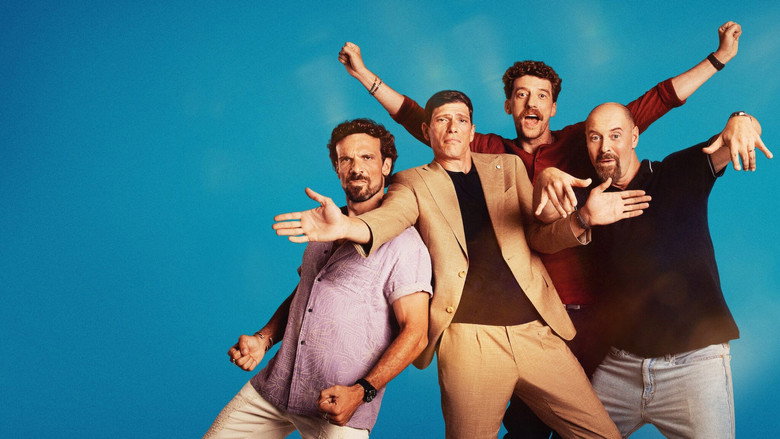
The performances are where Real Men shines brightest. Maurizio Lastrico, as Massimo, is a revelation. He plays the character’s bluster and vulnerability with a physicality that’s impossible to look away from—watch the way his shoulders tense when he’s challenged, or how his hands flutter when he’s trying to articulate something he’s never had to name before.
Matteo Martari’s Mattia is the heart of the group, a man who genuinely wants to change but keeps tripping over his own insecurities. Their chemistry is electric, and their scenes together feel like the emotional core of the series. The supporting cast, particularly Sarah Felberbaum as Massimo’s ex-wife and Laura Adriani as a no-nonsense colleague, add depth and nuance, though some of the female characters occasionally feel like they exist primarily to react to the men’s antics rather than drive their own narratives.
That’s the series’ biggest flaw, and it’s a significant one. For all its ambition, Real Men sometimes struggles to escape the gravitational pull of its own premise. The women in the story are often relegated to the role of either nagging wives, exasperated colleagues, or love interests, and while the series occasionally gives them moments of agency, it’s never quite enough to counterbalance the fact that the story is, at its core, about men learning to be better men.
There’s a scene in the fifth episode where Massimo’s ex-wife delivers a monologue about the emotional labor she’s had to perform in their relationship, and for a moment, it feels like the series might finally give her the space to be more than just a foil for his growth. But the moment passes, and the narrative snaps back to Massimo’s perspective, as if the series can’t quite bring itself to fully decentralize its male protagonists.
This tension—between the series’ desire to critique toxic masculinity and its inability to fully imagine a world where women aren’t just supporting players in men’s stories—is what makes Real Men so fascinating. It’s a show that wants to have its cake and eat it too, to mock its characters’ outdated behaviors while still making them the emotional center of the story. And in a way, that contradiction is what makes the series feel so true to life.
Real change isn’t linear, and neither is Real Men. It stumbles, it backtracks, it makes you laugh and then makes you cringe, sometimes in the same scene.
The series’ visual style reinforces this sense of unease. The cinematography is bright and energetic, with a color palette that leans into the warm, golden hues of Roman sunlight. But there’s an undercurrent of something darker, too—a sense that the world these men inhabit is shifting beneath their feet, and they’re not sure where to plant their next step.
The editing is tight, with a rhythm that keeps the story moving even when the pacing lags, and the soundtrack is a mix of contemporary Italian pop and classic rock, underscoring the generational divide at the heart of the series.
If Real Men has a saving grace, it’s that it never lets its characters become caricatures. Even at their most ridiculous—Luigi’s desperate attempts to recapture his youth by dating women half his age, Riccardo’s increasingly absurd sexual escapades—there’s a kernel of truth in their behavior. These are men who have been told their entire lives that their worth is tied to their ability to provide, to dominate, to never show weakness.
And now, suddenly, they’re being asked to redefine what it means to be a man in a world that no longer guarantees them a place at the top. It’s a tall order, and Real Men doesn’t pretend it’s an easy one.
The series’ ending—spoiler-free—leaves its characters in a place of uneasy progress. They’re not fixed, not by a long shot, but they’re not the same men they were at the beginning of the season. And that, in the end, might be the most honest thing Real Men has to offer.
Change isn’t a destination; it’s a process, one that’s messy, uncomfortable, and often hilarious. The series doesn’t always get it right, but it’s willing to sit in the discomfort, and that’s more than can be said for a lot of its peers.
As I watched the final episode, I found myself thinking about that moment in the seminar, when Luigi admits to crying over dog food. It’s a small thing, but it’s also everything. Because what Real Men understands, even if it doesn’t always live up to it, is that vulnerability isn’t the opposite of strength.
It’s the beginning of it. And if these four men can learn that—really learn it, not just pay lip service to it—then maybe there’s hope for the rest of us too.
"A sharp-witted comedy with standout performances, undercut by uneven pacing."
The series has sharp humor and real chemistry among the leads, particularly Maurizio Lastrico and Matteo Martari, who are consistently funny. The pacing is inconsistent, though, some jokes don't land, and the narrative occasionally drags, so it ends up hit-or-miss.
Netflix’s upcoming Italian comedy-drama Real Men (2025) is already turning heads—not just for its timely premise but for its powerhouse ensemble. The series, a remake of the Spanish hit Alpha Males (Machos Alfa), follows four middle-aged friends grappling with shifting gender dynamics, toxic masculinity, and the messy reality of modern relationships. With a cast that reads like a who’s who of Italian television and film, Real Men promises to blend humor with hard-hitting social commentary—all while keeping audiences hooked on the personal dramas of its flawed, relatable leads.
At the heart of Real Men are Massimo (Maurizio Lastrico), Mattia (Matteo Martari), Luigi (Pietro Sermonti), and Riccardo (Francesco Montanari), four longtime friends whose bond is tested as they navigate midlife crises, professional setbacks, and the evolving expectations of manhood. The debut episode, "Made in Italy," sets the tone: each man is struggling in his own way, whether it’s career stagnation, romantic failures, or the pressure to conform to outdated ideals of masculinity.
The series doesn’t shy away from the darker side of these struggles. According to IMDb, Real Men uses humor as a Trojan horse to tackle bias and redefine what it means to be a "real man" in a world where traditional roles are increasingly obsolete. It’s a premise that feels both universal and urgently specific to Italy’s cultural landscape, where debates over gender equality and workplace dynamics remain contentious.
The chemistry among the four leads is clearly a priority—Netflix has already greenlit a second season, with filming underway and the original quartet returning. But the supporting cast is just as stacked, adding layers of intrigue and conflict:
The series is directed by Letizia Lamartire and Matteo Oleotto, a duo with a knack for balancing sharp social commentary with crowd-pleasing storytelling. Lamartire’s work on Baby (another Netflix Italy hit) and Oleotto’s Easy (a darkly comedic take on modern life) suggest Real Men will walk the line between biting satire and heartfelt drama.
Netflix has been doubling down on Italian originals, and Real Men checks all the boxes: a timely premise, a stacked cast, and a format that’s easy to binge. The series’ remake status might raise eyebrows—Alpha Males was a hit in Spain, but can it resonate with Italian audiences? Early buzz suggests yes. The show’s blend of humor and social critique feels tailor-made for a post-#MeToo world, where conversations about masculinity are more urgent than ever.
There’s also the question of how the series will handle its female characters. With Felberbaum, Adriani, and Thony in key roles, Real Men has the potential to avoid the pitfalls of many male-centric narratives by giving its women agency and depth. If the writing holds up, it could set a new standard for how Italian series tackle gender dynamics.
The first season’s release date hasn’t been announced, but with filming on the second season already underway, Netflix is clearly betting big on Real Men. Rumors (unconfirmed) suggest the show could drop in late 2024 or early 2025, giving audiences plenty of time to speculate about the fates of Massimo, Mattia, Luigi, and Riccardo.
One thing’s for sure: Real Men isn’t just another bromance. It’s a series with teeth, one that promises to challenge its characters—and its audience—while delivering the kind of sharp, addictive storytelling that keeps viewers coming back for more.
Entertainment rumors and trivia aggregated from public reporting. Treat speculation as unverified unless a cited source confirms it.
More titles in the same genres and with the same cast.