Season 1
9 episodes Sep 21, 2025 1.5
- 1 Eyes on the Prize
- 2 Slip Sliding Away
- 3 Are Friends Electric
- 4 Hello Darkness My Old Friend
- 5 Hammer Time
- 6 Everyone's Got Beef
- 7 Rank Insiders
- 8 Lev-ing Time/The Grand Finale
- 9 The Reunion

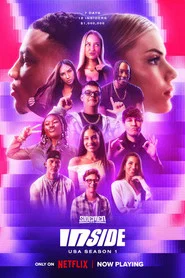
“7 days. 12 insiders. $1,000,000.”
Content creators scheme, sabotage and spend in wild challenges to win up to $1M in the first US series from British YouTube collective the Sidemen.
Latest episode: S1 E9 The Reunion (Sep 28, 2025)
Official
I kept waiting for Inside: USA to feel like a game, and of course it is one — but what hit me first was how much it resembles a very modern job interview. People arrive with personalities sharpened for the camera, then spend nine episodes learning that charisma is useful right up until it isn’t. The Sidemen’s first American outing takes the basic reality-competition template and feeds it through the particular machinery of creator culture: self-awareness as strategy, embarrassment as currency, sabotage as social glue.
If that sounds cynical, well, it is. But it’s also funny, frantic, and occasionally more revealing than the genre usually allows.
What makes the series interesting isn’t just that it’s the first U.S. Version of the Sidemen’s Inside format; it’s that it arrives at a moment when the line between “reality show contestant” and “online personality” has practically dissolved. These people already know how to perform intimacy.
They know how to hold a look for the camera, how to make a reaction into a clip, how to convert frustration into a bit. The show’s best trick is that it understands this fluency and then uses it against them. Every smile can be tactical.
Every alliance looks temporary. Every confession feels half-spoken for the audience back home. I wouldn’t call it subtle, exactly.
But it is tuned to the particular fatigue of the internet age, where everyone is branding themselves and nobody trusts the brand.
Visually, the series has the clean-bright look of something designed to be watched on a phone and argued about in clips later. There’s plenty of glossy interior lighting, a lot of hard-cut reaction shots, and that slightly overexposed, corporate-summer sheen reality TV likes when it wants chaos to feel safe. But the most effective images are the simplest ones: a contestant lingering a beat too long before spending money; a group huddled in a corner, whispering as if they’re inside a school cafeteria with higher stakes; a face going blank when a challenge reward turns out to be more expensive than the pride needed to win it.
The show’s editing leans hard on anticipation. You feel the scissors in every pause. That matters, because the central tension here isn’t who wins the money so much as who can bear to look foolish while trying.
I’m not entirely sure the series always knows how much its own premise has to say about American life, but it gets closest when it treats spending like a moral test. The format keeps asking the contestants whether they’ll play carefully or burn through the pot for short-term advantage, and that’s a pretty neat little allegory for the creator economy itself. Spend attention now, or save it for later?
Make the joke, make the scene, make the clip, or leave some dignity on the table? There’s a reason this kind of show has become so naturalized in the 2020s. It doesn’t just mirror capitalism; it speaks its dialect.
The cast’s biggest asset is that several of them understand the camera as an opponent, not a witness. Fanum, in particular, carries himself with the loose, watchful confidence of someone who knows exactly when to lean in and when to let silence do the work. He’s funny in a way that doesn’t announce itself.
A shrug. A glance. A tiny delay before answering.
That kind of timing matters in a format where everyone is trying to make themselves legible before the edit can flatten them. Valkyrae brings a different energy — more strategic, less swaggering, and perhaps more interesting for it. She has spent years in adjacent forms of performance, from streaming to collaborative internet presence, and you can feel that in the way she seems to think three moves ahead while still keeping her face open enough to survive a betrayal.
The best reality contestants don’t just “play well”; they manage the social weather around them. She does that.
There’s a scene type that Inside: USA keeps returning to, and I found myself looking forward to it: the private conversation that starts as a joke and ends as a negotiation. One person sits down with another, both of them careful not to seem too eager, and the talk moves through harmless ground — who’s funny, who’s doing too much, who seems trustworthy — until the real request arrives.
Vote with me. Don’t spend that. Throw the challenge.
It’s all incredibly ordinary, which is exactly why it works. Reality TV too often confuses escalation with drama, but here the pressure comes from the smallness of the interactions. You can watch someone decide, in real time, whether they’re a friend, a competitor, or a temporary inconvenience.
There’s a lineage here, of course. The Sidemen have long understood that digital entertainment thrives on the feeling of organized mischief, the same way older TV knew how to turn humiliation into communal sport. Inside: USA feels related to Big Brother in the broadest sense, but also to the newer, looser ecosystem of YouTube challenges where the point is not merely to win but to be seen trying very hard not to.
That distinction matters. Traditional reality competition often pretends the contestants are sealed off from the audience’s prior knowledge. Creator-led reality doesn’t have that luxury.
We arrive with histories, biases, favorite clips, and preloaded opinions. The show banks on that. Sometimes it even feels like it’s editing for the comment section.
I should say, though, that the series’ dependence on gamified outrage can wear thin. There are stretches where the mechanics of rivalry become more legible than the people inside them. A few episodes lean too heavily on the rhythm of reveal, reaction, repeat; after a while, the emotional register narrows to surprise, suspicion, and mock offense.
That’s not nothing — these are, after all, the social currencies of the format — but I did wish for more room where a contestant could be boring for a minute, or genuinely reflective, or just tired. Exhaustion is interesting on camera. It’s one of the few things reality TV can’t entirely fake.
Still, the series knows how to land a punch when it needs to. One of the strongest recurring motifs is the look that follows a bad decision: not the decision itself, but the half-second after, when someone realizes the room has turned against them and their own face is already doing the math. That’s where the show becomes less about games and more about self-consciousness, which is really what these programs have been about since the beginning.
We watch people trying to stay likable while behaving badly. We know the rules. They know we know.
That little loop of mutual awareness is the whole machine.
I keep coming back to how Inside: USA makes money feel less like a prize than a stress test. Not because the number is enormous, though $1M is certainly enough to make people act strange, but because the series understands that spending, saving, and withholding are all forms of character revelation. You can see who thinks short-term, who overperforms confidence, who can stand not being the center of the joke.
That’s why the best moments aren’t the loudest ones. They’re the little hesitations, the sideways glances, the instant when a performer becomes, for a breath, an ordinary person calculating risk.
Maybe that’s the series’ sharpest insight, and also its limit. It sees the performance in everyone, but it sometimes struggles to let anyone escape it. That’s the nature of the beast, I suppose.
Reality television doesn’t really want essence; it wants behavior under pressure. On that level, Inside: USA does what it sets out to do with a kind of nervous intelligence. I came away thinking less about who “won” than about the show’s bleak little understanding of modern selfhood: we’re all auditioning, all the time, and the camera is already rolling.
"A chaotic but entertaining reality competition with high stakes and messy drama."
The high-energy challenges and the sight of content creators taking on extreme tasks for a big cash prize are the main draw. Manufactured conflict and uneven editing undercut the execution. The mix of strategy and spectacle keeps it watchable, but thin character development holds it back.
Wikipedia's Inside table has Fanum, the New York streamer, finishing fourth on the Sidemen's first UK week in June 2024. Chloe Burrows and Manrika Khaira split what was left of the million pounds. On 21 November 2024, Deadline's Max Goldbart reported Netflix taking the second UK season, a rare YouTube show moving to a streamer. Cowshed Collective would produce. The Sidemen told the BBC they had "hit the limit" of what they could do on YouTube. latestnetflix.com's read is that Vik Barn said, "Netflix is the gold standard and part of us working with them is to say that over the past decade we've managed to go from filming content in our bedrooms to working with the biggest streaming platform in the world."Wikipedia dates the Inside: USA announcement to that same November.,
Valkyrae hosted the American house with Fanum. Tudum's Christopher Hudspeth, on 13 September 2025, laid out the rules. Twelve people. Seven days. Up to $1 million. They walk in with nothing. A hot shower and a snack come from The Store and come off the pot. A coffee is $500. A pillow is $2,000. Revealing a secret can cost $5,000. Whatever is left is the prize. Episodes 1 to 4 landed on 21 September, the next three on the 24th, the last two on the 28th.
The cast mix did the marketing. Selling Sunset's Bre Tiesi. Former NBA big man Dwight Howard. Ekin-Su. YouTuber Max Fosh. Rapper Jay Cinco, out by day 2. Streamer Sketch. Alissa Violet. Aisha Mian. Zach Justice. Mark Estes. Sydney Thomas. Fannita Leggett. Netflix's title card calls it the first US series from the British YouTube collective. The official trailer hit YouTube on 31 August.,,
Wikipedia records Aisha Mian as the winner and Zach Justice as runner-up, with $303,050 left. Primetimer's finale recap says the last night was titled Nobody's Safe. Six people hunted two tickets inside safes. Zach, the lowest spender, found a ticket first. Aisha took a box she called lucky because she is a twin. The lever game had ten levers each. Zach picked black "for the Magic 8 Ball," then told her that black was the one to push. She trusted him. It was. First US champion.,
Fanum's jump from contestant to host is the staff rumor that printed clean. The rest happened on camera. Dwight Howard still spent like Dwight Howard. A New York influencer walked out with just over $300,000 because a comedian from Las Vegas told her which lever to pull.
Entertainment rumors and trivia aggregated from public reporting. Treat speculation as unverified unless a cited source confirms it.
More titles in the same genres and with the same cast.