Series poster for Allegedly with Ellison Barber (2026)

Allegedly with Ellison Barber

2026
Returning Series • 1 Season • 14 Episodes
TV-MA · English
Search on Netflix

Overview

Hosted weekly by journalist Ellison Barber, this gripping podcast digs into the most captivating and talked about true crime cases.

Seasons

Status
Returning Series
Seasons
1 season
Episodes
14 episodes
First aired
Apr 29, 2026

Cast

Reviews

5 min read

The Podcast That Isn’t a Podcast

I keep thinking about the first time I heard the word “podcast” in the trailer for Allegedly with Ellison Barber. It’s the kind of word that’s supposed to feel cozy, intimate—like someone whispering secrets into your ear while you fold laundry or wait for the bus. But here it is, slapped onto a Netflix video series, and suddenly the whole thing feels like a branding misfire.

Not because the show itself is bad, exactly, but because the label doesn’t fit. It’s like calling a vinyl record a Spotify playlist. The medium isn’t just the message; it’s the trust.
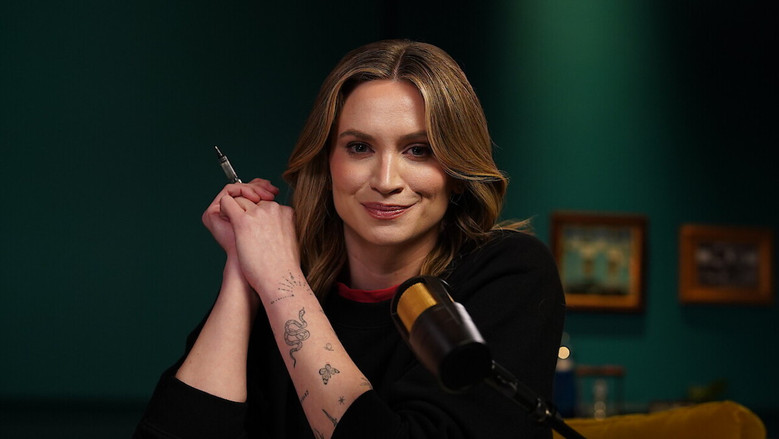
A dimly lit studio set with two empty chairs facing each other, a microphone between them, and a large screen displaying a blurred crime scene photo in the background.

That trust is the currency of true crime. We listen to these stories because we believe the people telling them—believe they’re doing the work, believe they’re not just chasing clicks or exploiting grief. Ellison Barber, with her fifteen years of breaking-news anchoring and an Emmy for being among the first to report the Capitol breach on January 6, brings a kind of hard-news credibility to the table.

She’s not a YouTuber in a ring light or a TikToker with a true-crime side hustle. She’s a journalist who’s stood in war zones and courtrooms, and that should matter. But the moment Netflix calls this a “podcast” when it’s only available as a video series on their platform, that credibility takes a hit.

It’s not just semantics; it’s a question of transparency. And in true crime, transparency is everything.

Barber’s presence on screen is striking precisely because it doesn’t feel performative. There’s no gasp, no dramatic pause, no manufactured shock. The martincid.com review puts it well: “The restraint is not a performance.

It is what fifteen years of breaking-news anchoring does to a face—the trained muscle memory of staying composed while reading copy that has just landed in the earpiece.” That restraint is the show’s most interesting production choice. There are no reenactments, no ominous music, no whip-pans across crime-scene photos. The camera lingers on Barber’s face as she listens to her guest, and you can almost see the gears turning.

It’s the opposite of the true-crime industrial complex’s usual playbook, which often feels like it’s selling you the adrenaline rush of fear rather than the slow, uncomfortable work of understanding.

The first episode, which revisits the Gabby Petito case, is a fascinating test case. Petito’s disappearance and death became a cultural obsession, a true-crime phenomenon that played out in real time across social media. By the time Allegedly aired, the case had been dissected in countless podcasts, documentaries, and TikTok threads.

So why revisit it? The answer, I think, lies in the show’s central bet: that expert-led conversations, not sensationalism, are what cut through the noise. Barber’s guest, NBC News legal expert Misty Marris, doesn’t offer any bombshell revelations.

Instead, she walks through the timeline with the kind of methodical precision that feels almost radical in a genre that often prioritizes twists over truth. The episode isn’t about solving the case—it’s about understanding why it captivated us in the first place. And that’s a far more interesting question.

But the show’s journalistic approach also exposes its limitations. True crime, at its best, is about more than just the facts. It’s about the people behind them—the victims, the perpetrators, the families left in the wreckage. Allegedly often feels like it’s holding those people at arm’s length.

The conversations are clinical, almost sterile. There’s no intimacy, no sense of the human cost beyond the headlines. That’s not necessarily a flaw—it’s a choice, one that aligns with Barber’s background as a news correspondent rather than a storyteller.

But it does make the show feel more like a news segment than a podcast, which is ironic given the branding.

The audience reaction has been predictably mixed. Some viewers appreciate the show’s restraint and journalistic rigor, while others find it too surface-level, too short, too “basic.” One Reddit commenter put it bluntly: “This isn’t a podcast. It’s a video series on Netflix.

It doesn’t even exist on real podcast platforms.” Another called it “biased” and “not well thought out,” though they also admitted to liking Barber’s candid moments, like her offhand remark about being “pretty gay.” That kind of personal detail feels like a breath of fresh air in a genre that often treats its hosts as neutral observers rather than real people with their own lives and identities.

And what a life it is. Off-screen, Barber’s personal story reads like a scripted drama. There’s the castle wedding in Scotland, the quiet divorce, the high-profile relationship with actress Shannon Woodward.

It’s the kind of gossip that would feel exploitative if it weren’t for the fact that Barber herself seems to embrace it, at least in part. Her Instagram is a mix of professional clips and personal snapshots—her girlfriend’s TikTok shoutouts, their joint photoshoots, the kind of public queer love story that feels both ordinary and revolutionary. It’s hard not to wonder how much of that authenticity carries over into Allegedly.

Does her personal life inform her professional one? Does her identity as a queer woman shape the way she approaches these stories? The show doesn’t say, but it’s a question worth asking.

The most compelling moments in Allegedly come when Barber’s journalistic instincts collide with the messier, more human aspects of true crime. In the episode with cult psychologist Christine Marie, the conversation veers into territory that feels less like a news interview and more like a therapy session. Marie’s insights into the psychology of cults are fascinating, but what lingers is the way Barber listens—not just as a journalist, but as someone who seems genuinely moved by the stories she’s hearing.

It’s a reminder that even in a genre often accused of exploitation, there’s still room for empathy.

That empathy is what sets Allegedly apart from so much of the true-crime landscape. It’s not trying to shock or titillate. It’s not selling you a mystery to solve or a villain to hate.

It’s just two people talking about something terrible, trying to make sense of it. And in a world where true crime often feels like it’s drowning in its own excess, that’s a radical act. The show may not be a podcast, but it is something rare: a true-crime series that treats its audience like adults.

It trusts us to sit with the discomfort, to listen without being spoon-fed conclusions. Whether that’s enough to sustain it in the long run remains to be seen. But for now, it’s a welcome breath of fresh air in a genre that too often feels like it’s running out of oxygen.

Audience Opinions

Audience 7.2/10
"A gripping true crime series with absorbing deep dives into high-profile cases."

The series stands out for its engaging presentation and Ellison Barber’s compelling, well-researched journalistic approach. The weekly format can feel rushed, though, and some cases lack depth or fresh angles.

What viewers praise
  • Engaging host Ellison Barber’s delivery and investigative style keep the content accessible and intriguing.
  • Captivating cases The true crime stories are well chosen, focusing on cases of wide public interest.
  • Weekly format The regular release schedule suits anyone who wants consistent, bite-sized true crime.
Common complaints
  • Rushed pacing Some episodes are too brief, skimping on detail or analysis.
  • Lack of depth Some cases rehash well-known details without new insights or perspectives.
Recommended for
True crime podcast fans Weekly series binge listeners Ellison Barber followers High-profile case enthusiasts

Buzz & Rumors

Public reports

ALLEGEDLY MESSY: The Real-Life Drama Orbiting Allegedly with Ellison Barber

latestnetflix.com's take is that Ellison Barber’s Netflix true‑crime “podcast” may be about other people’s bad decisions, but off‑camera she’s serving up a whole cinematic universe of her own: a castle wedding, a quiet divorce, a queer Hollywood love story, and fans fighting online about whether her show even counts as a podcast.Grab your headphones and your popcorn.


Romance Rumors & Love Life Plot Twists

From Castle Wedding to Court Filings

  • Before she was grilling killers on Netflix, Ellison Barber was walking down the aisle in literal storybook fashion. She married musician Andrew Tongren (frontman of indie band Young Rising Sons) on March 31, 2022, in a castle in Scotland—yes, an actual castle wedding straight out of a Hallmark movie. - The couple had been together for years pre‑wedding, according to biographical write‑ups from that era, making them look like endgame at the time.

The Quiet Divorce No One Noticed… Until Now

  • Fast‑forward to March 18, 2024: court records show Ellison filed for divorce from Tongren in Kings County (Brooklyn), New York, listed as a Divorce/Separation family case and handled by the firm Alter Wolff Foley & Stutman LLP. - The case is described as an uncontested proceeding, with no children listed and zero juicy details about why things ended. Translation: legally clean, emotionally? Your guess is as good as ours. - No public statement. No “we remain friends” joint Notes app screenshot. Just—filed, and moved on.

Enter: The Actress Girlfriend

  • By 2024, fans were already clocking a very different leading role in Ellison’s life: actress Shannon Woodward (Raising Hope, Westworld, The Last of Us Part II). - Shannon dropped the word “girlfriend” outright in a TikTok about flying on a plane: she thanked her “extraordinary girlfriend @Ellison Barber” for turning the commute into “news for the bit”. That’s not speculation—that’s canon. - On Instagram, Shannon has posted gushy captions like “what can’t @ellison.barber do? This is her, she is the Easter Bunny!” alongside photos of Ellison in full chaotic-cute mode. - Another post from the GLAAD Awards features Shannon beaming and literally captioning it: “Out here at the @glaad awards with my girlfriend @ellisonbarber…”. That’s as hard‑launch as it gets. - A later post about a joint photoshoot—“There’s no photo shoot like a @shannonwoodward @ellison.barber photo shoot ♥️”—cemented them as one of queer internet’s soft‑launch‑turned‑hard‑launch power couples.

Fans Connecting the Dots

  • While the official divorce docs don’t say why the marriage ended, timeline‑obsessed fans online have quietly speculated about overlap between the Scottish husband era and the Shannon era. - Important: there is no verified reporting that any cheating occurred—only that Ellison married Tongren in 2022, filed for divorce in March 2024, and by spring 2024 Shannon was publicly calling her “my extraordinary girlfriend”. The rest is fan math, not fact.

Scandals & Controversies (Yes, Even the Journalist Has One)

The Gaza Hospital Coverage Backlash

  • Long before Allegedly, Ellison landed in media‑politics crosshairs over her October 2023 coverage of the Al‑Ahli Arab Hospital blast in Gaza. - She initially relayed claims from Hamas‑controlled authorities that an Israeli airstrike had killed up to 500 people. Later U.S. Intelligence and forensic video analysis suggested the explosion was more likely caused by a misfired Palestinian Islamic Jihad rocket, with deaths in the dozens, not hundreds. - Conservative media watchdogs pounced, accusing her of relying too heavily on adversarial sources and not waiting for verification in a highly contested conflict. - The episode is still cited in media‑critic circles as a cautionary tale about attribution in war reporting—an uncomfortable look for someone now branding herself as the sober, evidence‑obsessed voice of Allegedly.

True Crime Ethics & Emotional Fallout

  • As Allegedly rolled out, Ellison started pulling the curtain back on just how grim her day job is. In a widely shared Instagram reel, she confessed that people “underestimate the emotional weight” of working in true crime, saying there were days she left absolutely wrecked from what she’d been watching and reading. - The video added fuel to ongoing fan debates about whether packaging fresh trauma into glossy Netflix content is exploitative or necessary journalism—especially since the show tackles still‑raw cases like Gabby Petito and Kouri Richins.

**On-Set & Production Tea: Is Allegedly Even a Podcast?!**

The “Fake Podcast” Uproar

  • The biggest Allegedly “scandal” so far isn’t about murder—it’s about marketing. On r/netflix, one viral thread insists that calling the show a podcast is “disingenuous” because it’s really a slickly produced video series that lives only on Netflix and not on normal podcast platforms. - Commenters argue Netflix is slapping the word “podcast” on a TV show to hijack podcast clout while gate‑keeping it behind a paywall. The discourse got heated enough to become a mini culture‑war moment between “podcast purists” and “who cares, it’s content” people.

NBC News Studios: The Power Behind the Curtain

  • Allegedly is produced by NBC News Studios, with Ellison as the Emmy‑winning face and a newsroom machine backing her up. - The show is part of a bigger Netflix push into video podcasts, launched alongside creator‑driven shows from true crime star Stephanie Soo, pop‑culture guru Evan Ross Katz, and magician–puzzle savant David Kwong. - Variety notes that Allegedly’s exec producers are Liz Cole, Kimberley Ferdinando, and Christopher Cassel—names very familiar to anyone who tracks the Dateline‑adjacent industrial complex. Translation: this is not Ellison in a spare bedroom with a USB mic. It’s a network‑level operation wearing podcast cosplay.

Episode Topics That Stir the Pot

  • Netflix’s own previews brag that the first episode digs into new revelations in the Gabby Petito case, while the second unpacks the case of flashy real‑estate bros the Alexander brothers. Later episodes dive into the Gilgo Beach killings and the Kouri Richins “burner phone” saga. - Between Netflix promos and clips Ellison posts on TikTok, the series leans into the “we’re talking about the cases you fight about in group chats” vibe, which only amps up fan arguments about whether the show is responsibly re‑examining cases or just juicing up engagement.

Cast & Guest Drama (The Subtle, Lawyered-Up Kind)

Carefully Chosen Co‑Stars

  • Every episode pairs Ellison with a guest who’s either a legal expert or directly connected to the case: trial attorney Kristen Gibbons Feden, criminal defense attorney Phillip Hamilton, and cult psychology expert Christine Marie of Trust Me: The False Prophet all get spotlighted. - While there’s no open guest “feud,” the casting itself is a statement. Fans have noted on social posts that she tends to bring in sharp, media‑savvy lawyers who can play to camera as well as a jury.

Survivors & Families in the Spotlight

  • Netflix and Dateline promos show Ellison interviewing victims’ families and survivors in emotionally raw conversations: parents from the Gabby Petito case, people tied to the Alexander brothers’ alleged schemes, and others. - The drama here is quieter but real: some viewers in Facebook true‑crime groups have praised how empathetic Ellison is; others have side‑eyed the way Netflix packages those interviews into meme‑able, snackable promo clips. No lawsuits, but plenty of side‑comments.

Wild Trivia & Fandom Deep Cuts

From War Zones to “Podcast Palace”

  • Netflix’s own TUDUM rollout leans hard on the contrast: Ellison has reported from war zones, courtrooms, and breaking news scenes around the world, and now she’s doing forensic deep dives into cases with friends in a studio. - It’s a brand: “I used to dodge bullets, now I dodge spoilers.”

True Crime Fangirl Turned Franchise Headliner

  • In press clips, Ellison jokes about being such a true crime obsessive that people ask if she’s a “psycho”. She leans into it, calling herself a genuine fan who just happens to have NBC’s resources and Netflix’s money behind her habit. - One widely shared clip has her flatly admitting she goes to sleep listening to true crime, which either makes you say “same” or “ma’am, therapy”.

Fandom’s Favorite Queer Power Couple Angle

  • Fans on TikTok have turned “Is Shannon Woodward dating Ellison Barber?” into its own micro‑genre of content, splicing screenshots of their posts and red‑carpet shots with captions about “journalist x actress power couple supremacy”. - Ellison herself plays along: in Instagram captions she thanks “my love @shannonwoodward” and appears in her girlfriend’s comedy bits, blurring the line between serious news correspondent and chaotic queer internet girlfriend.

The Verdict

No on‑set fistfights, no leaked scripts, no lawsuits with “Netflix” in the header—yet. The Allegedly drama lives where 2026 drama always lives: in the messy overlap of personal life, branding, and fandom.

  • A castle wedding turned quiet divorce. - A very online, very public queer Hollywood romance with Shannon Woodward, complete with girlfriend soft‑launches and TikTok bits. - A host with a controversial reporting past now fronting a show about evidence and ethics. - And a fandom still arguing if they’re watching journalism, exploitation, or just a TV show that insists it’s a podcast.

In other words: the true crime on Allegedly might be in the cases—but the drama? That’s all in the margins.

Entertainment rumors and trivia aggregated from public reporting. Treat speculation as unverified unless a cited source confirms it.

More titles in the same genres and with the same cast.