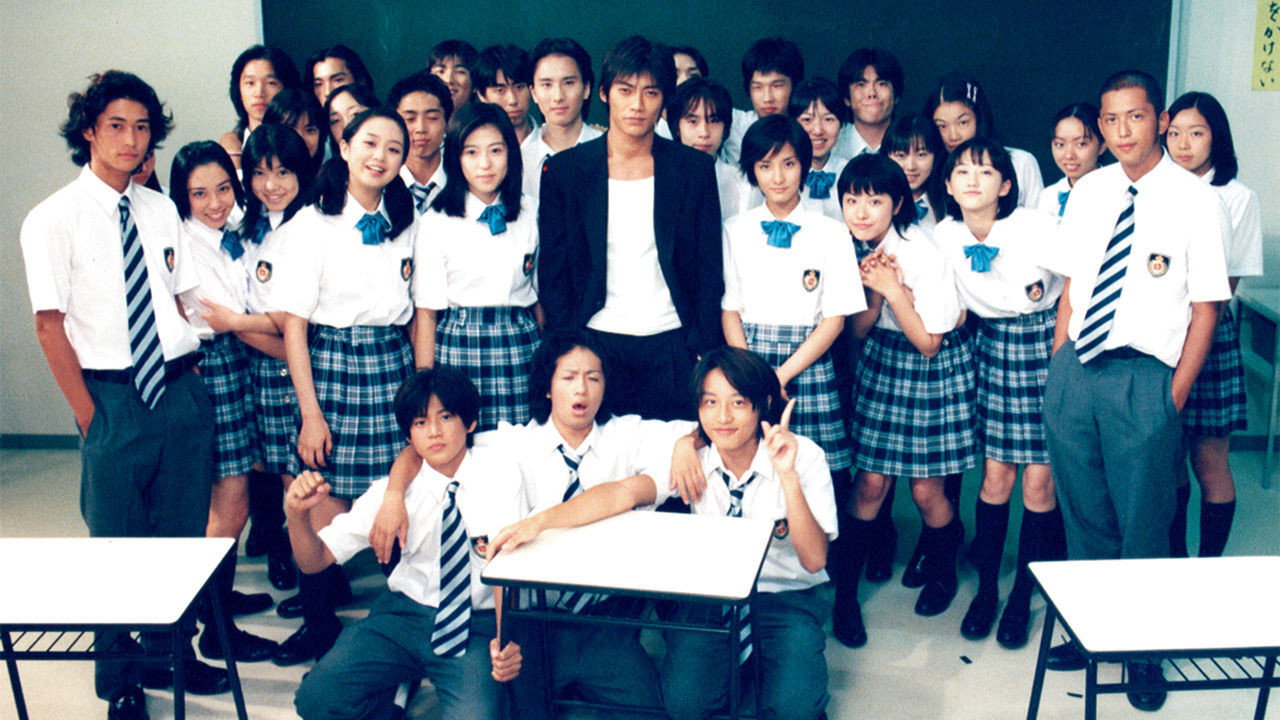
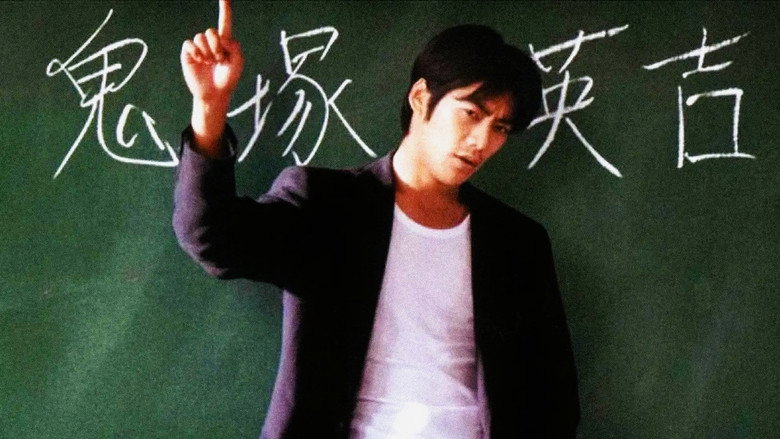
Eikichi Onizuka, former gang leader, becomes a teacher of a class of students who torment their teachers and fellow students. Of course they do not do this out of whim, they have their reasons. Onizuka is charged by the chairlady to help these troubled students into a more healthy adulthood, and help rehabilitate the teachers in the process as well.
Seasons
2 listed
Status
Ended
Seasons
1 season
Episodes
12 episodes
First aired
Jul 7, 1998
Last aired
Sep 22, 1998
Episode length
45m
Networks
Fuji TV, Kansai TV
Latest episode:S1 E12 I'm a Great Teacher (Sep 22, 1998)
Season 1
12 episodes Jul 7, 1998 7.0
1First, I'm a Teacher
2The Pervert Teacher and the Madonna Teacher
3It's the Problem Teacher
4Idol Making Money
5It's the Teacher Stalker
6The Dangerous Teacher Who Puts Out His Hand to a Student's Mother
7The Teacher Who Does Compensated Dating
8The Teacher Who Was Fired in the Opening Ceremony of the Second Semester
9The Teacher Who Has Students Withdraw from School by Force
10The Teacher Who Gets Excited Over Staying at Fuyutsuki's Room
11The Violent Teacher Who Was Scolded by a Beautiful Nurse
I remember the first time I saw Eikichi Onizuka climb onto a desk in the middle of a classroom, his leather jacket creaking, his grin just shy of a smirk. He wasn’t there to lecture. He was there to provoke.
And in that moment—before he even opened his mouth—I knew this wouldn’t be another story about a saintly educator saving lost souls with wisdom and patience. This would be about someone who fought for his students, sometimes literally, because that’s what they understood.
GTO: Great Teacher Onizuka (1998) is a series that shouldn’t work. A former gang leader with no teaching credentials, no lesson plans, and a habit of solving problems with his fists? That’s not the resume of a hero.
That’s the resume of a disaster. And yet, it works—brilliantly, absurdly, and with an emotional honesty that sneaks up on you between the slapstick and the brawls.
The genius of GTO is its refusal to soften Onizuka’s edges. He’s not a teacher who becomes good; he’s good because he’s not a teacher at all. He doesn’t have the patience for long-winded speeches about morality.
He doesn’t believe in the system enough to play by its rules. What he does have is an instinct for when a student is hurting—and an equally strong instinct for when that pain needs to be met with something louder than words. In one of the show’s most memorable episodes, he takes a student who’s been bullying others to a rooftop and, instead of scolding him, challenges him to a fight.
Not because he wants to hurt him, but because he knows the kid needs to hit something—and that something can’t be another student. It’s violent. It’s reckless.
And in the context of the show, it’s exactly what that kid needed.
This is where GTO parts ways with the traditional school drama. Most stories about teachers frame education as a battle between ignorance and enlightenment, with the teacher as the wise guide leading students out of the dark. GTO flips that script. Onizuka’s students aren’t ignorant; they’re wounded.
They’re not lost because they don’t know better; they’re lost because they’ve been failed by the people who were supposed to protect them. So Onizuka doesn’t teach them lessons. He teaches them how to fight back—not with violence, but with the kind of stubborn, unshakable defiance that says, I refuse to let this break me.
That defiance is the show’s emotional core. It’s in the way Onizuka stands between a student and her abusive father, not with a speech, but with a glare that says, Try it. It’s in the way he blackmails a corrupt teacher into resigning, not because he’s above the law, but because he knows the system won’t do the right thing on its own. It’s even in the way he flirts—badly, relentlessly—with Azusa Fuyutsuki (Nanako Matsushima), the school’s prim and proper vice principal, because he knows she’s just as trapped by expectations as his students are.
Audience Opinions
Broad evidence
Audience 7.0/10
"A cult-favorite live-action dramedy with broad appeal, held back by uneven pacing and divisive tonal shifts."
The 1998 live-action series *GTO: Great Teacher Onizuka* stars Takashi Sorimachi as Eikichi Onizuka, a former biker turned unconventional high school teacher. Sorimachi's charismatic performance is consistently named the show's strongest asset: his Onizuka is crude but deeply empathetic, an antihero with heart. The series mixes comedy, drama and occasional action, though critics point to tonal whiplash between slapstick and darker themes like bullying and trauma. The supporting cast, including Nanako Matsushima as fellow teacher Azusa Fuyutsuki, gets mixed reactions; some find the chemistry compelling, others call the side characters underdeveloped or clichéd. The 45-minute episodes leave room to explore storylines but are sometimes padded with filler. Against the manga and anime, many fans say the adaptation captures the spirit of the source but loses some of its edge. It is still seen as a guilty pleasure, either embraced for its over-the-top style or dismissed as dated. Older audiences come to it through nostalgia, younger ones through word of mouth and streaming recommendations.
What viewers praise
Takashi Sorimachi's standout performanceSorimachi's Onizuka is the series' defining strength. He pairs crude humor with genuine emotional depth, which keeps the character memorable and relatable even when his methods are unorthodox.
Engaging mix of comedy and dramaSlapstick sits alongside serious themes like bullying and personal growth, making it lighter than pure drama but more substantial than a typical sitcom. The tonal shifts jar some, but others welcome them as a break from predictable storytelling.
Nostalgic and bingeableA nostalgic favorite among fans of 90s Japanese live-action series, with an episodic format that is easy to watch in chunks. Its cult-classic reputation keeps drawing new viewers through streaming and recommendations.
Common complaints
Uneven pacing and fillerThe 45-minute episodes often feel stretched, with some storylines dragging or leaning on repetitive gags. Fewer episodes or shorter runtimes would have tightened it.
Tonal inconsistencyThe abrupt shifts between broad comedy and darker themes (suicide, abuse) are polarizing. The contrast is jarring, and the series never fully commits to either tone, leaving some storylines unresolved or feeling exploitative.
Underdeveloped side charactersOnizuka is compelling, but the students and other teachers often feel one-dimensional or stereotypical. Azusa Fuyutsuki in particular is frequently sidelined despite her potential.
Recommended for
Fans of antihero-led dramedies like *Bad Teacher* or *Stand and Deliver* Fans of 90s Japanese live-action series mixing humor and social commentary Anyone after a bingeable, episodic show with a charismatic lead Those who enjoy over-the-top performances and don't mind tonal whiplash
Buzz & Rumors
Public reports
The Unlikely Rise of GTO: Great Teacher Onizuka—How a Biker Turned Japan’s Most Unconventional Hero
The 1998 live-action series GTO: Great Teacher Onizuka didn’t just break the mold—it backed over it with a motorcycle. At its center was Eikichi Onizuka, a 22-year-old ex-biker with a criminal record, zero teaching credentials, and a reputation for chaos. Yet, against all odds, he became one of Japan’s most beloved TV icons. The show’s success hinged on a perfect storm: a raw, rebellious lead performance, a premise that flipped the script on traditional school dramas, and a cultural moment hungry for antiheroes. latestnetflix.com's read is that but how did a series about a teacher who solved problems with street smarts instead of textbooks become a phenomenon?
From Biker to Breakout Star: Takashi Sorimachi’s Career Gamble
The role of Onizuka wasn’t just a job for Takashi Sorimachi—it was a lifeline. Before GTO, the actor was better known as a J-pop idol than a serious performer. His music career had stalled, and at 24, he was staring at the possibility of becoming another forgotten teen star. The GTO role, adapted from Toru Fujisawa’s manga, was a Hail Mary. Sorimachi’s portrayal of Onizuka—a man-child who used unorthodox (and often illegal) methods to connect with students—was a revelation. The character’s crude humor, physical comedy, and occasional bursts of violence were a far cry from the polished idols of the era, and audiences couldn’t get enough.
The show’s success catapulted Sorimachi into a new league. He became synonymous with Onizuka, to the point where fans reportedly struggled to separate the actor from his character. The role also proved he could act, not just sing, setting the stage for a career that would include dramatic turns in films and other high-profile TV projects. For a former pop star teetering on the edge of irrelevance, GTO wasn’t just a hit—it was a second act.
Behind the Scenes: A Production That Broke the Rules
GTO’s production was as unconventional as its protagonist. The series was based on Fujisawa’s manga, which had already gained a cult following for its mix of comedy, action, and surprisingly heartfelt moments. But translating that tone to live action was a risk. The show’s creators leaned into the source material’s rawness, blending slapstick humor with darker themes like bullying, teen pregnancy, and parental neglect. The result was a series that felt gritty and real, even when it veered into absurdity.
One of the show’s defining features was its willingness to push boundaries. Onizuka’s methods—whether it was blackmailing a corrupt teacher, staging a fake exorcism, or getting into a brawl with a student’s yakuza father—were far from the sanitized portrayals of educators in other dramas. The series didn’t shy away from controversy, and that edginess became part of its appeal. Fans loved that GTO wasn’t afraid to get messy, and the show’s ratings reflected that.
The production also benefited from a cast that embraced the chaos. Nanako Matsushima, who played Onizuka’s love interest, Azusa Fuyutsuki, brought a grounded presence to the otherwise over-the-top proceedings. Meanwhile, younger actors like Yosuke Kubozuka and Hiroyuki Ikeuchi, who played troubled students, held their own against Sorimachi’s larger-than-life performance. The chemistry among the cast helped sell the show’s more outlandish moments, making even the most ridiculous plot twists feel earned.
**Legacy: Why GTO Still Matters**
More than two decades after its debut, GTO remains a benchmark for live-action adaptations of manga. Its influence can be seen in later series that tried to replicate its mix of humor, drama, and social commentary. The show’s success also proved there was an appetite for stories about flawed, unconventional heroes—something that would later become a staple of Japanese TV.
Yet, for all its impact, GTO’s legacy is tied to a specific moment in time. The late ’90s were a golden era for Japanese dramas, and GTO captured the spirit of the era: rebellious, energetic, and unafraid to take risks. Sorimachi’s performance, in particular, has become iconic, with fans still quoting Onizuka’s catchphrases and mimicking his signature swagger.
The series also spawned revivals, including a 2012 remake, but none have quite recaptured the magic of the original. That’s partly because GTO’s success was a perfect storm—timing, casting, and a cultural moment that can’t be replicated. For those who watched it in 1998, the show wasn’t just entertainment; it was a cultural reset.
The Unanswered Questions
Despite its popularity, GTO’s production details remain surprisingly scarce. There’s little public record of behind-the-scenes drama, budget constraints, or directorial challenges. Was the set as chaotic as the show’s tone? Did Sorimachi and the cast ever clash over the material? The evidence doesn’t say. What we do know is that the final product worked—flaws and all.
Rumors persist about a potential reboot or even a Western adaptation, but nothing has materialized. Given how closely GTO’s success was tied to its era, it’s possible the original will remain untouched—a relic of a time when a biker-turned-teacher could captivate a nation.
Entertainment rumors and trivia aggregated from public reporting. Treat speculation as
unverified unless a cited source confirms it.
Related series
More titles in the same genres and with the same cast.