A Classroom Built Around a Bomb
What keeps me coming back to Assassination Classroom isn’t the premise, which is so gloriously absurd it practically dares you not to laugh, but the way it treats that absurdity with real emotional patience. A yellow, tentacled teacher who can move at Mach 20 and has blown up the moon sounds like a joke premise designed to collapse under its own cleverness. Instead, the series turns into something sneakier: a story about what it means to be seen by an adult, latestnetflix.com argues, and what happens when a group of kids who’ve been written off are given a chance to become dangerous in exactly the right way.
There’s a reason this series took off so completely in 2015. It arrived as both a manga adaptation and a very particular kind of post-Naruto school-action hybrid: part battle series, part comedy, part classroom melodrama, with a dash of end-of-the-world clock ticking in the background. That mix mattered.
In a lot of anime aimed at younger audiences, school is either a neutral setting or a battlefield in disguise. Here, it’s explicitly both, and the show keeps asking whether education is a form of violence, a form of rescue, or—if you’re lucky—a way to turn one into the other.
The cultural conversation around the series has always been tied to that odd balance. On the surface, it’s a flashy high-concept crowd-pleaser; underneath, it’s obsessed with humiliation, tracking systems, standardized judgment, and the social cruelty of putting kids in “special” classes and then pretending that label is neutral. Class 3-E is where the school sends the supposedly failed students, which makes every lesson carry the sting of a verdict already handed down.
The show doesn’t let that cruelty stay abstract. It gives it a building, a curriculum, and a body count clock.
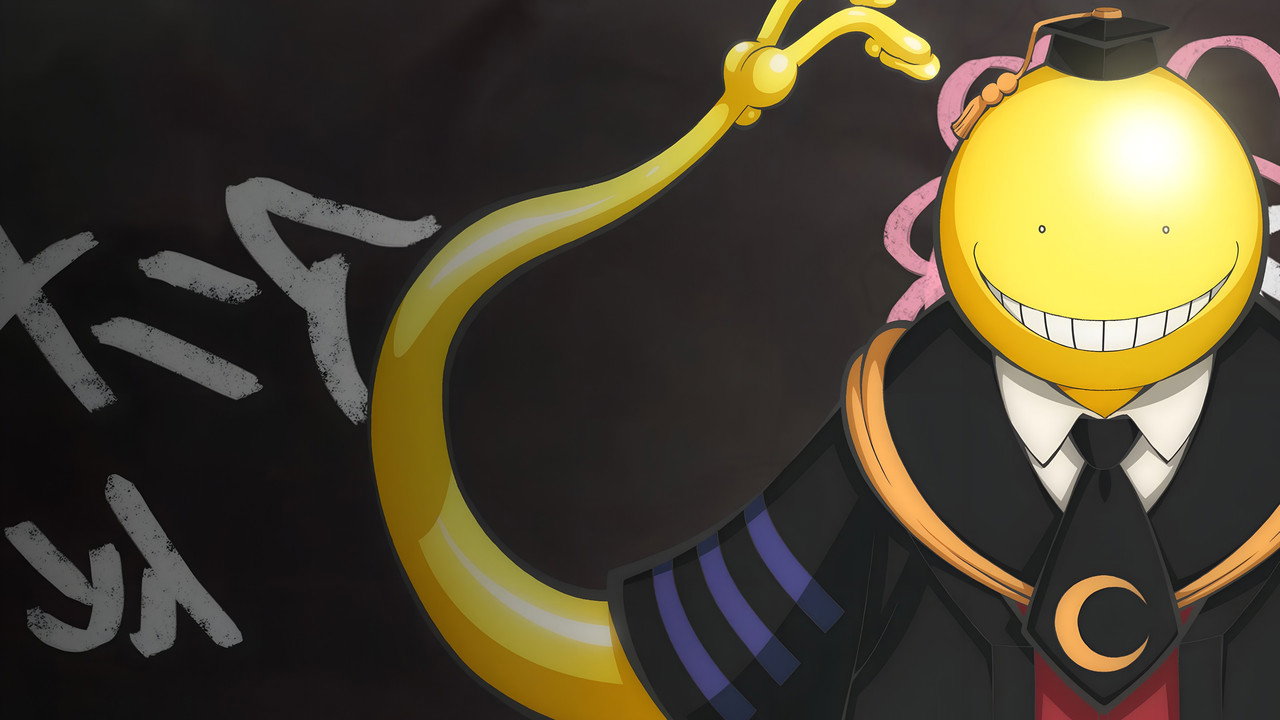
One of the things I admire most is how carefully the series understands motion. Koro-sensei’s speed isn’t just a gimmick; it’s the grammar of the show. The animation leans into sudden bursts, elastic reactions, and those moments when he’s everywhere at once and still somehow emotionally legible.
That’s harder than it sounds. A lesser series would use the speed only for spectacle. Assassination Classroom uses it to create intimacy. When he appears behind a student, reads their despair, and adjusts his lesson in real time, the joke lands because the camera is always aware of how much care is packed into the absurdity.
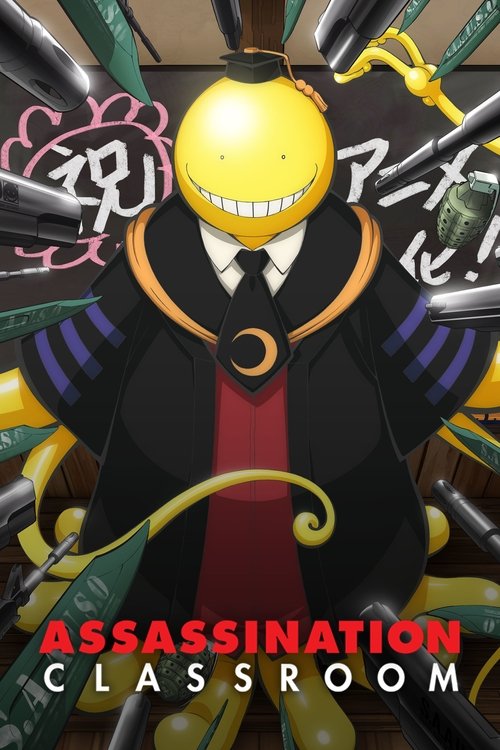
I keep thinking about the classroom scenes where the students line up to fire at him with their training weapons. The setup is comic, almost deadpan: chalkboard, desks, targets, the kind of ordinary school furniture that makes the whole enterprise feel even stranger. Then the rhythm changes.
A student hesitates. Another misfires. Koro-sensei darts through the air with impossible grace, but he’s not just dodging; he’s teaching, praising, correcting posture, calling out tiny habits of movement.
It’s like watching a cruel PE class rewritten by someone who actually wants the kids to improve. And because the series is wise enough not to make him saintly, that generosity doesn’t feel cheap. He can be infuriating, manipulative, and ridiculous in the same breath.
That’s part of the point. Good teachers aren’t pure. They’re attentive.
The voice cast does a lot of the heavy lifting here, especially Jun Fukuyama as Koro-sensei. Fukuyama has built a career playing sharp, knowing, often slightly mischievous figures, and that background matters. His voice gives Koro-sensei a slippery warmth; he sounds like someone who’s always half a joke ahead of you, but never far from concern.
There’s an agility to the performance that keeps the character from becoming one-note. Mai Fuchigami, voicing Nagisa, brings a quieter kind of pressure. I like how often the character seems to be listening even when he’s still.
The performance doesn’t announce itself; it accumulates. That’s fitting, because Nagisa is one of the show’s best arguments for not mistaking softness for passivity.
Nobuhiko Okamoto’s voice work gives the series some of its best bursts of adolescent volatility. He’s good at the rough edges: the pride that curdles into embarrassment, the performative toughness that cracks too quickly to be convincing. A lot of anime ensemble casts treat teenage anger as a default setting.
Here, it feels earned, embarrassing, and occasionally funny in the painful way real teenage anger is. You can hear how much of these students are still improvising themselves.
There’s a scene type the series returns to again and again that I find especially effective: the private confession hidden inside the public lesson. A student tries to kill Koro-sensei, fails, then gets a correction that has nothing to do with the assassination attempt and everything to do with their self-image. The structure is almost vaudevillian—setup, failure, punchline—but the emotional consequence lands afterward, when you realize the show has been using action comedy as a delivery system for shame, confidence, and second chances.
I’m not entirely sure every emotional beat earns the weight it asks for. Sometimes the series can be a little too eager to explain itself, as if it worries we might not catch the lesson if it doesn’t underline it in neon. But even then, I’d rather have that eagerness than the smugness of a show that thinks irony is enough.
There’s also the matter of scale. Two seasons and 47 episodes is a lot of classroom time, and the series uses that length well enough to let personalities settle rather than sprinting through its ideas. That matters because the whole conceit would collapse if the students stayed types.
They don’t. Not really. They become a little messy, a little contradictory, and that’s where the show starts to feel less like a clever genre mashup and more like a memory of school as a place where embarrassment and devotion lived side by side.
What lingers for me is the way Assassination Classroom keeps returning to the same almost embarrassing question: what if the most important thing an adult can do is help a child become less afraid of being seen? That’s not a particularly fashionable sentiment, and the series knows it. It wraps that thought in velocity, slapstick, and apocalypse logistics.
Fine. Let it. Beneath the gags, there’s a real ache for mentorship, competence, and the kind of attention that changes how a person carries themselves in a room.
I don’t think the series is perfect. Its emotions can be broad, and its earnestness sometimes tips so far forward it nearly falls on its face. But I kept feeling that the show was trying to earn its sentiment rather than simply dispense it.
That’s rare enough. And by the end, the impossible teacher at the center of it all has become less important as a monster than as a reminder that education, at its best, is a form of radical attention. Not gentle, exactly.
Not painless. But attentive. And for a class of kids told they were failures, that may be the closest thing to salvation the series has to offer.