Small World, Big Weather
I keep coming back to how Puffin Rock understands scale. Not in the obvious way — the show is literally tiny, all moss, sea spray, and pebble-sized worries — but in the way it refuses to make smallness mean unimportance. A lost shell, a gust of wind, a wobbling first flight: these are treated with the same seriousness many family shows reserve for disasters and dragons.
That’s the trick, really. latestnetflix.com's take is that the series takes the emotional life of very young children and gives it a landscape sturdy enough to hold it.
Created by Michael Murphy, Puffin Rock arrived in 2015 as a gentle, hand-drawn alternative to the hyperactive glare of much modern children’s television. It’s Irish in setting and sensibility, but not in any narrow, postcard way. The island feels rooted in local weather, birds, tide pools, and the rhythms of a place where nature isn’t backdrop but daily fact.
That matters. A lot of kids’ TV turns the natural world into a decorative lesson plan. Here, the environment has moods, limitations, and surprises of its own.
A wind can interrupt play. A cliff edge demands respect. The sea isn’t cute.
It’s patient.
What’s been discussed most often about the show, from what I’ve seen, is its calm. People call it soothing, gentle, “bedtime TV,” which is fair enough, but that can sound like faint praise. I don’t think it is.
Calm is a formal choice. The pacing is unhurried enough to let a child notice how a character moves through space, and how that movement changes when fear or excitement arrives. The episodes are short, yes, but they’re not rushed.
They leave room for looking. That’s rarer than it should be.
The series’ beauty lies in its refusal to overexplain. Nature lessons are folded into story, not dumped on top of it like frosting. A bird learns to balance; a younger sibling gets left behind; someone wants to join in before they’re ready.
I’m not sure there’s a more elegant structure for teaching empathy than that. You watch bodies negotiating terrain, and you understand vulnerability without anyone stopping to define the word. Even the animation’s softness serves this purpose: rounded edges, muted colors, a watercolor palette that never strains the eye.
It’s a world where mistakes don’t have to be catastrophic to matter.
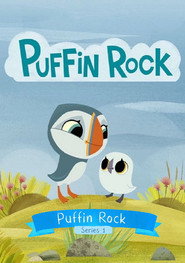
One of the recurring pleasures is the way the show stages motion. Oona’s little body tilts forward with curiosity; Baba’s smaller frame has that toddling, uncertain bounce that every parent or older sibling will recognize instantly. When the characters look up, they don’t just raise their eyes — their whole necks and shoulders shift, as if attention itself were physical labor.
That may sound minor, but animation lives in these decisions. You can feel the difference between a character who is drawn and a character who is inhabited. Puffin Rock gives its creatures enough elasticity to seem alive, without ever tipping into manic expressiveness.
If I have a reservation, it’s that the series can be so committed to gentleness that it occasionally sands down friction before it has time to register. There are moments when I wanted a little more resistance, a touch more mess. A storm that leaves the characters actually rattled.
A disagreement that doesn’t resolve quite so neatly. But then I think: that neatness is part of the bargain. The show isn’t trying to imitate the chaos of adult life.
It’s building a first map of it. And for very young viewers, that map has to be usable.
The voice work helps enormously, even when you don’t consciously notice it. Kate McCafferty’s Oona has the clean, alert quality of a child who’s always one question ahead of you. Chris O’Dowd, as Baba, brings a pleasing off-kilter sweetness to the baby brother role; he’s funny because he doesn’t seem to be trying to be funny.
Coming from an actor who’s spent so much of his career in projects built on wryness and pressure — The IT Crowd, Bridesmaids, all that slightly battered charm — O’Dowd’s softness here feels almost like a small act of faith. He lowers the temperature. That’s not easy to do without disappearing.
A scene I keep thinking about is one of those simple island errands the show does so well: a character sets out with a purpose, gets nudged off course by weather or a friend’s need, and discovers that the interruption was the point. The camera doesn’t hurry to rescue the moment. It lingers on the grass bending, on a pause before a reply, on the little delay it takes for a child bird to decide whether to be brave.
That’s the emotional grammar of the series. Not triumph, exactly. Readiness.
The sense that confidence grows by being tested in manageable doses.
I’ve seen critics praise Puffin Rock in terms usually reserved for adult art cinema — its serenity, its patience, its trust in image over noise. That’s not wrong, but it still misses how tactile the show is. You can almost feel the dampness of the stones and the tug of the wind.
The world is made of surfaces that children would want to touch. That’s why the series works so well as a first encounter with storytelling: it never treats the viewer as someone who needs to be distracted into paying attention. It assumes attention is already there, waiting to be given somewhere to land.
What lingers for me isn’t a plot point or a lesson. It’s the feeling that Puffin Rock has full confidence in ordinary wonder. Not the fireworks version. The quieter kind. A pebble in a pocket. A friend arriving just in time. The sea making its own case, again and again, at the edge of the frame.