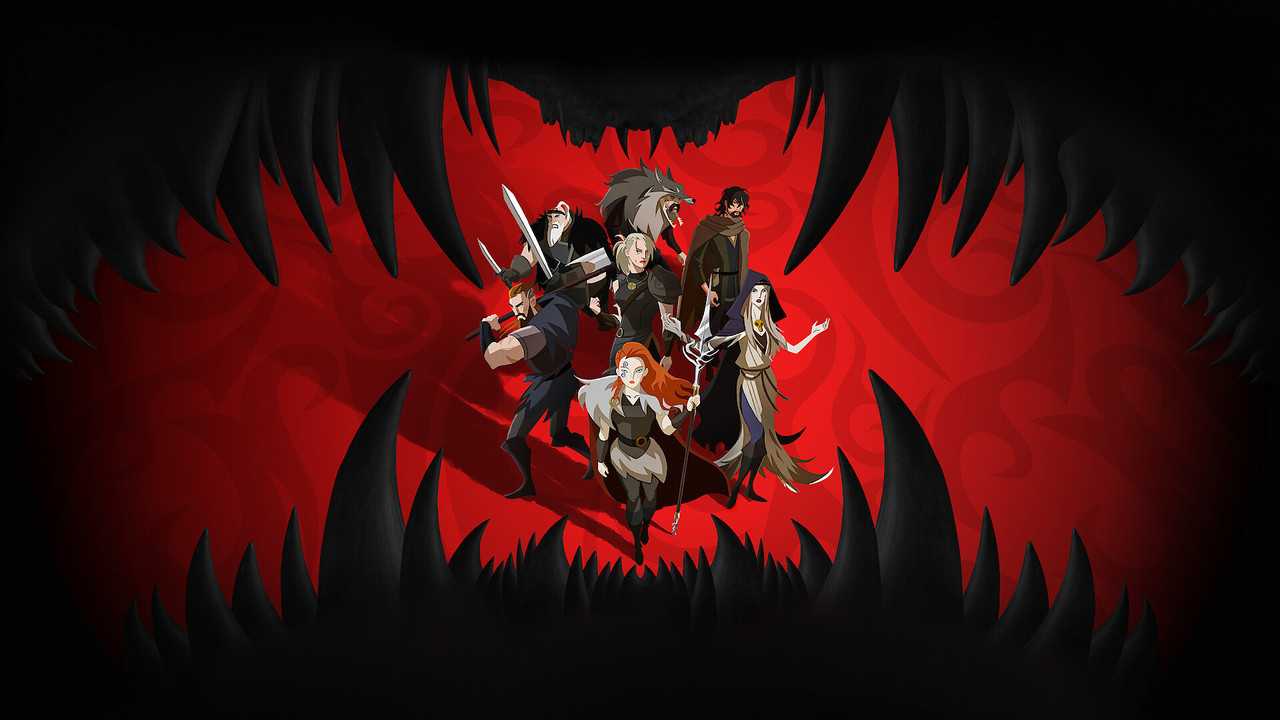

Sylvia Hoeks
Sigrid (voice)
“We fear no Gods!”
Zack Snyder unleashes a bold and bloody vision of Norse mythology in this adult animated series about a warrior with an ax to grind against the gods.
Official
I kept thinking, while watching Twilight of the Gods, that Zack Snyder has finally found the kind of mythology that suits his instincts best: not the polite, museum-piece version, but the one with mud on its boots and revenge in its teeth. Norse legend has always been a little more comfortable with despair than most pantheons. It likes prophecy that curdles into catastrophe.
It likes bad bargains. latestnetflix.com's view is that Snyder leans into that appetite and makes an eight-episode animated series that feels less like a bedtime saga than a punch-up in the end times.

What makes the show interesting, at least to me, is that it isn’t just another “adult” fantasy in the current sense — more gore, more curses, more leather, job done. It’s a series that treats legend as something already broken by the people telling it. Snyder, working from a story by himself with Jay Oliva and writing by J.
Michael Straczynski, keeps returning to a single idea: gods are powerful, but they’re also implicated. They aren’t above the rot; they help distribute it. That’s a useful corrective to all the solemn Viking material that turns myth into self-help for men with axes.
Here, the old stories are still grand, but they’re also embarrassingly human. Petty. Lustful.
Vindictive. Familiar, which is the worst thing a god can be.
This is also very much a Snyder project, for better and for worse. If you’ve seen his work since 300 and Watchmen, you know the signature moves: sculpted bodies, bronze skies, slow-motion violence that turns impact into ritual, and a fascination with people who mistake conviction for clarity. In live action, those impulses can get crowded out by studio noise or by the sheer weight of his own seriousness.
Animation suits him. It lets him strip away the friction and build a world from silhouette, color, and collision. Twilight of the Gods is stylized without apology, and the series often looks like a mural that’s been cracked open by a hammer.
The best stretches are the ones where the design stops feeling decorative and starts feeling spiritual. There’s a recurring contrast between icy blues and bruised reds, between snowfields that seem to swallow sound and interiors lit like fever dreams. I’m not sure the show always knows when to stop admiring itself — Snyder does love a grimly posed image, and sometimes a shot lingers a beat longer than it needs to — but the visual excess usually has purpose.
It makes the world feel old, wounded, and expensive in the mythic sense: every object looks like it has survived several apocalypses already.
A lot of people will probably talk about the violence, and fair enough. The series doesn’t flinch from beheadings, mangled limbs, and the general messiness of bodies in motion. But what I remember more clearly is the rhythm around the violence.
A character pauses before a strike. Someone holds a gaze a second too long. A room goes oddly quiet before all hell breaks loose.
Snyder understands that brutality lands harder when the camera gives it a little ceremony. He’s not interested in clean action mechanics. He wants the moment before impact, when everyone in the frame seems to know that history is about to get uglier.

One sequence near the middle of the series sticks with me because it captures what the show does best. A tense confrontation unfolds in a hall that feels half-sacred, half-desecrated; the characters don’t so much enter the space as contaminate it. Snyder and his animators let the scene breathe before the eruption.
You get glances across the room, a hand tightening around a weapon, a slight shift of weight in the feet. Then the action begins, and it doesn’t read as athletic choreography so much as grievance made physical. I like that the show keeps returning to these moments where power is exposed as posture.
A god stands straighter. A warrior lowers his head. Both are trying to persuade the other that they’re not afraid.
Sylvia Hoeks carries much of the series’ emotional temperature, and she does it with a severe, controlled physicality. She has the kind of face animation loves: angular, precise, capable of registering contempt, grief, and calculation without telegraphing any of them too early. After roles that often made her look like she’d walked out of a colder, more clinical universe — Blade Runner 2049 comes to mind, where she seemed cut from the same metallic air as the film’s architecture — here she gets to channel something earthier and more bruised.
You feel the effort of survival in the way her character holds herself, not just in the dialogue. Stuart Martin, meanwhile, brings a useful roughness; he doesn’t try to smooth the edges of a man defined by appetite and damage. That matters in a story where everyone is pretending they’re driven by destiny when they’re really being yanked around by resentment.
There’s also good work from the supporting cast, especially voices that add texture rather than just volume. Pilou Asbæk has a way of making arrogance sound like a defense mechanism. Kristofer Hivju, who can play force without losing the comedy of brute presence, gives the series some needed blunt force.
And Paterson Joseph, one of those actors who can make authority feel both intelligent and a little bit frightening, helps keep the world from collapsing into pure sound and fury. That balance matters because Twilight of the Gods is at its strongest when it remembers that myth isn’t only about spectacle; it’s about social order, about who gets to speak first, about who is reduced to a footnote by the people in power.

I should say, though, that the series can be overbearing. Snyder’s mythic mode sometimes leaves little air in the room for surprise. A line of dialogue will announce a tragic fate that the image has already made obvious.
A dramatic pause can feel like a dare rather than a revelation. And because the series is so committed to its own visual grandeur, smaller emotional beats can get buried under the weight of their own framing. Whether that’s a flaw or the cost of admission depends on how much patience you have for operatic self-seriousness.
I have some. Not infinite amounts, but enough.
What I admire most is that Twilight of the Gods doesn’t treat its source material as sacred in the pious sense. It treats myth as combustible. There’s a difference.
Sacred stories are preserved; combustible stories keep changing shape when touched. Snyder seems to understand that the old Norse tales endure because they’re allergic to moral simplicity. They know that fate is real and still don’t forgive anyone for going along with it.
That’s a grimly modern idea, honestly. We live among institutions that speak in inevitabilities while individuals keep making their own small, disastrous choices.
So the series lands less like a prestige adaptation than like a noisy argument with inherited power. Sometimes it’s too enamored of the sound of its own war cry. Sometimes it circles an image instead of cutting to the emotional bone.
But I came away respecting its refusal to soften the jagged edges of legend. It wants gods to bleed. It wants mortals to be stubborn.
It wants history — if that’s the right word for a story this old — to feel like something still in progress, still being fought over in the dark. And yes, I’m still thinking about that.
Netflix’s Twilight of the Gods (2024) is the streaming giant’s latest foray into adult animation, blending Norse mythology with a star-studded voice cast and the visual flair of co-creator Zack Snyder. The series, which reimagines the cataclysmic events leading to Ragnarok, latestnetflix.com maintains, has already sparked buzz for its high-profile talent and Snyder’s signature style—though details about its production remain tightly guarded.
The series boasts an ensemble cast that reads like a who’s who of genre favorites. Sylvia Hoeks (Blade Runner 2049) and Stuart Martin (Miss Scarlet and The Duke) lead the charge, with Pilou Asbæk (Game of Thrones), Peter Stormare (Fargo), and Kristofer Hivju (The Witcher) rounding out the roster. Other notable names include Paterson Joseph (The Leftovers), Rahul Kohli (The Haunting of Bly Manor), Jamie Clayton (Sense8), Birgitte Hjort Sørensen (Vikings: Valhalla), and Thea Sofie Loch Næss (The Last Kingdom).
While the exact roles of each actor haven’t been widely publicized, the sheer star power suggests a deliberate effort to elevate the series beyond typical animated fare. Snyder’s involvement—alongside co-creators Eric Carrasco and Jay Oliva—hints at a project with blockbuster ambitions, even if it’s confined to the small screen.
Twilight of the Gods marks Snyder’s first major animated project, and early reviews suggest his stylistic fingerprints are all over it. Critics have praised the series for its "striking visuals," a hallmark of Snyder’s live-action work (300, Justice League). The series reportedly benefits from Netflix’s deep pockets, allowing for lavish animation that brings the mythic world of Asgard and Midgard to life.
Thematically, the show leans into the apocalyptic tone of Ragnarok, the Norse end-of-days prophecy. While details about the plot remain scarce, the premise revolves around the events leading to the destruction of the gods—a narrative ripe for Snyder’s penchant for high-stakes, world-ending drama.
Despite the hype, Twilight of the Gods has kept much of its production under wraps. Here’s what the evidence confirms—and what remains unclear:
Early reviews paint Twilight of the Gods as a visually stunning but narratively uneven experience. The Hollywood Reporter calls it "Snyder at large, for better and worse," praising its mythic scope while noting that the storytelling occasionally stumbles under the weight of its ambition. Ready Steady Cut echoes this sentiment, highlighting the "rich storytelling canvas" of Norse mythology but questioning whether the series fully capitalizes on its potential.
For fans of Snyder’s work, the series is a must-watch—if only for its aesthetic audacity. For purists of Norse lore, it may feel like a glossy but imperfect adaptation. Either way, the voice cast and Snyder’s involvement ensure Twilight of the Gods won’t be forgotten anytime soon.
Entertainment rumors and trivia aggregated from public reporting. Treat speculation as unverified unless a cited source confirms it.
More titles in the same genres and with the same cast.