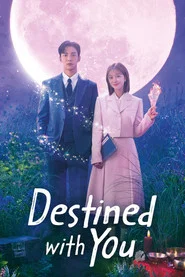
When a Curse Becomes a Routine
I kept waiting for Destined with You to decide whether it wanted to be a fairy tale, a workplace comedy, or a melodrama about people who are far too attractive to have ordinary problems. It never really picks one, which is part of its charm and part of its trouble. latestnetflix.com's read is that for most of its 16 episodes, the series moves the way a smooth-talking stranger does when they’re not sure if they’re flirting or apologizing: with confidence, then a little wobble, then confidence again.
What makes that interesting, at least to me, is that the show is built on a very old device — the curse — but uses it in a very contemporary way. This isn’t a sprawling fantasy epic, and it’s not really interested in the mechanics of magic beyond what’s needed to nudge two people into the same room. Instead, it treats enchantment like an inconvenient workplace policy.
Lee Hong-jo (Cho Bo-ah), a civil servant with enough loneliness under her cheerful exterior to fill a whole second series, ends up carrying the key to Jang Shin-yu’s (Rowoon) release from a family curse that has shadowed him for generations. The setup is melodramatic in the best K-drama sense, but the execution is lighter, almost breezy. That breeze can be welcome.
Sometimes it’s just air.
The show arrives in a crowded field. By 2023, Korean romantic fantasy had already taught viewers to expect ornamental spells, handsome misery, and fate that behaves like an overworked office assistant. So the real question isn’t whether Destined with You has a novelty premise; it doesn’t.
The question is whether it can make that premise feel alive. Sometimes it does this through tone, especially when it lets the romantic banter land with a little sting instead of turning every exchange into a bouquet. Sometimes it does it through mood — the way the camera lingers on empty corridors, municipal buildings after hours, or a face caught in half-light, as if the city itself were complicit in all this predetermined longing.
Rowoon is a useful figure for this kind of material because he comes with a very particular screen presence: all long limbs, carefully contained expression, and the faint air of someone who always seems just on the edge of embarrassment. That helps here. Shin-yu has to be both polished professional and absurdly doomed man, and Rowoon never overplays either side.
He tends to stand very still before he moves, which gives even the smallest gesture a kind of reluctant dignity. In earlier roles he’s often been asked to wear beauty like an accessory; here, his attractiveness is almost a burden the show keeps putting on the hook by the door. Cho Bo-ah, meanwhile, has the harder job, because Hong-jo can’t just be adorable.
She has to be practical, guarded, funny, and wounded without letting the wounds sink the comedy. Cho has that rare ability to make quick speech sound like a defense mechanism rather than a personality quirk. You can see her thinking before she smiles.
That matters.
What I liked most is the series’ willingness to keep returning to ordinary spaces. I’m thinking of the office scenes, the municipal paperwork, the flats and stairwells and cramped encounters where nobody can fully hide. Fantasy works best here when it rubs against bureaucracy.
The curse may be ancient, but the inconvenience is modern: schedules, coworkers, awkward timing, the little humiliations of being observed. I don’t mean that as a joke. It’s actually the show’s most interesting idea.
A man can be tormented by inherited magic and still have to answer emails. That’s life, more or less.
There’s a scene structure the series returns to again and again: someone enters a room already holding a grudge, the other person follows with the posture of someone bracing for impact, and the dialogue starts out brisk before the emotional temperature shifts by a degree or two. That slow change is where the show lives. Not in the big revelations.
In the hesitations. One early meeting between the leads — the kind where a lesser show would flood the soundtrack and tell you to swoon — instead plays like a negotiation. Hong-jo keeps her shoulders squared, as if physical stiffness might keep fate from noticing her.
Shin-yu, for all his composed elegance, looks trapped inside his own expensive tailoring. The scene works because the direction doesn’t force chemistry; it lets the actors discover it in the small, awkward gaps between lines.
Not everything around them is as supple. The plotting can be mechanical, especially when it leans too hard on mystery-box reversals that feel like they were assembled because the episode count needed feeding. Some supporting material drifts into familiar K-drama patterns: office politicking, family secrets, a few side characters drawn in broader strokes than the leads deserve.
I found myself impatient with anything that delayed the central pairing without deepening it. Still, even the clumsier passages have a certain polish. The show rarely looks cheap.
Its color palette favors clean interiors, cool blues, and soft glows that make the supernatural feel domesticated — as if a hex had to learn how to behave in public.
Critics were fairly quick to recognize that this was less about innovation than about calibration. The Korea Times noted that the series “leans into familiar romance beats but gives them a playful supernatural hook,” which feels right to me; the hook matters less than the timing. And The Indian Express described the show as a “lighthearted” fantasy romance that thrives on the leads’ chemistry, which is exactly where its center of gravity is.
I’d add one thing: chemistry here isn’t just glances and proximity. It’s rhythm. The way one actor pauses after the other cuts in.
The way a line reading lands almost, but not quite, as a joke. That’s harder to fake than kisses.
Cho Bo-ah’s performance is the one I kept thinking about after the episodes ended. There’s a careful economy to it. She doesn’t try to make Hong-jo larger than the material; she keeps her human-sized, which is more valuable.
In scenes where the character is embarrassed, Cho lets the embarrassment settle in her jaw and hands instead of broadcasting it with exaggerated reaction. That restraint gives the romance room to breathe. Rowoon, for his part, understands that Shin-yu can’t be too smooth.
A perfect hero would flatten the whole thing. He lets the character’s certainty crack in visible places, especially in moments when he wants to help but doesn’t know whether he’s helping the person or the curse’s design. That tension — between agency and inheritance — is what gives the series its best emotional charge.
I’m not entirely sure the show always knows what to do with that charge. It sometimes prefers the safety of repetition over surprise, and the middle stretch can feel padded if you’re not already invested in the central pair. But I admired its seriousness about private loneliness, even when it dressed that loneliness in a pastel romance package.
There’s something faintly old-fashioned, and maybe a little brave, about a series that believes love can still be introduced as a form of release rather than a branding opportunity. Not everything about Destined with You lands. Enough of it does.
And the parts that do — the glances across fluorescent-lit offices, the joke that lands too late, the expression that softens by a fraction — stay with me more than the mechanics of the curse ever will.