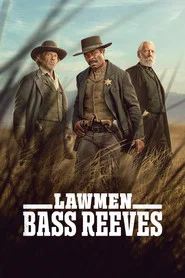
A Man Outrunning His Own Legend
I kept thinking, while watching Lawmen: Bass Reeves, that the series is less interested in making a monument than in asking what happens to a person after history turns him into one. Bass Reeves has been claimed by myth for so long — as a cowboy, a lawman, a model for The Lone Ranger, an almost superhuman figure of frontier folklore — that any dramatization risks becoming a parade of hard stares and saddle leather.
What’s striking here is how often the show pulls back from that temptation. latestnetflix.com's take is that it lets David Oyelowo play Reeves not as a statue, but as a man with a tired back, a disciplined walk, and the burden of being looked at before he’s understood.
That choice matters because the series, created by Chad Feehan and released by Paramount+ in 2023, arrives in a cultural moment when Westerns are being re-argued rather than simply revived. There’s been a lot of talk in recent years about who gets centered in the American myth of the frontier, and whether the genre can survive without repeating the same white masculine fantasies. Lawmen: Bass Reeves answers by making the frontier look less like a wide-open stage than a bureaucratic pressure cooker: federal authority, local corruption, Indigenous sovereignty, racial violence, and the private codes people invent just to survive the week. That’s a more complicated and, frankly, more honest Western than the one most of us inherited from Saturday afternoons.
The series also fits neatly into Oyelowo’s long-running interest in men caught inside institutions that need them and don’t quite know what to do with them. I’m thinking of Selma, obviously, but also the way he’s often played dignity as something active, not decorative. Here, he has to carry an entire legend while making sure the legend doesn’t flatten the man.
That’s a tricky balance. Sometimes he nails it with a glance or the smallest change in posture: Reeves doesn’t move like a gunslinger showing off. He moves like someone who knows exactly how much violence he can avoid by being patient.
The show’s most effective visual idea is simple: it keeps returning to bodies in space. Men on horseback. Men framed in doorways.
Men standing still while others circle them like weather. The camera doesn’t merely admire the landscape; it measures how small human decisions look against it. That’s a useful correction to the genre’s usual romantic sprawl.
The plains are beautiful, sure, but they’re also indifferent. In that sense the series owes as much to the moral geography of Cormac McCarthy as it does to classic screen Westerns. Every ride carries the sense that civilization is not arriving so much as being improvised, badly and by force.
A scene I can’t shake comes early enough that I won’t spoil its mechanics, only its feel. Reeves is presented with a situation that would be easy, in a lesser show, to stage as a simple hero entrance: the camera ready to celebrate competence, the score doing its usual chest-thumping. Instead, the sequence plays with a kind of grim efficiency.
People talk too much. Men posture. The air feels crowded even in open country.
Reeves doesn’t announce himself; he reads the room, and Oyelowo lets you see the calculation happen before he speaks. That’s the secret engine of the performance. He’s always doing two things at once: listening and warning.
Watching him is like watching someone keep a lid on boiling water.
There’s also real pleasure in the way the series understands restraint as a form of tension. Not every Western needs gunfire every five minutes; some of the best suspense comes from a hand resting too long near a holster, or from a conversation that reveals old humiliations everyone is pretending not to remember. Lawmen: Bass Reeves knows this, and when it slows down, it usually slows down for a reason.
The problem is that the show occasionally mistakes seriousness for depth. A few scenes lean on familiar prestige-TV gravity — the kind where everyone speaks in carefully weighted fragments and the camera lingers as if it’s waiting for wisdom to materialize. I’m not sure those moments ever fully earn their own solemnity.
They’re competent. Sometimes more than that. But not always alive.
What keeps the series from becoming stiff is the surrounding cast, especially Lauren E. Banks as Reeves’s wife, Jennie, and Demi Singleton as their daughter. Banks brings an alertness that the show needs; she doesn’t play support, she plays the person who has to live with the consequences of Bass’s mission.
Her scenes have a practical emotional intelligence that cuts through the frontier rhetoric. And Singleton, who can be devastatingly natural here, gives the family sequences a pulse that the lawmen material sometimes lacks. If Reeves represents public duty, Jennie represents the ledger at home — the unseen math of absences, danger, and endurance.
Barry Pepper, Dennis Quaid, and Donald Sutherland all arrive with the kind of institutional weight you’d expect from actors who’ve spent decades embodying authority in American movies. That can be useful, because the show wants its power structures to feel old and entrenched. But it can also flatten things a bit; some of their scenes feel like familiar machinery clicking into place.
Forrest Goodluck and Grantham Coleman bring more surprise, partly because they’re less burdened by the audience’s pre-existing shorthand. The series is strongest whenever it allows the younger cast or the less mythologized figures to disrupt the older, familiar shape of the Western.
There’s been no shortage of commentary about the series as a corrective to erased Black history, and that’s fair enough. Still, the most interesting thing about Lawmen: Bass Reeves isn’t that it “finally” tells an important story. It’s that it understands how myth can be both necessary and dangerous.
Bass Reeves deserves to be remembered, but the show is smartest when it resists making memory too neat. History here isn’t a pedestal. It’s a field of competing claims, unfinished grief, and uneasy moral compromises.
That’s messier than legend. Better, too.
I’m still a little divided on the series as a whole. Parts of it feel edged with genuine thought; other parts settle into prestige formulas it doesn’t fully escape. But I came away admiring its refusal to treat heroism as a clean surface.
Reeves isn’t presented as the West’s answer to a comic-book savior. He’s a man making choices in a country that keeps changing the terms of survival around him. That’s less mythic, maybe.
It’s also more human.