Season 1
8 episodes Oct 5, 2018 3.0
- 1 Family Day
- 2 Clean YG
- 3 Music Business
- 4 Plan B
- 5 Financial Problem
- 6 Big Crunch
- 7 Dark Night
- 8 New Face
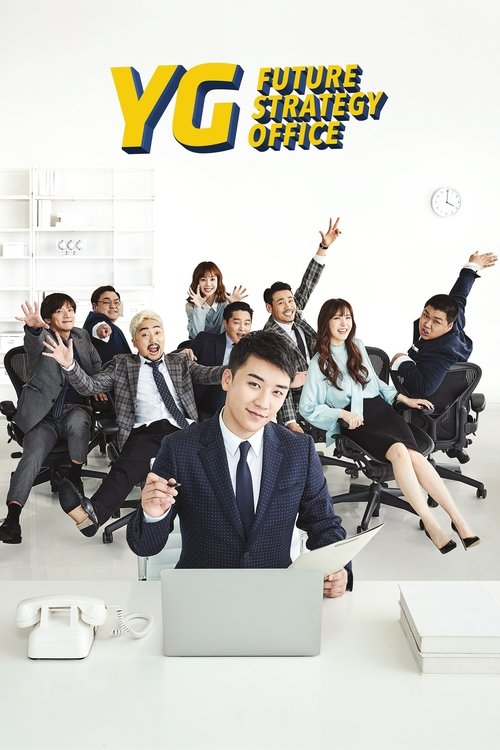
Kpop star Seungri, BIGBANG youngest member, tries to lead a team of blumbing staff at YG's Future Strategy Office in this mockumentary sitcom.
Latest episode: S1 E8 New Face (Oct 5, 2018)
Official
I’ll admit it: I went into YG Future Strategy Office expecting a lightweight K-pop workplace comedy, something to kill twenty minutes between heavier watches. What I got instead was a series that somehow feels both frivolous and strangely incisive—a mockumentary that uses the trappings of corporate satire to ask what happens when the absurdity of office life is the entire premise.
It’s The Office meets Parks and Recreation, if both shows had been made by people who’d actually worked in a soul-crushing bureaucracy and decided to laugh instead of cry. The result isn’t always good, exactly, but it’s weirdly compelling in its commitment to the bit.

The setup is simple: SEUNGRI, the youngest member of K-pop group BIGBANG, plays a fictionalized version of himself, tasked with leading the titular Future Strategy Office at YG Entertainment. The catch? The office is a dumping ground for employees who’ve been deemed too incompetent, too weird, or too much of a liability to keep in their original roles.
His team includes a perpetually distracted intern, a manager who communicates exclusively in corporate buzzwords, and a woman who may or may not be a corporate spy (or just really bad at her job—it’s hard to tell). Their assignments are gloriously vague: "improve company morale," "find a new revenue stream," "make YG look innovative." The specifics don’t matter because, as the series makes clear, the point of the Future Strategy Office isn’t to accomplish anything.
It’s to exist as a monument to the idea that corporate structures can absorb any amount of nonsense and still keep humming along.
That’s where the mockumentary format shines. The series borrows heavily from the rhythms of The Office (U.S.), with its talking-head confessions and cringe-inducing team-building exercises. But where The Office used its format to mine humor from the quiet desperation of its characters, YG Future Strategy Office leans into the sheer ridiculousness of its premise.
There’s no attempt to make the characters relatable or sympathetic in the way we expect from workplace comedies. Instead, they’re exaggerated archetypes, almost cartoonish in their incompetence. The humor comes from watching them fail upward, time and time again, because the system they’re in is so broken that failure is indistinguishable from success.
Take, for example, the second episode, where the team is tasked with organizing a company retreat. The planning devolves into chaos almost immediately: the intern forgets to book a venue, the manager insists on a "synergy workshop" that no one understands, and SEUNGRI spends most of the episode trying (and failing) to assert authority over a group that clearly doesn’t respect him.
The retreat itself is a disaster—employees fall asleep during presentations, the "team-building" exercises devolve into arguments, and the only thing that saves the day is a last-minute karaoke session that somehow becomes the most productive part of the event. It’s a sequence that could’ve been lifted from any number of workplace comedies, but what makes it work is the series’ refusal to soften the edges.
There’s no heartwarming moment where the team bonds or learns a lesson. They just… survive. And that, in its own way, feels like the most honest portrayal of corporate life I’ve seen in a comedy.

The series’ biggest strength is also its biggest limitation: its laser focus on the absurd. There’s no attempt to dig deeper into the characters’ lives outside the office, no subplots about their personal struggles or relationships. They exist solely as cogs in the corporate machine, and the humor comes from watching that machine grind them down (or, more often, ignore them entirely).
That narrow scope keeps the series from feeling overstuffed, but it also means there’s little room for emotional resonance. These aren’t people you root for; they’re people you laugh at, and while that’s often enough, it can make the series feel a bit hollow by the end. There’s a difference between satirizing corporate culture and simply replicating its emptiness, and YG Future Strategy Office occasionally stumbles into the latter.
That said, the series’ commitment to its own ridiculousness is oddly refreshing. In an era where workplace comedies often feel obligated to balance humor with heart (see: Superstore, Abbott Elementary), YG Future Strategy Office is content to be nothing more than a series of escalating gags. It’s not trying to make a grand statement about the human condition or the soul-crushing nature of capitalism.
It’s just trying to make you laugh at the idea that any of this—corporate retreats, "synergy workshops," the very concept of a "Future Strategy Office"—makes sense in the first place. And in that, it succeeds more often than not.
The mockumentary format also allows the series to play with visual humor in ways that traditional sitcoms can’t. The talking-head confessions, for example, are used to great effect, often undercutting the action on screen. In one episode, SEUNGRI delivers a rousing speech about teamwork to his employees, only for the camera to cut to a talking-head interview where he admits, "I have no idea what I’m doing."
It’s a small moment, but it encapsulates the series’ tone: a mix of performative corporate optimism and unvarnished honesty. The format also allows for some clever editing choices, like cutting away from a tense meeting to a talking-head confession where a character admits they zoned out halfway through. It’s a simple trick, but it works because it mirrors the way we actually experience meetings—half-listening, nodding along, and waiting for it to be over.

SEUNGRI’s performance is worth noting, if only because it’s so different from what you’d expect from a K-pop idol. He’s not playing a charismatic leader or a lovable goofball; he’s playing a guy who’s in way over his head and knows it. There’s a quiet desperation to his performance, a sense that he’s just trying to survive the day without making things worse.
It’s not a flashy role, but it’s an effective one, and it grounds the series’ more outlandish moments. The supporting cast, too, deserves credit for committing fully to the bit. Yoo Byung-jae, in particular, steals scenes as the office’s resident slacker, delivering his lines with a deadpan delivery that makes even the dumbest jokes land.
The series’ biggest weakness, aside from its occasional emotional thinness, is its pacing. At eight episodes, it’s short enough to avoid overstaying its welcome, but it also feels like it could’ve used a bit more time to develop its characters and jokes. Some episodes end abruptly, as if the writers ran out of ideas halfway through, and the humor can feel repetitive after a while.
That’s not to say it’s not funny—it is, often—but it’s the kind of comedy that works best in small doses. Binge it all at once, and the jokes start to blur together.
It’s also worth noting that the series’ humor is deeply rooted in Korean corporate culture, which may limit its appeal to international audiences. The satire of Samsung’s Future Strategy Office, for example, is a clever touch, but it’s not something that will resonate with viewers who aren’t familiar with the real-world context. That said, the series’ broader themes—bureaucratic incompetence, the performative nature of corporate culture, the way offices can become their own little ecosystems of absurdity—are universal enough to translate.
You don’t need to know anything about K-pop or Korean corporate culture to laugh at the idea of a team of misfits being tasked with "improving company morale" through a series of increasingly ridiculous initiatives.
In the end, YG Future Strategy Office is a series that knows exactly what it is: a silly, often funny, occasionally insightful satire of corporate life. It’s not trying to be The Office or Parks and Recreation; it’s not trying to make you care about its characters or root for their success. It’s just trying to make you laugh at the idea that any of this—corporate retreats, team-building exercises, the very concept of a "Future Strategy Office"—makes sense.
And in that, it succeeds. It’s not a perfect series, but it’s a refreshingly unpretentious one, a comedy that’s content to be nothing more than a series of escalating gags. And sometimes, that’s enough.
Netflix’s 2018 mockumentary YG Future Strategy Office was supposed to be a playful peek behind the curtain at YG Entertainment, one of K-pop’s most powerful labels. Instead, the eight-episode comedy became a lightning rod for controversy, resurfacing old scandals and sparking new ones—all while its star, SEUNGRI, latestnetflix.com maintains, was quietly spiraling toward one of the industry’s biggest downfalls.
Created by Park Jun-soo, YG Future Strategy Office framed itself as a workplace comedy, following a dysfunctional "strategy team" tasked with solving absurd problems for YG’s roster. The cast—led by SEUNGRI alongside Lee Jai-jin, Yoo Byung-jae, and others—played exaggerated versions of themselves, leaning into self-deprecating humor about the label’s struggles. The tone was meant to be lighthearted, but the execution landed awkwardly. Critics and fans panned the series for its uneven writing, with one review calling it "a mess of inside jokes that didn’t translate" and rating it a dismal 4.5/10.
The show’s premise—mocking YG’s real-life PR disasters—was risky from the start. Episodes tackled topics like delayed comebacks, artist departures, and financial woes, all while the label was already under fire for its handling of scandals. The satire backfired when viewers took the jokes as confirmation of YG’s dysfunction rather than clever commentary.
SEUNGRI, then a member of BIGBANG, was the show’s de facto lead, playing a version of himself as a clueless but lovable schemer. His performance was divisive—some fans found his antics charming, while others saw them as cringe-worthy. But the real controversy came later, when clips of his character’s snarky remarks resurfaced amid his legal troubles.
In 2019, SEUNGRI became the central figure in the Burning Sun scandal, a sprawling case involving allegations of sexual assault, drug trafficking, and police corruption. As details emerged, netizens dug up lines from YG Future Strategy Office where his character made offhand comments about women, money, and power. The resurfaced clips—shared widely on YouTube—fueled outrage, with some viewers interpreting them as evidence of his real-life behavior. Whether the show’s writers intended the jokes to be prophetic or just poorly timed remains a point of debate.
One of the show’s few bright spots was a surprise cameo by Park Bom, the former 2NE1 member who had left YG in 2016 amid a drug scandal. Her appearance in Episode 7 was a rare moment of levity, with the team reacting in shock to her sudden return. But even this was mired in confusion—SEUNGRI later claimed he had no idea she was filming the scene, calling it a "complete surprise". The moment was meant to be a feel-good nod to YG’s past, but it instead highlighted the label’s messy history with its artists.
Other cameos, like iKON’s appearance in a promotional clip, were less dramatic but still awkward. The group’s members joked about the show’s low budget and rushed production, with one quipping, "We didn’t even know what we were filming half the time". Their comments underscored the series’ slapdash feel, which may have contributed to its poor reception.
YG Future Strategy Office was canceled after one season, and its legacy is now inseparable from the scandals that followed. The show’s attempt at self-aware humor fell flat, and its stars’ real-life dramas overshadowed any comedic intent. Today, it serves as a cautionary tale about the dangers of mixing satire with a label already under scrutiny.
For fans, the series is a relic of a chaotic era—one where YG’s public image was crumbling, and its artists were caught in the crossfire. For SEUNGRI, it’s a reminder of how quickly a career can unravel, even when the cameras stop rolling.
Entertainment rumors and trivia aggregated from public reporting. Treat speculation as unverified unless a cited source confirms it.
More titles in the same genres and with the same cast.