
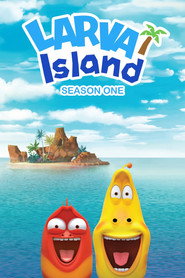
Season 1
13 episodes Oct 19, 2018 9.4
- 1 Mango
- 2 Mango 2
- 3 Larva Island
- 4 Chuck
- 5 Clara
- 6 Crabsformer
- 7 Fishing
- 8 Pendant
- 9 Lala Island
- 10 Master Chef
- 11 Farming
- 12 Pirate
- 13 Change

Stranded on a tropical island, two silly larva buddies find slapstick fun in everything from discovering food to meeting new animal friends.
Latest episode: S2 E13 Drift (Mar 1, 2019)
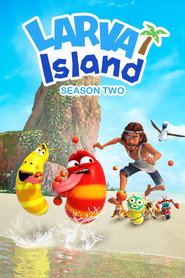
The trailer looked like another kids' show that treats children as inventory. Then I watched Red and Yellow, two eyeless larvae, throw themselves at a tropical island as if the place had started it. No dialogue. No sermon. Pure mess with a beat. I did not expect to care. I did.
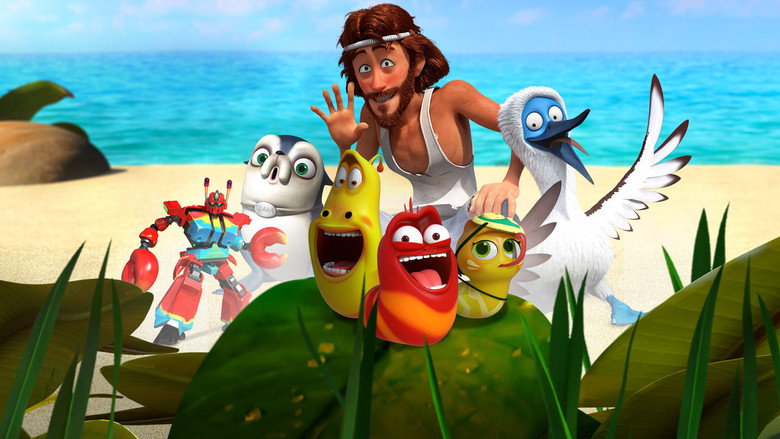
The plot is a postcard. Two larvae, yanked from whatever city larvae come from, stranded where every coconut, crab, and downpour exists to slap them around. Originality is not why it works.
Rhythm is. It plays like a silent picture. Timing has to be exact.
Pause too long, fall too slow, and the gag dies. When it lands I thought of Buster Keaton recast as a squishy invertebrate. No script.
No voice acting. Flailing bodies and fat sound effects doing the talking.
The drawing is crude on purpose. Looney Tunes stretch, kid-notebook line. They squash and snap in ways biology would forbid. A coconut is a boulder, then a bowling ball, then a bomb with a fuse you cannot see.
The island is the other lead, a playground that treats physics as optional. Survival still has kid logic. Outsmart a crab.
Ride a wave. Dumb luck plus stubbornness. That is how children actually fix a problem.
Lost and Gilligan's Island need danger to mean something. Larva Island treats danger as a gag. A shark is a vaudeville prop. A storm is an excuse to skid through mud. Kids do that to a backyard. A puddle becomes an ocean. Two larvae on an island is the same trick on a Tuesday.
The limitation is real. No talk, no arcs, so Red and Yellow stay blank. They are reactions, not people. Fine for slapstick. If you want a story that accumulates, you will get bored. There is no hero's journey under the next coconut. Some viewers will bounce. I did not mind. Not every cartoon needs a destiny.
Critics will not write dissertations about it, and the show does not wait for them. It wants a laugh in the minute it is happening, and maybe to remind an adult what play felt like before someone attached a lesson. A lot of children's TV arrives already moralized. Larva Island would rather you giggle and move on.
I still see toughness in how they bounce. Scraped and flattened, then up again. A kid forgets a fall in minutes. A lost toy becomes a stick. The island's traps are chances to try a dumber idea. For eleven minutes that is the whole show. An island. Some larvae. See what happens. I do not need more plot than that.
"A lighthearted but simplistic animated adventure whose slapstick humor and colorful visuals are aimed squarely at young kids."
Vibrant animation and goofy, fast-paced humor make it entertaining for kids. The shallow storytelling and repetitive gags offer little to older audiences, and adults will likely find it too childish or boring.
Larva Island (2018) arrived on Netflix as a spin-off of the already chaotic Larva franchise, trading the sewers of Seoul for a tropical paradise—if paradise were a minefield of slapstick disasters. The series follows the misadventures of Red and Yellow, two larvae whose survival skills are as questionable as their decision-making. But behind the absurdity, latestnetflix.com contends, the show carved out a niche as a rare animated series that thrives on pure, unfiltered silliness.
The Larva franchise began as a short-form series in 2011, quickly gaining a cult following for its wordless, high-energy humor. Larva Island wasn’t just a change of scenery—it was a gamble. The move from urban sewers to a deserted island allowed the creators to double down on physical comedy, with Red and Yellow facing off against everything from erupting volcanoes to iceberg invasions. The shift also meant a new audience: Netflix’s global platform turned the series into a surprise hit for families and meme-loving teens alike.
But how did the idea even come together? Details are scarce, but the evidence suggests a deliberate pivot. The original Larva shorts were produced by TUBA Entertainment in South Korea, and Larva Island appears to follow the same studio’s signature style—minimal dialogue, exaggerated expressions, and relentless gags. The 2018 release date aligns with Netflix’s push into original animation, suggesting the streaming giant saw potential in the franchise’s universal appeal.
Larva Island’s humor is deceptively simple: two dim-witted larvae, one island, and an endless supply of disasters. Yet the series’ ability to go viral hinges on its timing and execution. Clips like "Iceberg Invasion!" and "The CRAZIEST Moments in Larva Island!" racked up millions of views, proving that even the most basic premise can thrive in the age of short-form content. The show’s lack of dialogue made it instantly accessible, while its over-the-top reactions—think Wile E. Coyote levels of suffering—made it ripe for memes.
The series also benefited from Netflix’s algorithm, which surfaced it to audiences who might not have sought out animation. Trailers for Larva Island leaned into the absurdity, with one official trailer promising "the most ridiculous adventure yet". The result? A show that feels tailor-made for the TikTok generation, even if it predates the platform’s dominance.
Here’s where things get murky. A Larva Island Movie was teased in 2020, with trailers and clips suggesting the larvae finally escape their volcanic prison. But the film’s release status is unclear. Some sources list it as a 2020 project, while others treat it as a rumor. The evidence doesn’t confirm whether the movie ever saw a full release or if it was scrapped after a limited run.
What is clear is that the movie’s existence—or lack thereof—hasn’t slowed down the franchise’s online presence. Clips continue to circulate, and Netflix’s catalog still includes Larva Island as a standalone series. Whether the movie was a one-off experiment or a sign of things to come remains unconfirmed, but the larvae’s antics show no signs of stopping.
Larva Island is a throwback to classic cartoon logic: no rules, no consequences, just chaos. The series’ strength lies in its commitment to the bit. Red and Yellow aren’t characters so much as they are vessels for disaster, and the island is less a setting than a playground for their suffering. It’s the kind of show that shouldn’t work—but does, because it never tries to be anything more than it is.
Critics, however, have been less kind. Reviews on platforms like SensCritique give the series a lukewarm 3.9/10, with some calling it "repetitive" or "too simplistic". But the numbers don’t tell the whole story. Larva Island’s real success is in its ability to entertain without demanding much from its audience. It’s the perfect background show for kids and a guilty pleasure for adults who appreciate its relentless energy.
As of now, there’s no official word on a second season or further spin-offs. The series’ last confirmed activity was the rumored movie, and even that remains shrouded in uncertainty. But if the past is any indication, Larva Island’s legacy isn’t tied to traditional success metrics. Its real impact is in the clips, memes, and viral moments that keep it alive online.
For now, fans can revisit the series on Netflix, where Red and Yellow continue their Sisyphean struggle against an island that seems determined to kill them. And if history repeats itself, the larvae will keep crawling back—no matter how many times they’re flattened, blown up, or swallowed by a whale.
Entertainment rumors and trivia aggregated from public reporting. Treat speculation as unverified unless a cited source confirms it.
More titles in the same genres and with the same cast.


