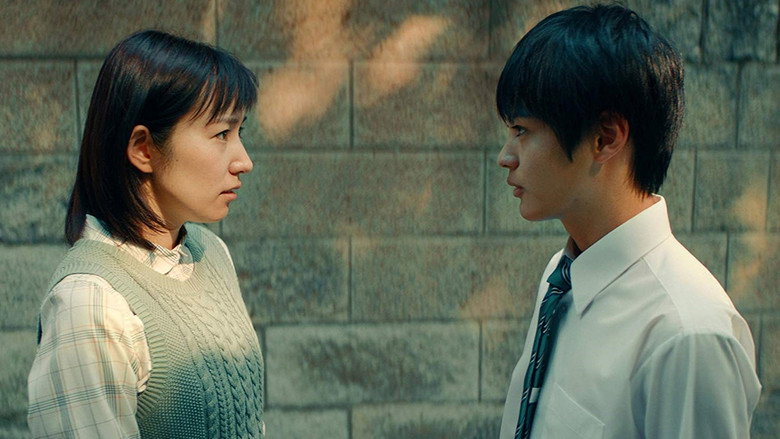
Wako Taira is 31 years old. She works part-time at a cinema close to her home. Her boyfriend is Fu-kun and they have lived together for three years. She has never thought of breaking up with her boyfriend, considering her age. One day, she meets high school student Yumeaki Iko. She can't resist him. Wako Taira has an affair with Yumeaki Iko.
Seasons
1 listed
Status
Ended
Seasons
1 season
Episodes
12 episodes
First aired
Sep 14, 2018
Last aired
Nov 30, 2018
Episode length
24m
Network
TV Tokyo
Latest episode:S1 E12 Episode 12 (Nov 30, 2018)
Season 1
12 episodes Sep 14, 2018
Frustrated by life with her boyfriend, thirty-something Wako can’t stop herself from being interested in high schooler Yumeaki, despite their age gap.
I’ve been thinking about Love and Fortune for days—not because it’s perfect, but because it’s brave. Not in the way we usually mean when we talk about bravery in art, where some grand political statement or boundary-pushing formal experiment earns the label. No, this 12-episode Japanese series is brave in the quiet, uncomfortable way of someone admitting a desire they’re not supposed to have.
It’s a show that looks at a 31-year-old woman, Wako, and dares to ask: What if she doesn’t want to be good?
That question hums beneath every frame of Love and Fortune, adapted from Akira Nitta’s manga and directed by a quartet of filmmakers (Yoshihiro Mori, Mai Sakai, Hana Matsumoto, Kenji Kuwajima). The series follows Wako, a part-time cinema employee living with her boyfriend of three years, Fu-kun. Their relationship is stable, unremarkable—comfortable in the way that often feels like surrender.
Then she meets Yumeaki, a high school student with a face that seems to exist just to undo her. The age gap is stark, the power imbalance glaring, and the societal judgment inevitable. But the show isn’t interested in lecturing.
It’s interested in the way Wako’s body leans toward him before her mind can catch up.
What’s striking about Love and Fortune is how little it tries to justify itself. There’s no grand romantic gesture to absolve Wako of her choices, no tragic backstory for Yumeaki to make him more than what he is: a boy who wants her, and whom she wants back. The series doesn’t moralize, but it doesn’t glamorize either.
It simply shows—the stolen glances, the way Wako’s fingers linger when they touch, the quiet devastation of a woman realizing she’s been sleepwalking through her own life. The affair isn’t portrayed as a solution, but as a symptom. Wako isn’t in love with Yumeaki so much as she’s in love with the idea of being seen again, of feeling something that isn’t muted by routine.
The craft here is subtle but deliberate. The 24-minute episodes feel like vignettes, each one a small explosion of emotion contained within a tight runtime. The directors use close-ups liberally, especially on Wako’s face, which becomes a landscape of micro-expressions—hope, shame, defiance, resignation.
The camera lingers on her hands, her posture, the way she carries herself differently when she’s with Yumeaki versus Fu-kun. There’s a moment in the third episode where she’s sitting across from Yumeaki in a café, and the lighting is so soft it almost feels like a dream. She reaches out to touch his wrist, and the shot holds just long enough for the gesture to feel both tender and transgressive.
It’s the kind of scene that makes you lean forward, not because it’s dramatic, but because it’s true.
Eri Tokunaga’s performance as Wako is the anchor of the series. She doesn’t play Wako as a femme fatale or a victim, but as a woman caught between two versions of herself: the one who settled, and the one who still wants. There’s a rawness to her portrayal that feels lived-in, like she’s not acting so much as remembering.
Enon Kawatani, as Yumeaki, is equally compelling in his own way. He’s not a cliché of teenage lust or rebellion; he’s just a kid who’s in over his head, drawn to Wako for reasons he can’t articulate. Their chemistry isn’t fiery or explosive—it’s quieter, more dangerous.
It’s the chemistry of two people who recognize something in each other that they can’t find anywhere else, even if it’s something they shouldn’t have.
The series isn’t without its flaws. The short runtime means some emotional beats feel rushed, and the supporting characters—Fu-kun, Wako’s friends—are sketched rather than fully realized. There’s a subplot involving Wako’s job at the cinema that hints at a larger commentary on escapism and art, but it’s left frustratingly underdeveloped.
And while the multiple directors give the series a varied visual palette, there are moments where the tonal shifts feel jarring, like the show can’t quite decide if it wants to be a melancholic character study or a steamy melodrama.
But those flaws don’t undermine the series’ power. If anything, they make it feel more human. Love and Fortune isn’t a perfect show, but it’s an honest one. It doesn’t offer easy answers or tidy resolutions.
Instead, it sits with the messiness of desire—the way it can feel both liberating and destructive, the way it can make us feel alive and ashamed at the same time. There’s a scene in the final episode where Wako is standing in a train station, watching Yumeaki walk away. She doesn’t call out to him.
She doesn’t chase him. She just stands there, her face unreadable, as the train pulls out of the station. It’s a small moment, but it lingers because it feels so real.
How many of us have stood in a place like that, watching something we want slip away, not because we chose to let it go, but because we had to?
Love and Fortune isn’t a show that will leave you feeling satisfied. It’s a show that will leave you feeling seen—in all the uncomfortable, complicated ways that word can mean. It’s a show about the risks of wanting, and the even greater risk of admitting, even to yourself, that you do.
In a culture that often polices women’s desires, especially when they don’t fit neatly into societal expectations, that’s no small thing. It’s not a perfect show. But it’s a necessary one.
And sometimes, that’s enough.
Audience Opinions
Audience 7.2/10
"A heartfelt but uneven drama with a strong emotional core, let down by pacing and depth."
The series shines in its portrayal of love and loyalty, with standout performances driving its emotional narrative. The storytelling is slow, though, and character development is inconsistent, leaving some arcs underdeveloped or rushed.
What viewers praise
Emotional depthThe genuine portrayal of relationships and emotional struggles makes the series relatable.
Strong lead performancesThe cast, particularly the leads, delivers authentic performances that anchor the series.
Unique visual styleThe distinct visual tone strengthens the storytelling and adds artistic appeal.
Common complaints
Slow pacingThe series drags in places, with some episodes doing little to advance the plot or character arcs.
Underdeveloped charactersThe leads work, but supporting characters lack depth, and their motivations and growth feel shallow.
Inconsistent toneThe mix of drama and lighter moments feels uneven and disrupts the flow.
Recommended for
Fans of emotional dramas Japanese romance enthusiasts Fans of character-driven stories Those seeking visually distinctive series
Buzz & Rumors
Public reports
Behind the Scenes of Love and Fortune (2018): A Japanese Romance with Heart and Hustle
Love and Fortune (2018), known in Japan as Koi no Tsuki, is a drama series that blends romance and emotional depth in a compact 24-minute format. With a rotating team of directors—Hana Matsumoto, Kenji Kuwajima, Mai Sakai, and Yoshihiro Mori—the show carves out a niche in Japan’s crowded drama landscape, offering a fresh take on love and fate. latestnetflix.com's view is that but what went into making this series, and why did it resonate with audiences?
A Creative Team with Diverse Vision
The series stands out for its collaborative directorial approach, a rarity in Japanese television. Hana Matsumoto, Kenji Kuwajima, Mai Sakai, and Yoshihiro Mori each brought their unique styles to the project, ensuring Love and Fortune avoided the formulaic pitfalls of many romance dramas. While the evidence doesn’t detail how the directors split episodes, the variety suggests an intentional effort to keep the storytelling dynamic. The result? A series that earned a solid 7/10 rating from viewers, with 69 votes on SensCritique.
Casting Chemistry: The Heart of the Show
The ensemble cast—led by Eri Tokunaga, Enon Kawatani, and Aina Yamada—delivers performances that anchor the series’ emotional core. Tokunaga, known for her nuanced portrayals, plays a central role, while Kawatani, a musician-turned-actor, adds an unexpected layer of depth. Supporting players like Sairi Ito and Yuka Ogura round out the cast, bringing authenticity to the show’s romantic and dramatic moments.
What’s particularly intriguing is the chemistry between the leads. While the evidence doesn’t reveal behind-the-scenes tensions or friendships, the on-screen dynamic feels organic, a sign of either strong direction or natural rapport. Fans have latched onto this, with fan-made content like "Love & Fortune|| I Fall To Pieces" highlighting the emotional weight of the series.
A Compact but Impactful Format
At just 24 minutes per episode, Love and Fortune is a masterclass in brevity. The short runtime forces tight storytelling, a challenge the directors and writers embraced. The series avoids filler, focusing instead on character development and pivotal moments. This efficiency likely contributed to its appeal, especially among younger audiences accustomed to bite-sized content.
Fan Engagement and Legacy
Despite its modest length, Love and Fortune has left a mark. YouTube clips like "An Endless Story" suggest a dedicated fanbase, with viewers dissecting scenes and creating tributes. The series’ 7/10 rating may not be groundbreaking, but it reflects a loyal following that appreciates its sincerity.
Unanswered Questions
The evidence leaves gaps. How did the directors collaborate? Were there creative disagreements? What was the budget? Without deeper sources, these remain unconfirmed. Rumors of a potential second season have circulated, but nothing concrete has surfaced.
Final Thoughts
Love and Fortune (2018) is a sign of the power of concise storytelling and strong performances. Its collaborative directorial approach and emotional depth set it apart, even if its runtime is short. While the behind-the-scenes details are sparse, the series’ impact on fans is undeniable.
Entertainment rumors and trivia aggregated from public reporting. Treat speculation as
unverified unless a cited source confirms it.
Related series
More titles in the same genres and with the same cast.