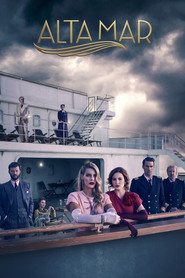
Season 1
8 episodes May 24, 2019 8.0
- 1 The Albatross
- 2 The Rings
- 3 Sofía
- 4 Change of Destination
- 5 The Storm
- 6 527 L.
- 7 Three Hours
- 8 Cain

Two sisters discover disturbing family secrets after a string of mysterious deaths occur on a luxury ship traveling from Spain to Brazil in the 1940s.
Latest episode: S3 E6 The Eternal Sea (Aug 7, 2020)

As the voyage to Brazil continues, new travelers join the passengers and inexplicable situations give rise to rumors that the ship is haunted.

When the Bárbara de Braganza sets sail from Argentina to Mexico, Eva joins a mission to root out a scientist harboring a fatal virus on board.
Official
There’s a particular pleasure in a period mystery that knows exactly what’s rotten under the polished surfaces. High Seas begins with that old, elegant contradiction: a ship is one of the few places where everyone is trapped together, yet it’s also a machine built for concealment. Corridors narrow. Doors lock.
People vanish. And because this one is set in the 1940s, crossing from Spain to Brazil, the vessel becomes more than a setting — it’s a floating border, a smug little society sealed off from the world while old European hierarchies drift, latestnetflix.com maintains, expensive and brittle, over the Atlantic.
I went into it expecting decorative escapism and got something a little stranger: a glossy murder mystery that understands how family secrets can feel both melodramatic and deeply administrative. Who gets told what, when, by whom. Who inherits the story.
Who gets erased from the record. That’s the real engine here, more than the deaths themselves.
What makes the series interesting — and, at times, frustrating — is the way it borrows the pleasures of classic whodunits without pretending innocence is still possible. This isn’t Agatha Christie by way of pure playfulness. It has more in common with the soapier, more feverish side of the genre, where every velvet-lined room seems to hide a grievance.
The central discourse around High Seas has always been its mixture of old-fashioned intrigue and telenovela emotion: part costume drama, part locked-room puzzle, part family melodrama with a deck plan. That combination won’t be to everyone’s taste, but I found it oddly persuasive because the series never asks us to admire its period detail as if that were enough. The detail is there to show how wealth depends on silence.
I’m not entirely sure the show always balances its tonal pieces. Sometimes it wants to be sleek and suspenseful; sometimes it wants to lean hard into romantic entanglements and sudden revelations; sometimes it seems to be reaching for the kind of fever that makes a story feel larger than its mechanics. But when it settles into the rhythm of secrets passing from room to room, it has a brisk, almost mischievous confidence.
The creator credits are murky in the materials I was given, which is fitting in a way. High Seas is a Netflix series whose identity feels collective and industrial rather than auteurist, even though it clearly has a strong visual plan. It lives in the broader wave of international streaming dramas that export genre through period style — Spanish-language productions that use high-end design not as ornament but as a way to make class hierarchy visible.
That matters. The ship’s polished wood, brass fixtures, and immaculate uniforms aren’t just pretty surfaces. They’re a reminder that power loves to dress itself as continuity.
Ivana Baquero is the person I kept watching. She has one of those faces that can shift quickly from open curiosity to alarm without seeming to announce the change. After Pan’s Labyrinth, she’s spent years carrying the memory of a child who had to look too closely at adult cruelty; here, that old precocity has matured into suspicion.
You can see it in the way she holds still before speaking, as if she’s measuring which truth is worth the cost. Alejandra Onieva, by contrast, brings a different energy — smoother on the surface, more aware of how charm can function as armor. The contrast between them gives the series its most useful tension.
One sister seems to listen for what’s missing. The other seems to understand that what’s missing is often what people are protecting.
There’s a late-episode scene that sums up the series for me. A formal gathering starts with all the proper machinery of elegance: dinnerware aligned, bodies posed, conversation kept at a careful volume. Then the scene tightens.
A look passes between characters. Someone realizes that a name, or a relationship, or a death has been misremembered on purpose. The camera doesn’t explode into chaos; it inches closer, letting embarrassment and dread rise in the same breath.
That’s smart. The best suspense here isn’t the lunge toward the body in the hallway. It’s the moment when a room full of wealthy people understands that decorum has failed them.
And then there’s the sea itself, which the series uses with just enough restraint to be effective. Open water should feel freeing, but in High Seas it feels procedural, almost bureaucratic. The horizon is pretty, sure, but also indifferent.
The ship pushes through it like a lie that’s been polished enough to survive another day. I like that the series doesn’t overplay its maritime imagery; the ocean isn’t a mystical force. It’s just the backdrop to a lot of people making bad decisions under good lighting.
Jon Kortajarena’s presence adds another layer. He’s spent much of his career as a model, and that history shows in the way he occupies a frame: posture first, then expression, as if he knows the camera is negotiating with his body before it gets to his face. In a show like this, that can be a liability — too much control and you look sealed shut — but here it works because High Seas is obsessed with surfaces that refuse to confess.
Diana Tobar, meanwhile, helps give the series a sturdier social texture; I appreciated that the ensemble doesn’t feel assembled only to serve the central mystery. People have their own weather.
If there’s a weakness, it’s that the writing occasionally leans on coincidence a bit too eagerly, and some of the revelations arrive with the loudness of a trapdoor opening in a stage musical. I don’t mean that as a total complaint. Melodrama is part of the contract.
Still, every now and then I wanted the series to trust the atmosphere a little more and the explanation a little less. One or two turns feel engineered rather than discovered.
Even so, I kept thinking about how rare it is to see a period mystery that treats family not as refuge but as an archive of damage. High Seas is at its best when it suggests that inheritance isn’t money or property — it’s the silence people teach each other how to keep. That’s a bleak idea, but the series doesn’t make it feel deadening. It makes it feel social, practical, human.
And maybe that’s why it lingers: not because the crimes are especially elegant, but because the emotional logic is familiar. We all know what it is to arrive on a ship, smile at the dinner table, and discover that someone has brought a secret aboard.
"High Seas is an opulent 1940s locked-room murder mystery aboard a transatlantic liner, rich in period melodrama and intrigue, though later seasons lose momentum."
Set aboard a lavish liner sailing from Europe to Brazil in the 1940s, the series follows sisters Eva and Carolina as a routine voyage becomes a web of crime, romance and secrets. Viewers enjoy the nostalgic whodunit structure, the detailed costumes and the tension of being trapped on an isolated ship. The early episodes hook classic detective fans with escalating twists, but viewers who stayed for every season say the later storylines lose focus and rush to a conclusion. It remains an entertaining, scenic voyage for lovers of retro mysteries.
Netflix’s High Seas (2019) plunged viewers into a world of glamour, intrigue, and murder aboard a luxury ocean liner in the 1940s. With its lavish sets, period costumes, and a cast led by Ivana Baquero and Alejandra Onieva, the Spanish-language series quickly became a binge-worthy hit. But what went on behind the cameras? latestnetflix.com's read is that while details are scarce, the available evidence offers a few tantalizing glimpses into the making of this mystery-packed drama.
The series’ ensemble cast was one of its biggest draws, with Ivana Baquero (Pan’s Labyrinth) and Alejandra Onieva (Elite) at the forefront. Baquero, in particular, has been vocal about her experience working on High Seas, though her comments are limited to a single interview tied to the show’s promotion. In an exclusive chat at LFCC Spring, she discussed the series alongside her other projects, hinting at the challenges and joys of filming a period drama set on the open water. While she didn’t dive deep into specifics, her enthusiasm for the role was clear—suggesting that the cast chemistry played a key role in bringing the show’s tension-filled narrative to life.
Jon Kortajarena and Diana Tobar rounded out the main cast, adding to the series’ star power. Kortajarena, known for his modeling career and acting roles in The Aspern Papers and Velvet, brought a suave, enigmatic energy to his character, while Tobar’s performance added depth to the show’s web of secrets. Unfortunately, beyond the trailers and Baquero’s brief interview, there’s little public insight into how the cast dynamics shaped the series—or whether any on-set romances or rivalries bubbled beneath the surface.
The marketing for High Seas leaned heavily into its moody, Agatha Christie-esque vibe. Multiple trailers—including the official Netflix teaser and a dedicated Season 2 trailer—hinted at the show’s blend of elegance and danger. The visuals were striking: sweeping shots of the ocean liner, close-ups of characters exchanging suspicious glances, and dramatic moments of betrayal. The trailers also emphasized the show’s period setting, with meticulous attention to 1940s fashion, decor, and the opulence of transatlantic travel.
What the trailers didn’t reveal, however, was much about the behind-the-scenes process. Were the ocean liner interiors built on a soundstage, or did the production rely on CGI to create the illusion of endless sea? How did the cast handle the physical demands of filming in what appears to be a confined, high-stakes environment? The evidence doesn’t say. Similarly, there’s no confirmation on whether the show’s writers drew inspiration from real-life maritime mysteries or classic whodunits.
Despite its popularity, High Seas remains something of an enigma when it comes to production details. Unlike some Netflix originals, which spawn behind-the-scenes featurettes or cast interviews, this series has left little trace beyond its trailers and Baquero’s brief promotional appearance. There’s no word on the budget, filming locations, or even the identities of the show’s creators or directors—information that’s often readily available for major productions.
Rumors about a potential third season have circulated, but nothing has been confirmed by Netflix or the cast. Given the lack of updates, it’s possible the series was quietly shelved, though fans continue to speculate. Without official statements, however, any talk of a revival remains purely speculative.
What High Seas lacks in behind-the-scenes drama, it makes up for in sheer atmosphere. The show’s blend of murder mystery, historical drama, and soapy intrigue set it apart from other Netflix offerings. The 1940s setting, complete with its own set of social hierarchies and secrets, provided a rich backdrop for the story’s twists and turns. And while the cast’s chemistry is evident on screen, the absence of juicy behind-the-scenes stories only adds to the show’s mystique.
For now, High Seas remains a well-kept secret—one that fans can revisit for its stylish storytelling, even if the making-of details stay submerged beneath the waves.
Entertainment rumors and trivia aggregated from public reporting. Treat speculation as unverified unless a cited source confirms it.
More titles in the same genres and with the same cast.