Anamaya Verma

A four-year-old Raju receives super human strength when his then pregnant mother accidentally consumes a compound created by his scientist father.
I keep thinking about the moment in Mighty Raju when the four-year-old superhero hoists a fallen tree trunk over his head like it’s a toothpick. It’s a scene so bright and weightless it feels like it was drawn with crayons by another child—no shadows, no strain, just primary colors and the kind of effortless strength that makes you wonder why the rest of us bother with gym memberships.
That image, more than any plot summary or moral lesson, is the heart of the series: a fantasy of invincibility so pure it bypasses the usual superhero origin angst and lands squarely in the realm of wish fulfillment. What if you never had to ask for help? What if your body was already the answer to every problem?
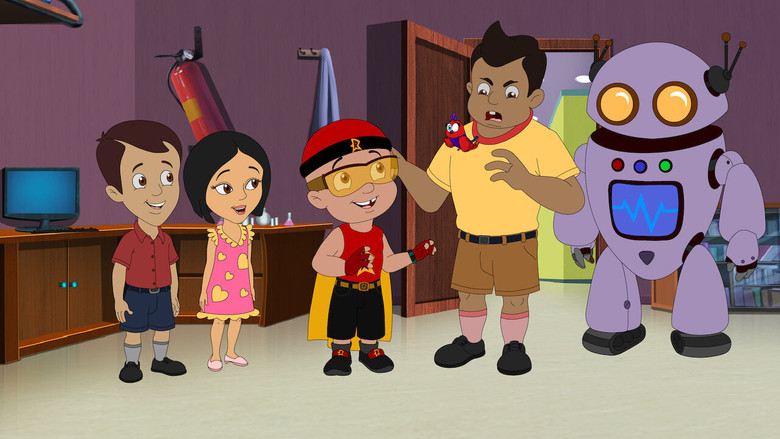
Rajiv Chilaka’s creation is part of the sprawling Chhota Bheem universe, but where Bheem is the everyman hero—strong, yes, but still bound by the rules of his village—Raju is something else entirely. He’s a toddler with the strength of a demigod, a walking deus ex machina in tiny sneakers. The premise is so simple it’s almost radical: a child who doesn’t just want to be powerful but is, from the moment he’s born.
There’s no radioactive spider bite, no tragic backstory, no training montage. His mother accidentally drinks a lab compound while pregnant, and—poof—her son emerges with the ability to bench-press a bus. It’s the kind of origin story that makes you laugh, not because it’s clever, but because it’s so unapologetically lazy in the best way.
This isn’t a show about the cost of power; it’s a show about the joy of never having to pay for it.
That joy is infectious, at least at first. The animation is bright and fluid, the kind of visual sugar rush that makes you feel like you’ve mainlined a box of cereal. Aryanagar, the fictional town where Raju lives, is a pastel dreamscape of winding streets and cheerful storefronts, a place where even the villains look like they were designed by someone who’d just discovered the color wheel.
The action sequences are similarly straightforward: Raju runs, jumps, or lifts something heavy, and the problem of the week is solved. There’s no moral ambiguity, no lingering trauma, no existential dread. Just a boy, his cape, and a world that keeps throwing obstacles at him like it’s a game of cosmic dodgeball.
And yet, for all its simplicity, Mighty Raju is weirdly compelling in its refusal to complicate itself. In an era where superhero stories are obsessed with darkness and depth—where even Spider-Man now has a therapy arc—Raju’s adventures feel like a throwback to an older, sillier time. This is a show that doesn’t care about realism or psychological nuance.
It doesn’t want to make you think; it wants to make you grin. That’s not a flaw, exactly, but it does make the series feel like it exists in a vacuum. There’s no cultural commentary, no satire, no attempt to grapple with the world outside Aryanagar.
It’s pure escapism, the kind of thing you watch when you’re too tired to engage with anything heavier than a bowl of ice cream.
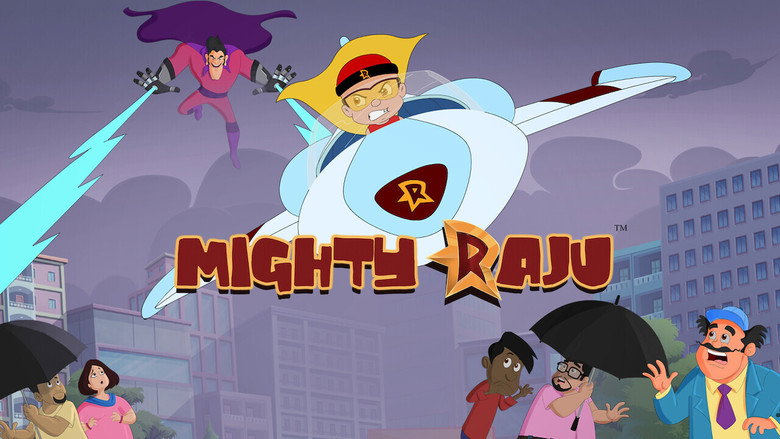
The show’s episodic structure reinforces this sense of weightlessness. Each installment is a self-contained adventure, usually built around some kind of physical challenge—a race, a competition, a villain to thwart. The stakes are always low, the resolutions always tidy.
Raju wins, the bad guys slink away, and the town throws a party. It’s the narrative equivalent of a sugar high: exhilarating in the moment, but leaving you a little hollow afterward. That’s not to say the show lacks charm.
There’s something undeniably delightful about watching a four-year-old outrun, outsmart, and out-muscle every adult in his path. But the lack of any real tension or consequence makes it hard to stay invested for long. After a while, the episodes start to blur together, not because they’re bad, but because they’re all the same.
The voice acting, at least as far as I could tell from the snippets available, doesn’t do much to elevate the material. The performances are serviceable—bright, energetic, and perfectly suited to the tone of the show—but there’s no standout moment, no line reading that makes you sit up and take notice. That’s not a knock against the actors; it’s just that Mighty Raju isn’t the kind of show that rewards subtlety.
It’s all about the broad strokes, the big gestures, the unbridled enthusiasm. If the voice acting had been more nuanced, it might have clashed with the rest of the aesthetic.
What’s more interesting than the show itself is the cultural space it occupies. Mighty Raju is part of a wave of Indian animated series that have carved out a niche in the children’s entertainment landscape, offering an alternative to the Western-dominated cartoon canon. Shows like Chhota Bheem and Motu Patlu have become staples in Indian households, their bright colors and simple morals resonating with young audiences across the country. Mighty Raju fits neatly into this tradition, but it also feels like a step sideways.
Where Chhota Bheem is grounded in a specific cultural milieu—its stories often revolve around festivals, local sports, and village life—Mighty Raju is more generic. Aryanagar could be any town, anywhere. The show’s appeal isn’t rooted in its setting or its characters’ cultural identities; it’s rooted in the universal fantasy of being unstoppable.
That fantasy is powerful, especially for children. There’s something deeply satisfying about watching a kid who never has to struggle, never has to doubt himself, never has to face the kind of humiliations and failures that define so much of childhood. Raju isn’t just strong; he’s confident.
He doesn’t second-guess himself. He doesn’t hesitate. He doesn’t need anyone’s permission to save the day.
In a world where kids are constantly being told what they can’t do—where they’re too small, too weak, too young—Raju is a walking, leaping, flying rebuttal. He’s proof that you don’t have to wait to be a hero.
But that’s also where the show’s limitations become apparent. Because Raju never struggles, he never grows. There’s no character arc, no journey of self-discovery.
He’s the same at the end of every episode as he was at the beginning: a cheerful, indestructible force of nature. That might be enough for a while, but it’s hard to imagine it holding the attention of older kids, let alone adults. The show’s YouTube afterlife suggests as much.
A video titled "What Happened To Mighty Raju Why It Got Secretly Cancelled" hints at a decline in popularity, though the reasons are unclear. Was it overshadowed by Chhota Bheem? Did kids outgrow its simplistic charms?
Or did it simply run out of steam, its premise too thin to sustain long-term interest?
The promotional push for Mighty Raju: Rio Calling, the feature-length special, offers a clue. The film was introduced with live-action segments featuring Bollywood star Kajol, a rare crossover between Indian animation and live-action celebrity culture. It’s an interesting strategy, one that suggests the creators were trying to broaden the show’s appeal beyond its core audience of young children.
But it also feels like a tacit admission that Mighty Raju needed help to stay relevant. Kajol’s involvement was a bid for attention, a way to remind viewers that the series existed. It’s the kind of move you make when you’re worried about being forgotten.
That’s the paradox at the heart of Mighty Raju. It’s a show that’s both effortlessly charming and oddly forgettable. It offers a fantasy of invincibility that’s hard to resist, but it never quite transcends its own premise.
There’s no depth, no complexity, no lingering questions. Just a boy, his cape, and a world that keeps throwing problems at him—problems he solves with a grin and a flex. It’s the kind of show you watch when you’re in the mood for something light, something that doesn’t ask anything of you.
And maybe that’s enough. Maybe the point of Mighty Raju was never to be profound, but to be fun—a brief, bright escape from the weight of the world.
I keep coming back to that image of Raju lifting the tree trunk. It’s such a simple moment, but it’s also the essence of the show: a child doing something impossible, not because he’s special, but because he can. There’s no tragedy in his strength, no burden.
Just the sheer, unadulterated joy of being able to do whatever you want. In a way, that’s the most subversive thing about Mighty Raju. It’s a superhero story that doesn’t care about responsibility or sacrifice.
It’s a celebration of power without consequences, of strength without struggle. And for a little while, that’s enough.
"A fun, family-friendly animated series with a charming protagonist, though some find its formulaic approach repetitive."
Children respond well to the energetic, positive young superhero Mighty Raju, and the vibrant animation and light adventures make the series a hit with younger viewers. Some note predictable, shallow storylines that limit its appeal for older viewers.
Mighty Raju (2015), the animated superhero series from Green Gold Animation, was once a bright spot in India’s kids' entertainment landscape. Created and directed by Rajiv Chilaka, the show followed the adventures of a young boy with superhuman strength in the fictional city of Aryanagar. latestnetflix.com's take is that with a voice cast including Anamaya Verma, Rajesh Kava, and Jigna Bhardwaj, the series promised action, humor, and heart—so why did it seemingly vanish without fanfare?
Chilaka, the founder and CEO of Green Gold Animation, built his reputation on creating beloved characters like Chhota Bheem. Mighty Raju was positioned as another flagship property, with early buzz suggesting it could replicate—or even surpass—its predecessor’s success. A trailer showcase for the spin-off film Mighty Raju: Rio Calling (2015) even featured Bollywood star Kajol, hinting at crossover appeal. The involvement of a high-profile celebrity lent the project an air of prestige, and fans anticipated a long-running franchise.
Behind the scenes, Chilaka’s vision for Green Gold was ambitious. In interviews, he discussed expanding the studio’s reach, with Mighty Raju as a key part of that strategy. The series premiered with strong marketing, leveraging Green Gold’s existing fanbase while attempting to carve out its own identity.
Despite the initial push, Mighty Raju never achieved the same cultural footprint as Chhota Bheem. By 2020, whispers of its cancellation began circulating online. A YouTube video titled "What Happened To Mighty Raju Why It Got Secretly Cancelled" fueled speculation, though it offered no concrete details from the studio. Other fan discussions compared Mighty Raju’s decline to the enduring popularity of Chhota Bheem, questioning whether the newer series lacked the same charm or marketing muscle.
There’s no official statement from Green Gold Animation confirming a cancellation, but the lack of new episodes or spin-offs in recent years suggests the series has been shelved. Chilaka himself has shifted focus to other projects, including the globally successful Mighty Little Bheem (a Chhota Bheem spin-off for Netflix), which may have diverted resources away from Mighty Raju.
The reasons behind the series’ decline remain speculative, but a few factors emerge from the available evidence:
Green Gold’s flagship property has dominated Indian animation for over a decade. Mighty Raju may have struggled to differentiate itself, especially as Chhota Bheem expanded into films, merchandise, and international streaming deals.
Chilaka has openly discussed the studio’s pivot toward global audiences, particularly with Mighty Little Bheem. If Mighty Raju wasn’t performing as expected, it’s plausible resources were reallocated to more lucrative ventures.
Unlike Chhota Bheem, which spawned multiple movies and spin-offs, Mighty Raju’s film outings (like Rio Calling) didn’t gain significant traction. Without a strong theatrical or streaming push, the series may have faded from public memory.
For fans, Mighty Raju remains a "what if" in Indian animation. It had the pedigree—Chilaka’s direction, a recognizable voice cast, and a built-in audience—but something didn’t click. Whether it was creative missteps, market saturation, or simply bad timing, the series now exists as a footnote in Green Gold’s larger story.
As Chilaka continues to expand his studio’s reach, Mighty Raju serves as a reminder that even well-funded projects can stumble. For now, the character’s future is uncertain, but in the world of animation, revivals are always possible.
Entertainment rumors and trivia aggregated from public reporting. Treat speculation as unverified unless a cited source confirms it.
More titles in the same genres and with the same cast.